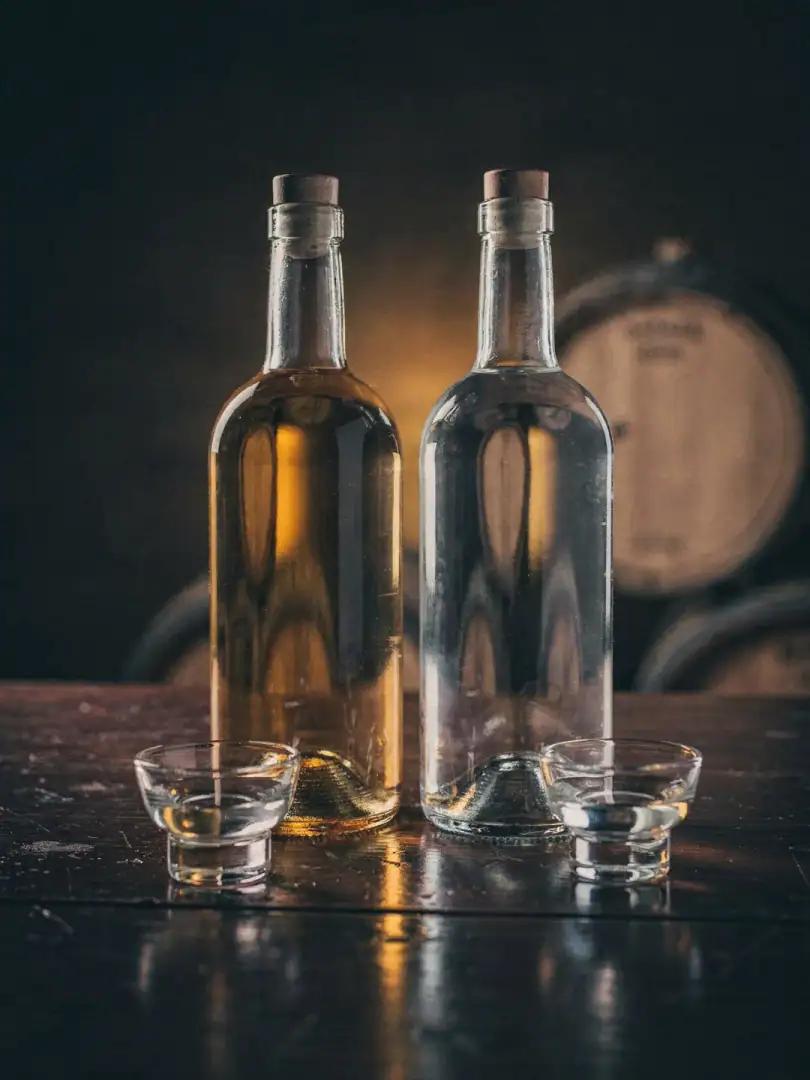
Color instead of age
"Gold is better and older"
A golden tequila automatically seems more refined than a clear one, older, pricier, better aged. This stop shows why color alone reveals little about aging and what the Joven class actually means.
What does the golden color really mean?
Many buyers assume a golden tequila is automatically older and therefore higher quality than a clear one. That's only sometimes true. The Joven category, often labeled Oro on bottles, doesn't describe a level of aging but a blend. A Joven can be a mix of unaged Blanco with some Reposado, Añejo or Extra Añejo, but it can just as easily be a pure Blanco that's had color and flavor added after distillation, without a single day spent in a barrel.
This impression is reinforced by the fact that many supermarket shelves display Blanco and Joven side by side, with the golden Joven usually sitting in the flashier bottle design. Anyone who needs to decide quickly is then more likely to reach for the bottle that visually looks more aged, without reading the fine print on the back label.
Where does the color come from in Joven tequila?
For Blanco, any additive is strictly forbidden; the standard is unambiguous about that. For the other classes, however, NOM-006 allows what's called abocamiento: caramel, oak extract, glycerin and sugar syrup, together up to a limit cited in several sources as around one percent of weight, though the details remain disputed. These additives don't need to appear on the label. A producer can therefore take a freshly distilled, unaged tequila, tint it with a bit of caramel, sell it as Joven, and the visual result will look almost no different from a tequila that has spent months in an oak barrel.
Some producers voluntarily disclose whether their Joven is a genuine blend or colored Blanco, but they're under no obligation to do so. Anyone who cares about this detail is more likely to find it on a producer's website than on the bottle itself, since the standard requires no disclosure here.
Which classes show genuine aging?
Actual barrel aging only begins with Reposado, at least two months of direct contact with oak. Añejo requires at least one year, Extra Añejo at least three years, both in barrels with a capacity of no more than 600 liters. These three classes genuinely get their color and part of their aroma from the barrel, not from a bottle with additives mixed in afterward. Anyone who cares about aging should therefore look not at the color but at the class name on the label for a reliable indication.
There's also a noticeable price difference between the three aging classes, roughly rising with storage time: Añejo and Extra Añejo tie up barrel capacity, storage space and evaporation losses for months or years, costs a producer has to factor in. A Joven, by contrast, leaves the distillery almost immediately after distillation and never incurs these costs in the first place.
Why does the misconception persist anyway?
With many other brown spirits, such as whisky or rum, color really is more closely tied to genuine barrel contact, even though coloring agents are permitted there too. Many buyers unconsciously carry this expectation over to tequila. Marketing reinforces the image further: golden bottles look more premium and more expensive, regardless of what's actually in the glass. The rule of thumb therefore remains: color shows that additives might be present, but not automatically how long, or whether, the spirit was actually aged.
Anyone unsure can check for themselves: a genuinely aged tequila usually states the class explicitly on the back label, Reposado, Añejo or Extra Añejo, while a Joven specifically carries no such statement. If no aging information appears at all and the advertising focuses solely on the golden color, a second look at the label is worthwhile.