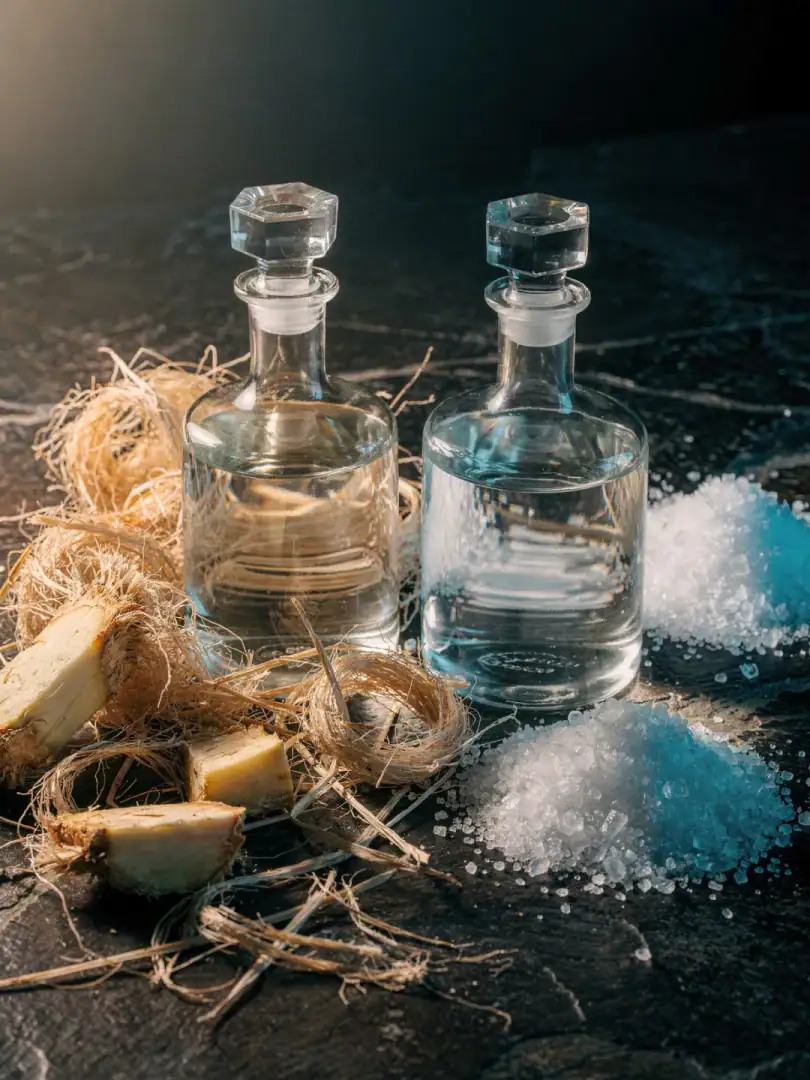
100% Agave
100 Percent or Mixto
Some bottles say "100% Agave," others simply say "Tequila." The difference isn't a marketing detail but a legal boundary: with plain Tequila, nearly half the sugars can come from entirely different sources.
The 51 Percent Rule for Mixto
NOM-006 distinguishes two categories. For "100% Agave," all fermentable sugars must come from the Blue Weber Agave. For plain "Tequila," often called "Mixto" in the trade, at least 51 percent agave sugar is enough, with the remainder allowed to come from other sugar sources.
These missing up to 49 percent typically come from cane sugar or glucose syrup, which are considerably cheaper than the laboriously extracted agave sugar. A Mixto is therefore cheaper to produce, but must be openly labeled as "Tequila" without the "100% Agave" addition. Anyone who just glances quickly at the label when shopping can easily miss this difference, since both bottles look almost identical from the outside.
What Abocamiento Means
Besides the sugar's origin, the law permits one more intervention during Tequila's aging: the so-called abocamiento. Caramel for coloring, oak extract, glycerin for added body, and sugar syrup may together be added up to an industry-common guideline of about one percent of weight. This doesn't have to appear on the label. For consumers, this addition is often barely perceptible in taste, but it noticeably changes the color and texture of the finished Tequila.
This has given rise to a countermovement of its own: independent testing bodies like Tequila Matchmaker test bottles in the lab and specifically flag additive-free Tequilas, since the law itself stays silent on the matter. For Blanco, the situation is more strictly regulated than for aged classes, though the exact limits aren't consistently documented in the sources.
Where Tequila May Be Bottled
A second major difference concerns the place of bottling. "100% Agave" Tequila must be bottled entirely in Mexico at approved facilities, even if it's later exported abroad. This rule is meant to prevent the contents from being altered or stretched along the long journey.
Plain Tequila (Mixto), by contrast, may be exported in large tank containers, known in the trade as "a granel," and bottled only in the destination country. This was standard practice for many mass-market brands for decades, until consumer advocates and Mexican producers demanded more transparency. Today, many brands deliberately advertise that they are bottled directly in Mexico.
Why Mezcal Doesn't Know This Distinction
A look at Mezcal shows just how unusual this two-tier system really is. Under NOM-070, Mezcal must always consist of 100 percent agave sugar; there's no such thing as a "Mixto" there. Anyone who stretches Mezcal with foreign sugar isn't even allowed to call the result Mezcal anymore. Historically, the loosening of rules for Tequila dates back to a time when demand grew faster than pure agave was available.
For buyers, this means: the label "100% Agave" is genuinely useful additional information for Tequila, but for Mezcal it's a given, and is therefore usually not specially emphasized on the label.
Cristalino: A Name Without Its Own Status
Another source of confusion is the term "Cristalino." It sounds like its own legal category, but it isn't one: NOM-006 recognizes only Blanco, Joven, Reposado, Añejo and Extra Añejo as official classes. "Cristalino" is purely a trade name for an aged Tequila that has subsequently been filtered and decolorized, usually through activated charcoal.
The result looks like a Blanco but has gone through the aging period of an Añejo or Extra Añejo. Nothing changes about the name "Tequila" itself, since Cristalino remains normally regulated within its base category. The term shows well, though, that not every name on a label is also a legal term. Anyone who values pure agave should therefore pay attention to the category and agave content rather than fancy trade names.