One Single Agave
Only One Single Agave
Tequila permits only a single agave variety: the Blue Weber Agave. Mezcal, by contrast, uses up to a dozen different species depending on the region. Why this one particular plant became the rule has to do with sugar, cultivation, and history.
What Makes the Blue Weber Agave Special
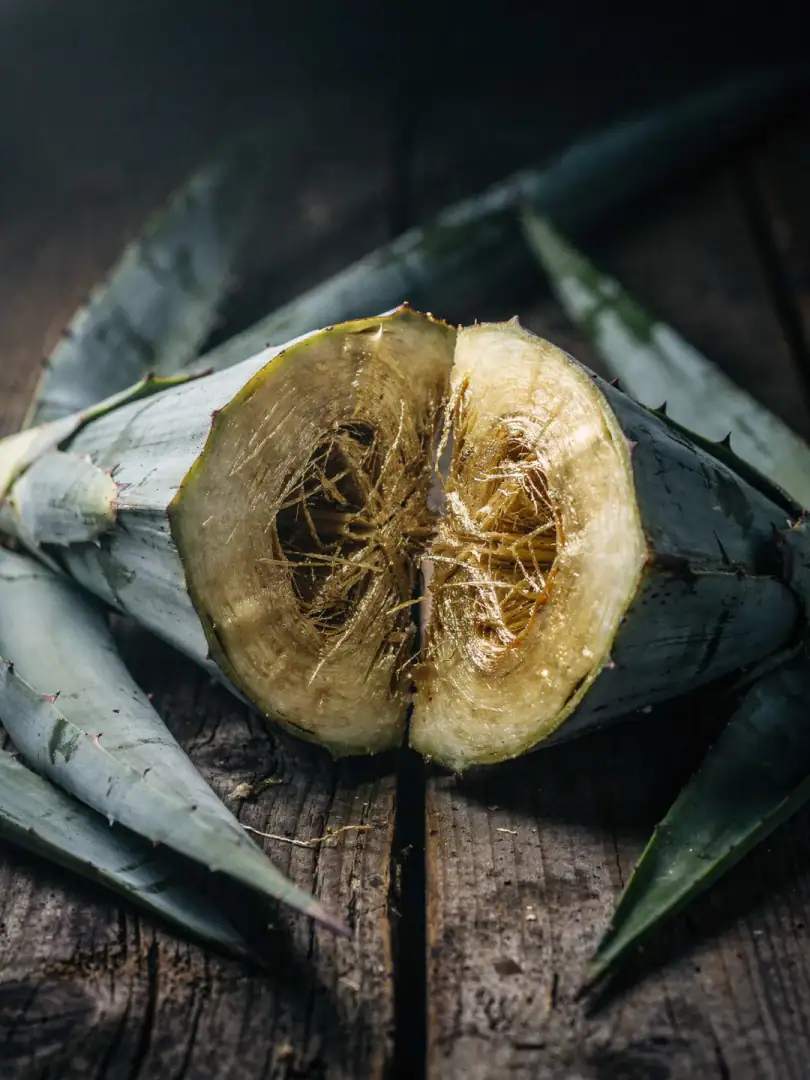
Shimmering blue-green with sharp, tough leaves, the Blue Weber Agave – botanically Agave tequilana Weber, variety Azul – grows in the fields of Jalisco. Its core, the so-called piña, named for its resemblance to a pineapple, stores large amounts of fermentable sugar. This sugar is exactly what turns into alcohol during cooking and fermentation. By the time a piña is ready for harvest, it typically weighs between thirty and ninety kilograms, depending on age and soil.
Other agave species contain different types of sugar or ripen much more slowly. The Blue Weber Agave usually takes six to eight years to mature for harvest, which is relatively short compared to some wild agaves used for mezcal. For a large, predictable market, this was a decisive advantage.
Why the Law Allows Only One Species
NOM-006, the regulation that governs tequila down to the smallest detail, permits only this single variety to bear the name "Tequila." An agave spirit made from Agave angustifolia or Agave potatorum, however similar it might taste, cannot be called tequila, even if it comes from within the geographic tequila region. Both the plant and the region must match at the same time.
This restriction to a single species is what most clearly sets tequila apart from mezcal. Mezcal mainly permits Agave angustifolia, commonly known as Espadín, but also allows dozens of other species depending on the region. Tequila deliberately chose uniformity over diversity. This choice also makes enforcement easier, since inspectors only need to identify a single plant in the fields, not a dozen different ones.
Monoculture and Its Risks
Concentrating on a single species comes at a cost. Because virtually all tequila agaves are genetically closely related, disease or pests can strike the entire region at once. In the early 2000s, a bacterial infection caused noticeable agave shortages, which for a time also drove up the price of tequila. Similar concerns have accompanied every discussion since then about possibly expanding the range of agave species permitted for tequila.
Some producers have therefore begun growing additional wild agave varieties outside their actual tequila production, purely to increase genetic diversity across their fields. Still, when it comes to the name "Tequila," only the single, legally defined species remains permitted.
Different Names, Different Plants
Raicilla permits five agave species, but explicitly excludes the Blue Weber Agave – a precise counterpoint to tequila. Bacanora relies on a subspecies adapted to Sonora, while Sotol comes from an entirely different plant family altogether, Dasylirion, only distantly related to agave.
Each of these rules about the plant is closely tied to the rule about the region, which the previous stop already described. Together, plant and region form the two pillars on which practically every protected agave name in Mexico rests. Anyone who knows both rules understands at a glance why an agave spirit made from the same plant can be called Tequila in one region and not two kilometers further on.
Clones instead of diversity
Unlike many wild agaves, the Blue Weber Agave barely reproduces from seed in practice. Farmers instead rely on so-called hijuelos, small offshoots that grow directly from the mother plant and are planted as clones in new rows. This speeds up cultivation considerably, since growers don't have to wait for a flower, which in agave often only appears after years.
The downside of this practice lies in exactly what causes the genetic narrowness of the stock: clones barely differ from one another, which means diseases can spread especially easily. Some projects therefore deliberately let individual agaves flower and reproduce via seed again, even though this costs sugar yield for the spirit.