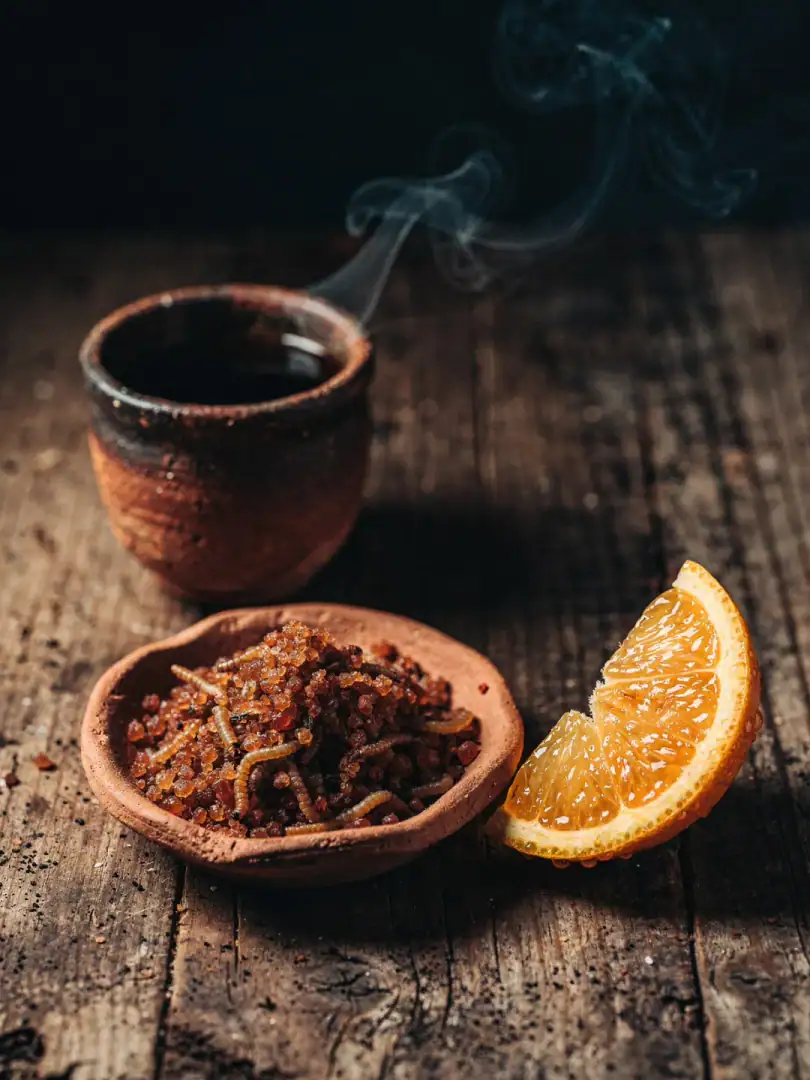
Worm salt and chapulín
Mezcal with orange
Mezcal usually isn't paired with lime but with an orange slice and a pinch of salt made from roasted worms or grasshoppers. What sounds like a dare is actually its own tabletop tradition, independent of the myth surrounding the worm in the bottle.
Why orange, not lime
Instead of lime, mezcal is usually served with an orange slice, sometimes dusted with a bit of salt. The sweetness of the orange meets the smoky flavor that develops when the agave hearts are roasted in the earthen pit, rounding it out rather than masking it.
Unlike the salt-and-lime ritual associated with tequila, this isn't really about covering anything up: by regulation, mezcal must always be 100 percent agave — there's no equivalent to tequila's mixto. Orange and salt complement the spirit rather than disguise it.
What sal de gusano really is
What sounds like a dare is actually more of a craft. Sal de gusano is made from roasted, finely ground gusano de maguey — the larva of a moth that lives on agave plants — mixed with chili and salt. The flavor is earthy, lightly smoky, with a mild kick.
This is its own tradition, independent of whether a worm happens to be floating in a bottle of mezcal or not. Exactly where the custom of distilling a worm along with the mezcal originated isn't clearly documented — the salt mixture as a table accompaniment rests on firmer historical ground.
Sal de chapulín: the grasshopper variation
In Oaxaca, sal de chapulín is common: roasted, ground chapulines, small grasshoppers that have been eaten there since pre-Hispanic times, mixed with chili and salt. It tastes nuttier than the worm variety.
Whole roasted chapulines are also often brought to the table as a snack in their own right, independent of the mezcal glass. Both salts, gusano and chapulín, exist side by side in Oaxaca's drinking culture, not as rivals but as regional variations.
How mezcal is drunk
Mezcal isn't knocked back. Served in a jícara, a small vessel made from a hollowed-out gourd shell, or in a copita, it's first smelled at the glass, then sipped slowly in small amounts.
Some mezcaleros briefly touch the drink to their lips before taking the actual sip — a gesture meant to pay respect to the spirit, more custom than fixed rule.
The myth of the worm in the bottle
A completely different myth surrounds the worm in the bottle, unrelated to the salt on the table. According to legend, a businessman named Jacobo Lozano Páez came up with the idea in the 1940s or 1950s of placing a gusano larva directly into the mezcal bottle — as a marketing trick to set his product apart from the competition, not as an old craft tradition.
This has little to do with the craft of the palenques. Many mezcaleros still reject the worm-in-the-bottle practice today, arguing that it distracts from the actual distilling and is often misunderstood abroad as a dare rather than a mark of quality.
The belief that the worm contains mescaline or other intoxicating substances is also a myth. It's edible, but has no bearing on the effect of the mezcal — anyone who eats it is following a ritual rather than chasing a buzz.
Why tequila has no comparable salt pairing
There's no equivalent to sal de gusano or sal de chapulín for tequila. This has less to do with regulations than with origin: tequila developed in the towns and fields around the town of Tequila in Jalisco, where insects were never part of everyday cuisine the way they were in rural Oaxaca.
In Oaxaca, by contrast, chapulines have been part of the cuisine since pre-Hispanic times, far beyond the mezcal glass — roasted as a snack, in tacos, on tlayudas. The salt mixture served alongside mezcal isn't an isolated drinking ritual, then, but a slice of a much larger regional food culture.