Guelaguetza and Ritual
Palenque and Guelaguetza
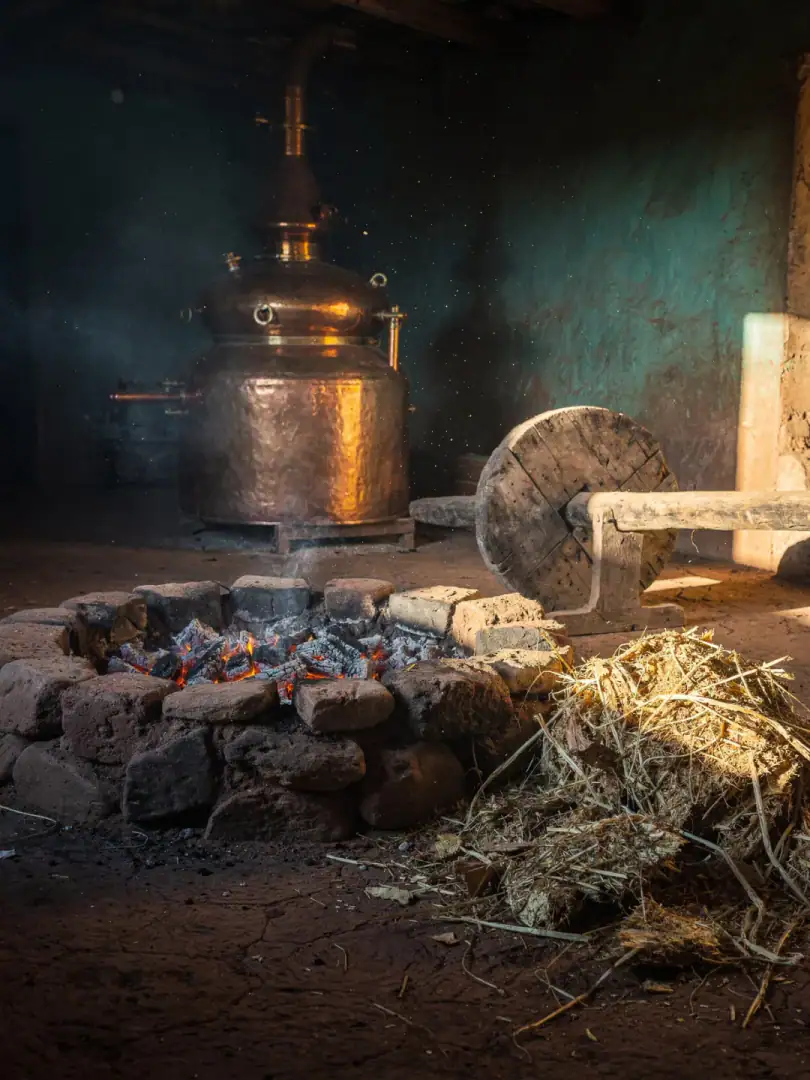
Anyone visiting a mezcal distillery, a palenque, sees the earthen pit, the stone wheel, and the copper still all in one visit. Around the Guelaguetza festival and the saying “Para todo mal, mezcal,” it becomes clear just how deeply mezcal is woven into everyday life and celebration in Oaxaca.
What a Palenque Visit Reveals
Visitors to a palenque, a traditional and often family-run mezcal distillery, see the earthen pit where the agave hearts roast under soil, stones, and fire, the tahona – a mule-drawn stone wheel used for crushing – and stills made of copper or clay.
Many palenques in Oaxaca welcome visitors, often pairing the tour with a tasting right on site. The visit shows just how much handwork goes into every bottle, long before it reaches the glass.
A tour usually ends with a tasting of several mezcals from the same palenque, often served straight from the still at temperature, barely diluted. Visitors learn how different two batches from the same agave species can taste – depending on how long the piñas roasted, how finely they were crushed, or how the fire was managed during distillation. Many palenques sell their mezcal exclusively on site or through a few local dealers, without any large distribution network. So if you fall for a particular bottle, you'll often only find it where it was actually made – and nowhere else.
Guelaguetza: Oaxaca's Great Festival
Every July, the Guelaguetza brings together dance and music groups from across the state in the city of Oaxaca. The name comes from Zapotec and refers to a principle of giving and receiving in return – mutual support within the community.
Mezcal is part of the festivities, poured in small rounds between performances. It's part of the hospitality with which the Guelaguetza welcomes visitors, not the main event itself.
“Para todo mal, mezcal”: A Saying, Not a Cure
“Para todo mal, mezcal, y para todo bien, también” – mezcal for every misfortune, and for every joy as well – is a well-known Mexican saying. It describes an attitude, not a form of medicine.
Mezcal is drunk both in sorrow and in joy, as a companion to the occasion rather than a remedy for it. Anyone who takes the saying literally as a health claim is confusing a figure of speech with fact.
Mezcal as a Shared Drink
In Oaxaca, mezcal is often passed around from a single shared bottle, with everyone getting a small amount in their jícara or copita.
The sharing itself is part of the ritual: a mezcal poured for just one person is the exception in this culture, not the rule.
The Mezcalero: Knowledge Passed Down Through Generations
Behind every palenque stands a mezcalero, often from a family that has worked the same earthen pit and tahona for generations. The knowledge is passed down orally and through hands-on work, not textbooks: how long the piñas need to roast, when the mash is ready for distilling, how strong the fire beneath the still may burn. Families running a palenque sometimes trace their tradition back four or five generations, even though written records of it are rare.
This passing down of knowledge also explains why the flavor differs from palenque to palenque, even when the same agave species and the same region are behind it. Small decisions made by the mezcalero, more than any fixed recipe, ultimately shape every bottle.
Calenda: The Processions Before the Big Festival
In the city of Oaxaca, the Guelaguetza itself is often preceded by calendas, street processions with music, giant papier-mâché figures, and dancers in the traditional dress of their respective regions. They draw locals and visitors alike and set the mood for the performances of the following days.
Mezcal accompanies these processions as well, usually in small sips along the roadside rather than as part of a fixed ritual. As with the Guelaguetza itself, the shared celebration takes center stage, while the drink remains a companion, not the reason for it. Anyone who experiences a calenda gets a sense of how closely music, dance, and mezcal are interwoven in Oaxaca. Every segment of the Guelaguetza program has its own traditional dress and often its own small mezcal round at the sidelines.