Not always smoke
Smoke doesn't always mean mezcal
"Smells like a campfire, must be mezcal" – this shortcut is wrong more often than you'd think. Smoke comes from the earthen pit, not from the name on the label, and some mezcals barely have any smoke at all.
Where the smoke actually comes from
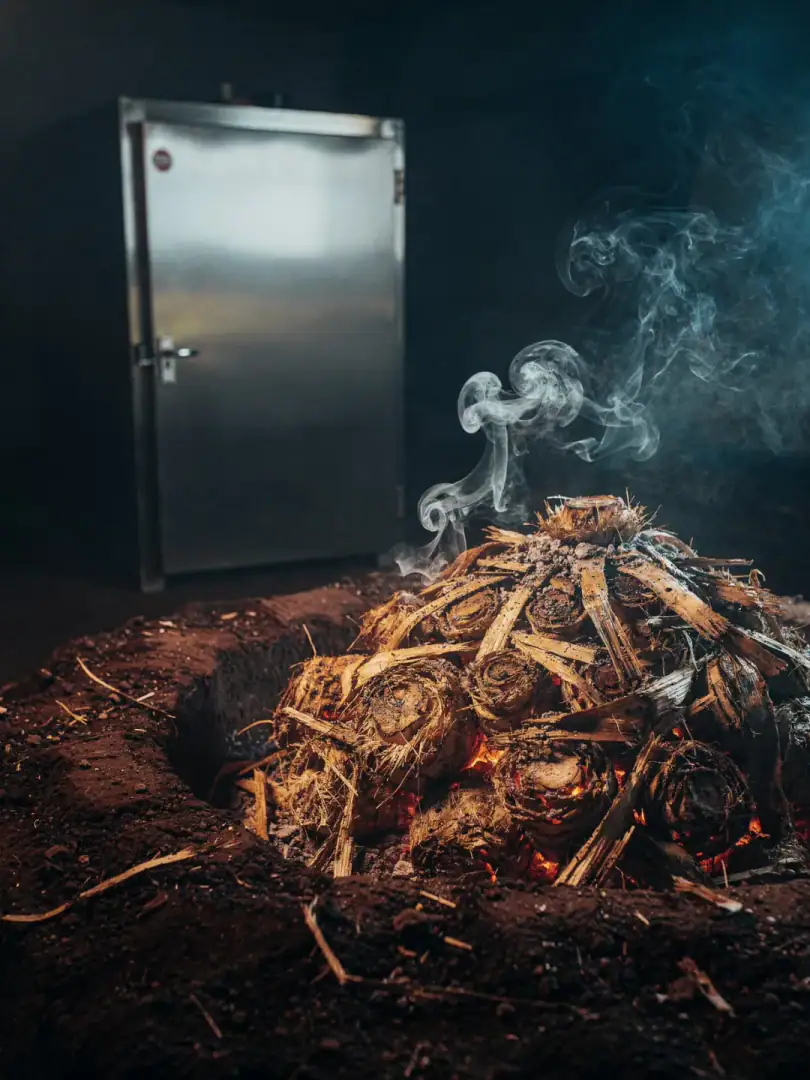
Mezcal usually tastes smoky when the agave hearts are cooked in an earthen pit. This is a hole in the ground lined with hot stones, fired with wood, then covered with agave fibers and earth. Smoke from the glowing wood seeps directly into the piñas. It stays in the spirit right through to distillation.
This method belongs to Mezcal Artesanal and Mezcal Ancestral under the NOM-070 standard, not to mezcal in general. How strong the smoke tastes in the end also depends on the type of wood used, the cooking time, and the size of the pit. Two earthen-pit mezcals can differ noticeably for that reason alone.
Industrial mezcal without an earthen pit
Not every mezcal goes through an earthen pit. For the basic category simply labeled "Mezcal," without the addition of Artesanal or Ancestral, the standard also permits ovens, autoclaves, or diffusers. These are the same fast, steam-based methods used in industrial tequila production.
A mezcal made this way can come out with no detectable smoke note at all, since the wood fire of the earthen pit is simply absent. Anyone who believes every genuine mezcal must be smoky underestimates just how differently the standard's three production tiers actually taste.
Smoke outside of mezcal
The reverse is also true: other agave spirits can taste earthy or slightly smoky without being called mezcal. Raicilla, depending on the producer, is likewise cooked in earthen pits or brick ovens. This occasionally gives its herbal base a faint smoky edge. Raicilla still carries its own designation of origin and may not be called mezcal.
Sotol from northern Mexico traditionally also involves an earthen-pit-like cooking process, though the exact details of this method haven't been fully documented so far. Smoke alone is therefore not a reliable way to identify a particular name. It mainly reveals how an agave or a Dasylirion plant was cooked.
Smoke as a clue, not as proof
For your own nose, this means: a pronounced smoky note points to a traditional earthen-pit process. But it proves neither that a spirit is mezcal, nor that every mezcal must taste this way. Checking the label instead – Mezcal, Artesanal, Ancestral, or one of the other designations of origin – gives you more reliable information than your nose alone.
Precisely because smoke is so noticeable, it can easily mask the subtler base notes of cooked agave from the third stop on this journey. Learning to tell the two apart makes it easier to recognize whether a mezcal is interesting because of its earthen pit or because of its agave variety.
A simple test for your own nose
If you're unsure whether it's smoke or just an earthy roasted note in the glass, the best approach is to compare two Blanco mezcals made from the same agave species. If one comes from an earthen pit and the other from an autoclave, the difference is almost always immediately obvious. Without such a comparison, smoke is easily mistaken for pure roasted sweetness.
A second clue lies in the price and the label description. Mezcal Ancestral and Artesanal usually cost noticeably more than simple, industrial mezcal because of the greater effort involved. This price range alone doesn't replace your nose, but it offers a rough first orientation.
Which wood for which smoke
The type of wood used in the earthen pit shapes the smoky flavor. Many palenques in Oaxaca rely on native hardwood such as encino, a Mexican oak, because it burns long and evenly. Some operations use mezquite wood instead, which gives off a stronger, almost resinous smoke. Switching the wood can make the same palenque, the same agave, and the same recipe taste completely different.
The burn duration and how often fresh wood is added also change the amount of smoke. A short, hot fire leaves a different smoky character than a slow smolder over many hours. This is exactly why even two mezcals from neighboring palenques using the same agave species often taste differently smoky, even though both qualify as Artesanal under NOM-070.