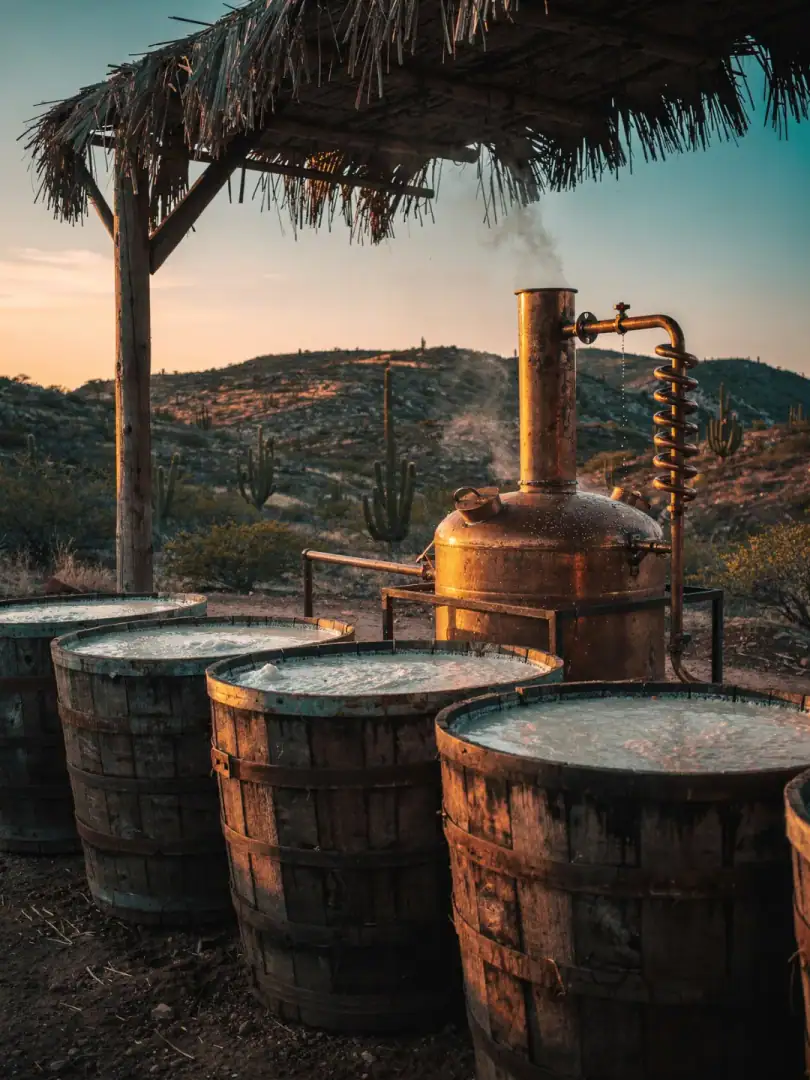
Wooden Vat and Alambique
Fermentation & Distillation
The pressed mosto of Agave cocui goes raw and unfiltered into wooden vats. This is how fermentation has been done in Pecaya for generations, and the tradition knows no added yeasts. Whatever wild yeasts are present in the juice and the air simply begin to work on their own.
After about three days, fermentation is complete. The mosto has turned into a milky, cloudy, mildly alcoholic liquid. Agave fibers mostly stay behind in the trough, since the juice was already pressed and washed beforehand. In some Mexican mezcals, by contrast, whole fibers go into the fermentation along with the juice.
Distillation takes place in alambiques that the artisans build themselves, consisting of a kettle, a head, and a coiled cooling worm. A first run separates the alcohol from the rest of the fermented juice. A second, rectifying run further purifies and concentrates the distillate until the desired alcohol content is reached.
The result is a filtered spirit at no more than 50 percent ABV. It is bottled exactly as it comes off the alambique — no caramel, no syrup, no oak extract. Anyone who distills this way may call what's in the bottle Cocuy Pecayero. Anyone who instead blends neutral alcohol with a little real agave spirit is only making "Aguardiente de Cocuy," a different, historically fraught category.
In Pecaya, it is mostly family operations that maintain and repair their own alambiques over the years. An industrial diffuser or a continuous column still, as used by some tequila distilleries, has no place here. Distilling remains handwork, from the first drop to the last.