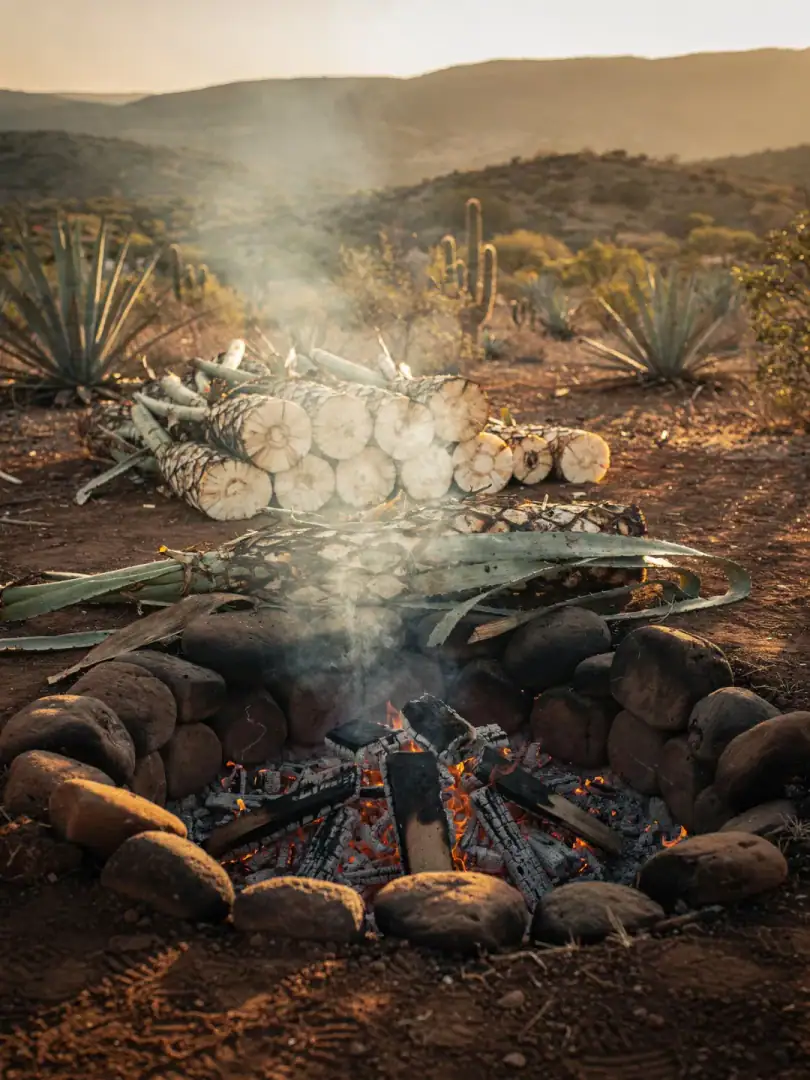
Smoke from Cardón Wood
Cooking & Milling
Before the piña can yield its sugar, it must first be cooked. In Pecaya this happens in an earthen oven, where the peeled stalks are placed in a dug-out pit. There they're covered with the agave's own leaves. They roast for three to five days while a slow fire of cardón and cují wood smolders beneath them — both woods grow abundantly in the dry hills around Pecaya.
The wood of the cardón imparts its own distinctive smoky flavor as it burns. This columnar cactus stands everywhere among the agaves, and its smoke later reappears in the finished Cocuy. Once the piña is fully cooked, it turns brownish and smells smoky. It already tastes noticeably sweet, with readings of 12 to 20 degrees Brix.
Unlike tequila, Cocuy Pecayero permits only the slow earthen oven. No autoclave and no diffuser is allowed to break down the piñas with steam in just a few hours. Once cooked, the stalk is placed in a ground-level wooden trough. There it is pounded by hand with a heavy wooden mallet until the fibers and juice separate.
The crushed mass is then washed and pressed, releasing the sugary juice, the mosto. Only those who cook in the earthen oven and pound by hand with a wooden mallet may call their spirit Cocuy Pecayero. Those who instead use an autoclave or a steel mill may be making tequila or industrial mezcal, but not this agave spirit from Falcón. A diffuser is never used.