Restanques & Safre
Soils
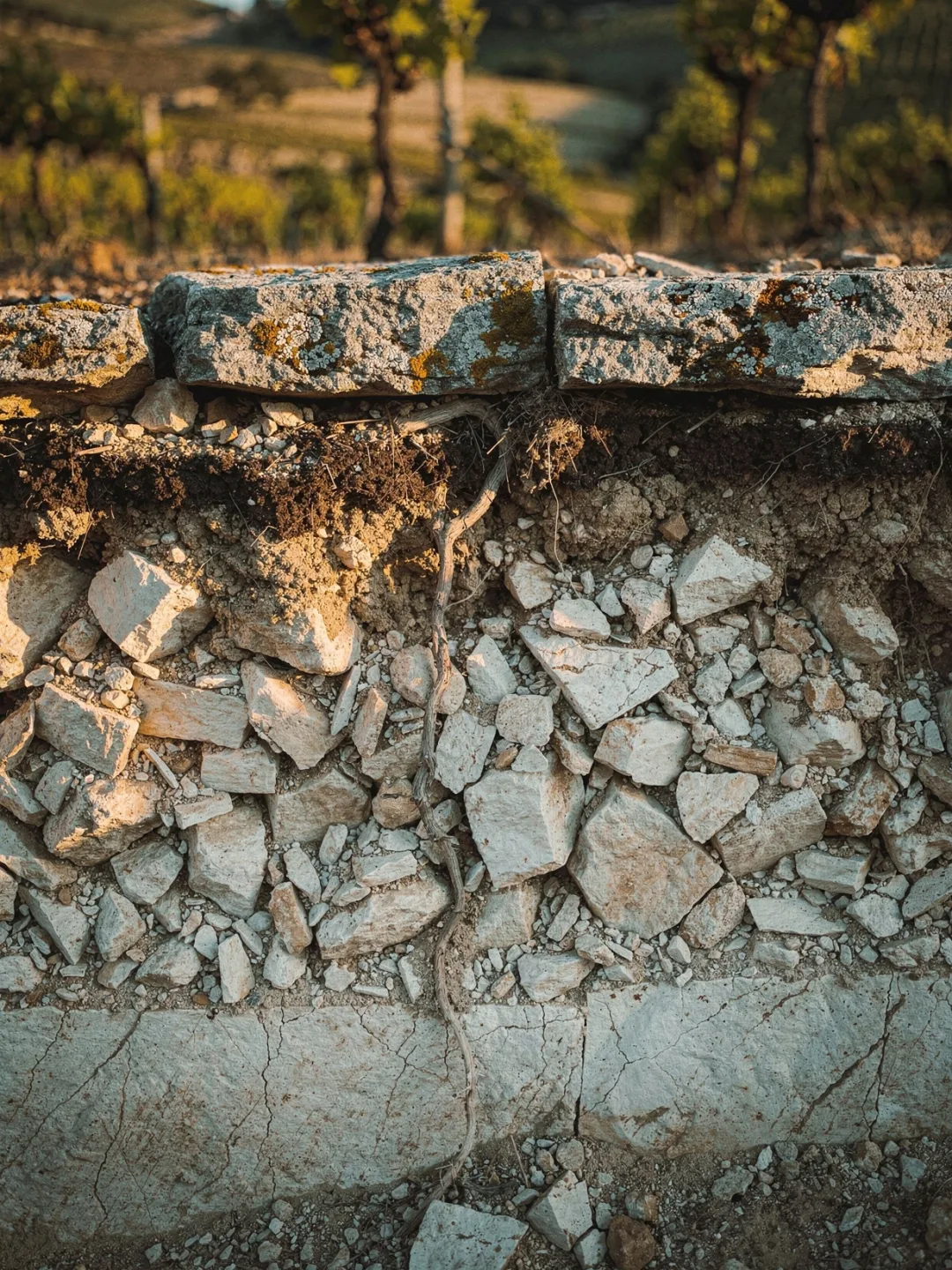
Dig a hole in a vineyard near Bandol. The spade hits stone. Beneath a hand's-width of humus comes rubble: slabs of limestone and sandstone, interspersed with sandy marl, all loose and sharp-edged — this is the soil beneath the famous restanques. Dry-stone walls support these terraces, which step down the slopes above the sea like a staircase.
This soil holds barely any water and even fewer nutrients, and that's precisely the point. The vine has to fight for survival and drives its roots deep. What's missing above, it finds further down in a layer of safre, a soft, pale sandstone. It stores moisture like a sponge and releases it in portions through August.
Around forty kilometers further east, in the Massif des Maures, the ground looks entirely different. Two worlds, one region. There lies crystalline rock over three hundred million years old: schist, mica, and quartzite, weathering into thin, bluish-gray slabs. Many of the grapes for rosé grow on this rock, while the limestone terraces of Bandol and Cassis are reserved more for the powerful reds.
Both soils force the vine to produce small berries, because water stays scarce. A small berry has proportionally more skin than juice, and that's exactly where color, tannin, and most of the aromatic compounds reside. A Mourvèdre from the restanques therefore tastes denser than one from the fertile valley floor, even though the same things happen to both in the cellar.
Anyone who thinks only of pale summer rosé underestimates what these soils are capable of. A Bandol red from a 1980s vintage often drinks better today than it did at ten years old. The barren restanque rock forces Mourvèdre into exactly the structure needed for a long life in the bottle. So the leanest soil in Provence produces the region's longest-lived wines, not the most fertile sites.
A thin, pale layer of decomposed leaf litter and garrigue herbs. In the restanques, often only a hand's-width thick, because wind and sun break down organic matter quickly.
The root: This is where the fine roots sit, absorbing the rare rain immediately — and the first to dry out when the Mistral blows for days on end.