Why paleness matters
Glassware
A glass plays a real part in how a Provence rosé tastes, because its aromas are delicate and evaporate quickly. Unlike a bold red wine, a pale rosé has little to mask a flaw in the glass.
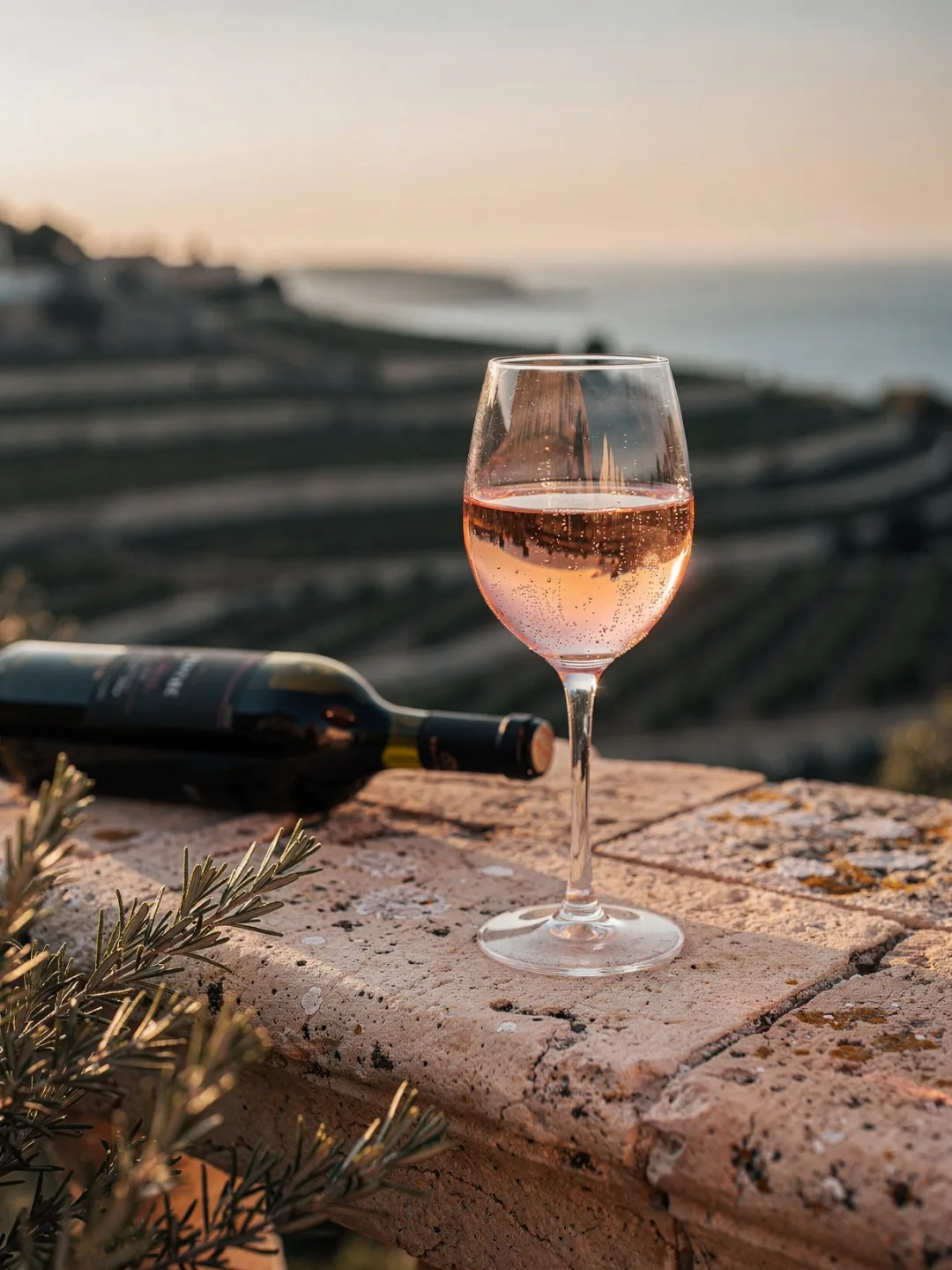
A tulip shape is recommended: rounded at the bottom, narrower at the top. The wide base increases the surface area from which aromatic compounds are released. The narrow rim funnels them toward the nose, a so-called chimney effect. A too-wide glass, the kind used for full-bodied reds, simply lets the delicate scent of citrus and red berries dissipate.
The stem is no mere decoration. Cold protects the fruit. Holding the glass by the bowl warms the wine with your hand, and a rosé loses its freshness faster than you can pour a refill. Eight to eleven degrees Celsius is considered ideal, noticeably cooler than for a white wine from further north. If the wine comes out of the fridge any warmer, the acidity suddenly feels dull instead of crisp.
Only fill the glass to about a third, rarely more. Above that line, there's still room for the aroma to gather, and that's exactly the space that's lost when someone generously fills to the brim. For official tastings, Provence, like all of France, uses the narrow INAO glass, named after the state institute for designations of origin, which has mandated its shape for decades.
With a Bandol red made largely from Mourvèdre, the opposite holds true. It needs a rounder glass with more air space, so the variety's angular tannins can soften. Often it sits in a decanter for half an hour before it even becomes approachable. Two wines from the same region, two entirely different glasses.