Mistral and Sea
Climate
Mediterranean climate sounds like a single weather pattern, but Provence experiences several at once. Along the coast around Bandol and Cassis, the sea tempers the extremes; inland, temperatures swing more widely. Over it all lies an amount of sunshine that has few rivals: between 2,700 and 2,900 hours a year.
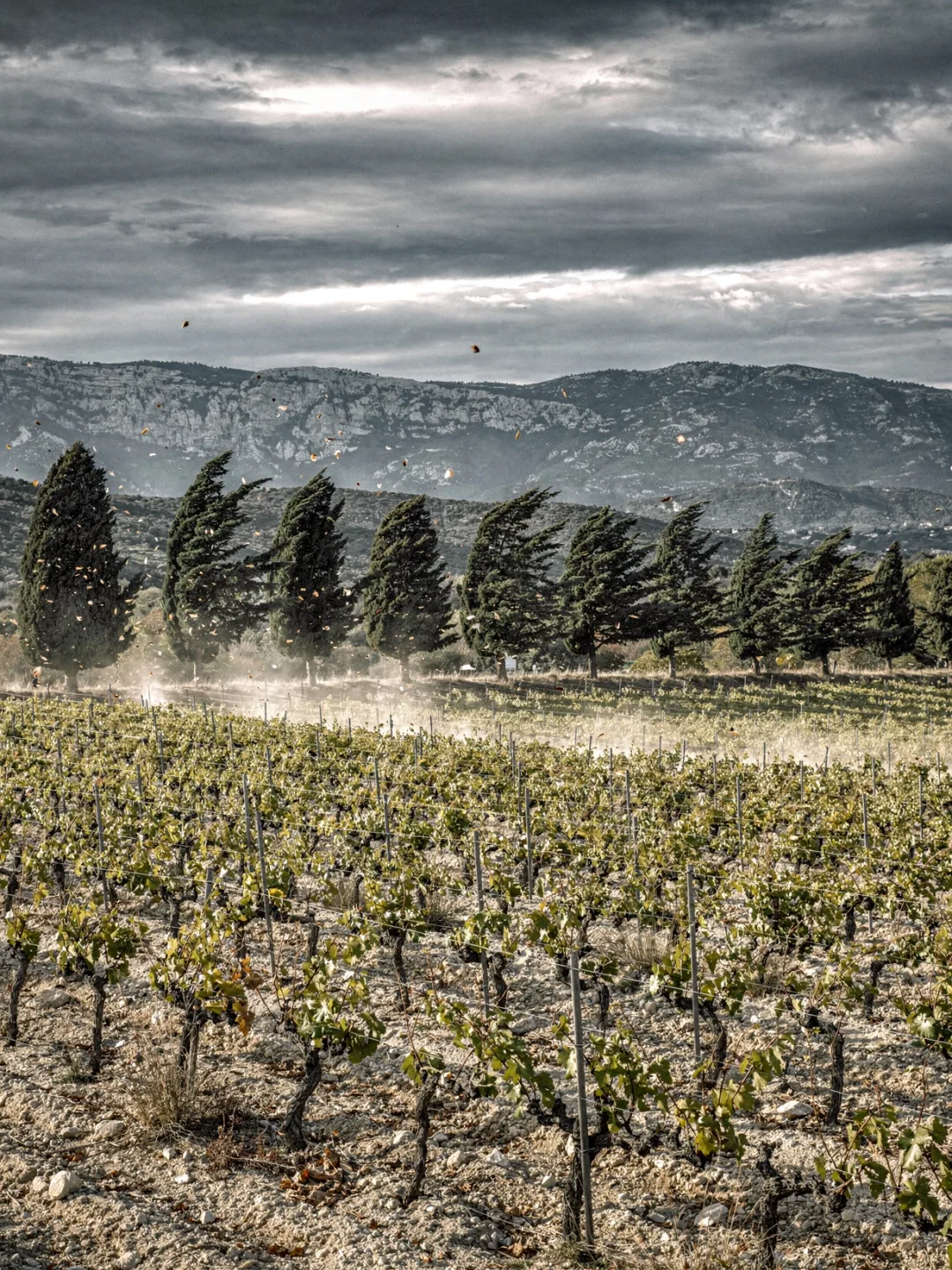
The Mistral, a dry, often bitterly cold downslope wind from the Rhône valley, blows over the vineyards on up to a hundred days a year. It is no accident. It sounds like a burden, but it's mainly a form of protection. The wind dries the grapes immediately after rain, giving fungal diseases little chance to take hold, and many estates therefore manage with remarkably little spraying.
More important than the peak temperature is the swing between day and night. Both matter equally. Near the coast, the evening cools noticeably, and this difference locks acidity into the berry. That's precisely the backbone a rosé needs to taste crisp rather than flat. Vineyards further inland, farther from the cooling sea air, struggle more with this and slide into overripeness more quickly.
At the Massif des Maures, where warmth stays trapped in the dark rock, evenings are noticeably milder than in open country. In Bandol, meanwhile, an amphitheater of hills above the sea creates its own microclimate. Both benefit from the sea. Sunshine hours there approach nearly three thousand — a prerequisite for the late-ripening Mourvèdre to fully mature at all.
Climate change is shifting the calendar. In 2026, harvest in Provence began in late August, a good ten days earlier than the previous record year of 2020. A mild, rainy winter and a hot, dry summer had pushed the grapes along. For rosé, this is a delicate development, since its freshness depends on exactly the acidity that vanishes first when grapes hang too long in the heat.