Volcano, Wind, Sea
Climate
A wind from the Sahara shapes Sicilian summers more than any weather forecast. The Scirocco blows hot across the Mediterranean. It occasionally pushes temperatures in the south above forty degrees Celsius and can reach gusts of a hundred kilometers per hour. Where it hits the vines unchecked, it practically parches them.
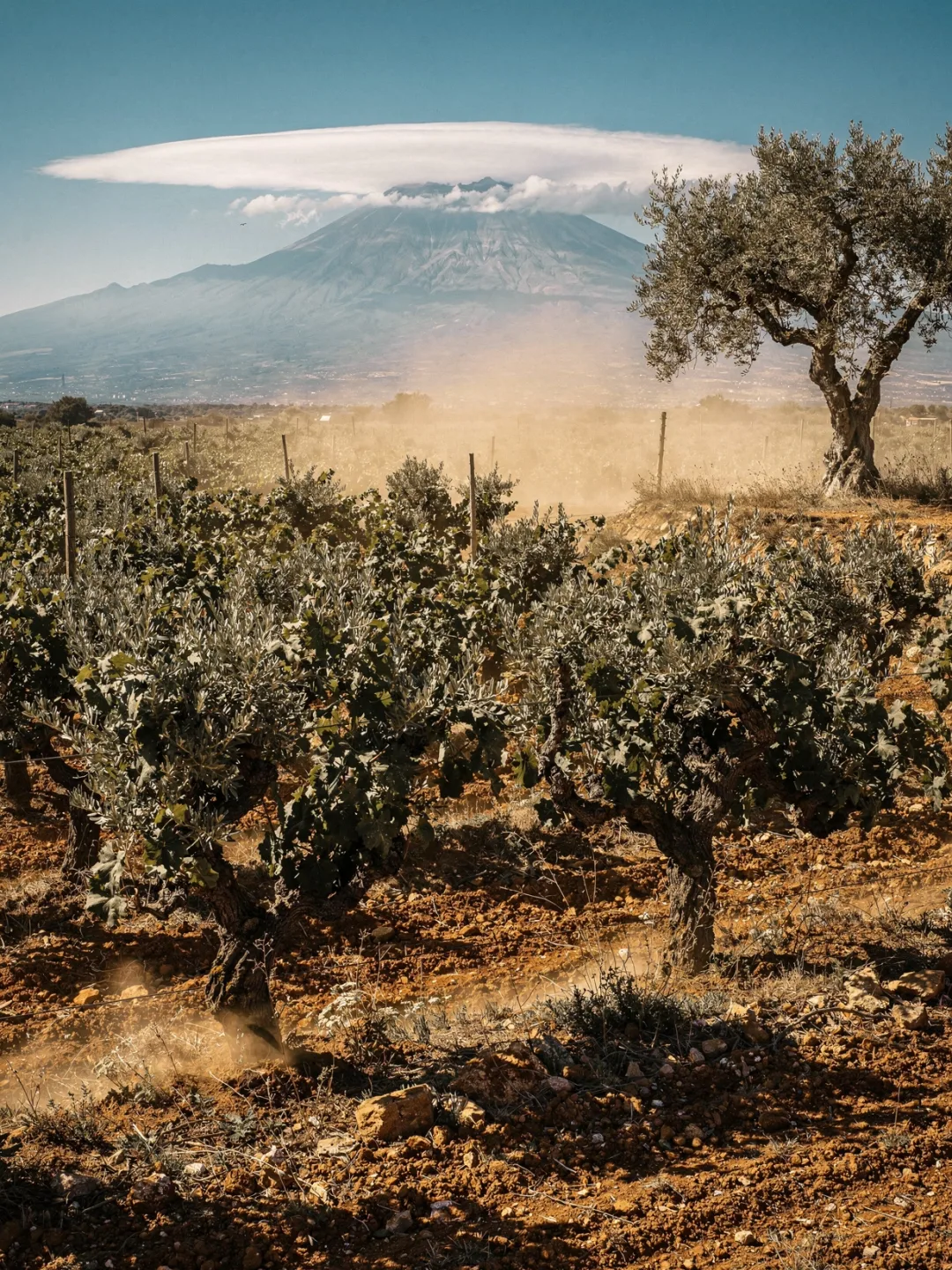
Etna defies the island's own reputation as Europe's hot dead end. The vineyards there sit between four hundred fifty and just over a thousand meters, and with every meter of elevation, the temperature drops noticeably. At night, in the upper sites, it often falls well below twenty degrees. Down at the coast, meanwhile, summer heat still lingers. It's precisely this gap between day and night that preserves acidity in the grape and gives an Etna Rosso its final pale, taut character—quite unlike what you'd expect from Sicily.
Add to that simply a lot of light. In July, the sun shines over Sicily for more than eleven hours a day on average, one of the highest figures anywhere in Europe. Under these conditions, grapes ripen quickly and reliably. That leads to Italy's earliest harvests: on the coast, picking often begins as early as August, while on Etna, sheltered by altitude, harvest doesn't start until October.
Rain doesn't fall evenly across the island. The north lies in the rain shadow of the mountains and gets noticeably more precipitation than the dry south. Etna plays a role here too: its meltwater provides additional moisture that's missing elsewhere on the island, which is why vegetation on its slopes is noticeably greener than in the rest of Sicily.
On Pantelleria, the volcanic island between Sicily and Tunisia, wind itself becomes a cultivation method. No vine here could survive tall wires. That's why the Zibibbo vines grow low to the ground in alberello form, tucked into small stone hollows—a protection people invented centuries ago that the plants still depend on today.