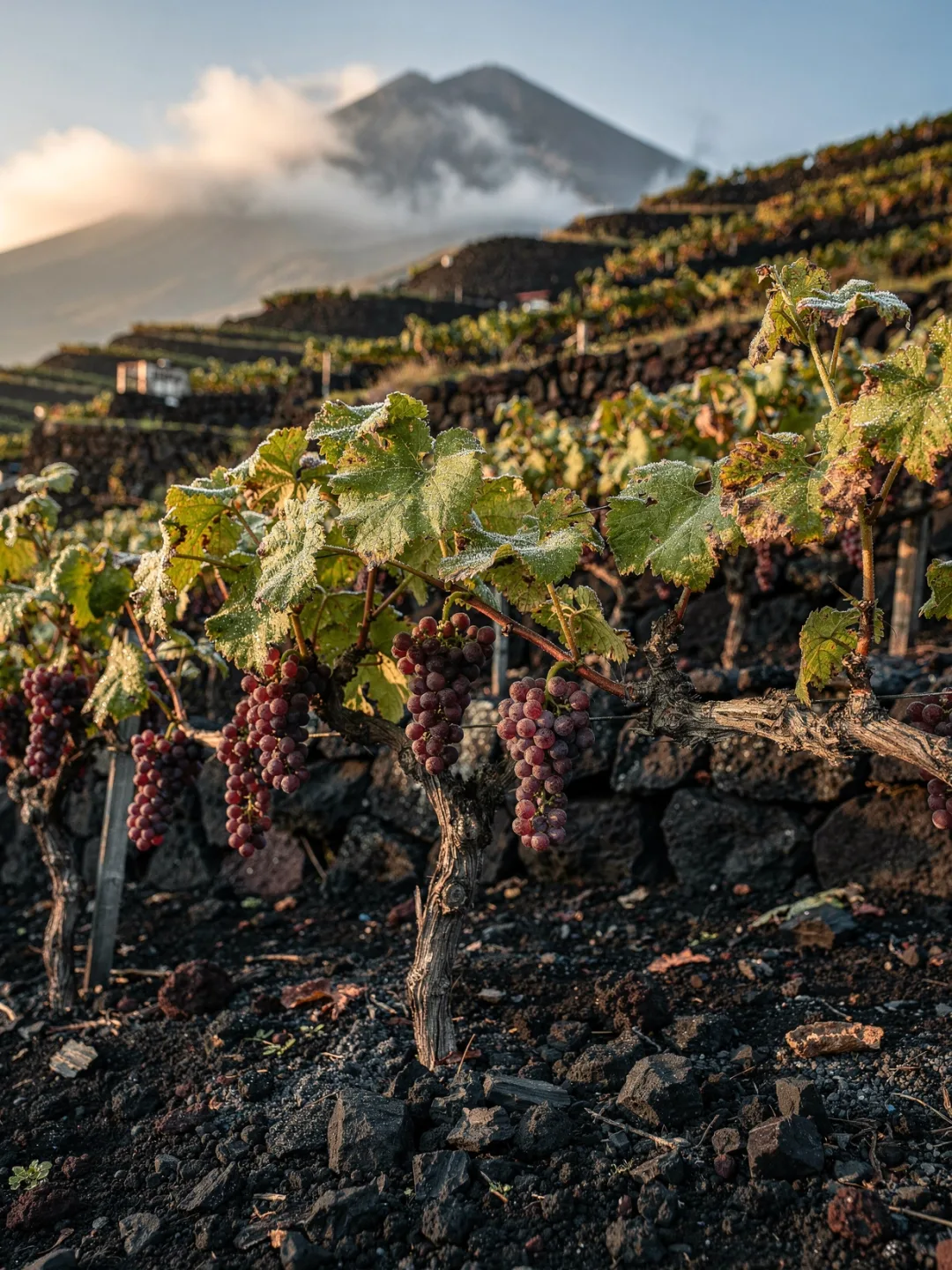
Nero and Nerello
Grape Varieties
One grape variety shapes the island's reputation more than any other. Nero d'Avola covers around eighteen thousand hectares, named after the town of Avola in the southeast, where it most likely originated. The berries carry thick, almost black skins—hence the name, "the black grape of Avola"—and this skin delivers both color and tannin in equal, powerful measure.
In the glass, this shows immediately. A Nero d'Avola is dark to violet in color, its tannin firm yet silky rather than harsh. The nose moves between blackberry, sour cherry, and black pepper, with leather and cedar in ripe vintages. In hot coastal sites, the variety quickly turns powerful. On cooler inland soils, it stays leaner and spicier.
On Etna, an entirely different variety rules, one barely related to Nero d'Avola. Nerello Mascalese must make up at least eighty percent of every Etna Rosso by regulation. It's named after the town of Mascali on the volcano's eastern flank, where it has grown on lava soil for generations. It's pale in color, almost translucent, with plenty of acidity and fine rather than powerful tannin. Connoisseurs are reminded more of Pinot Noir than of a typical southern Italian red. Up to twenty percent Nerello Cappuccio may be blended in; it mainly supplies the color and body that Mascalese alone sometimes lacks.
In the southeast, around Vittoria, a third, entirely distinct variety grows. Frappato has thin skins, barely any tannin, and an aroma of strawberry and violet, almost like a rosé disguised as a red. On its own, it produces light wines meant to be drunk cool. Blended with fifty to seventy percent Nero d'Avola, it becomes Cerasuolo di Vittoria, the island's only DOCG—power and lightness in the same bottle.
When it comes to white wines, the island splits into east and west. On Etna, Carricante carries the wines, a variety with so much malic acid that many winegrowers need malolactic fermentation just to make it approachable. In the west, by contrast, Grillo dominates, bred around 1870 by Baron Antonino Mendola from a crossing of Catarratto and Zibibbo. For decades, Grillo supplied only the base wine for Marsala. Only in the last roughly thirty years have winegrowers also been vinifying it dry, with notable success.