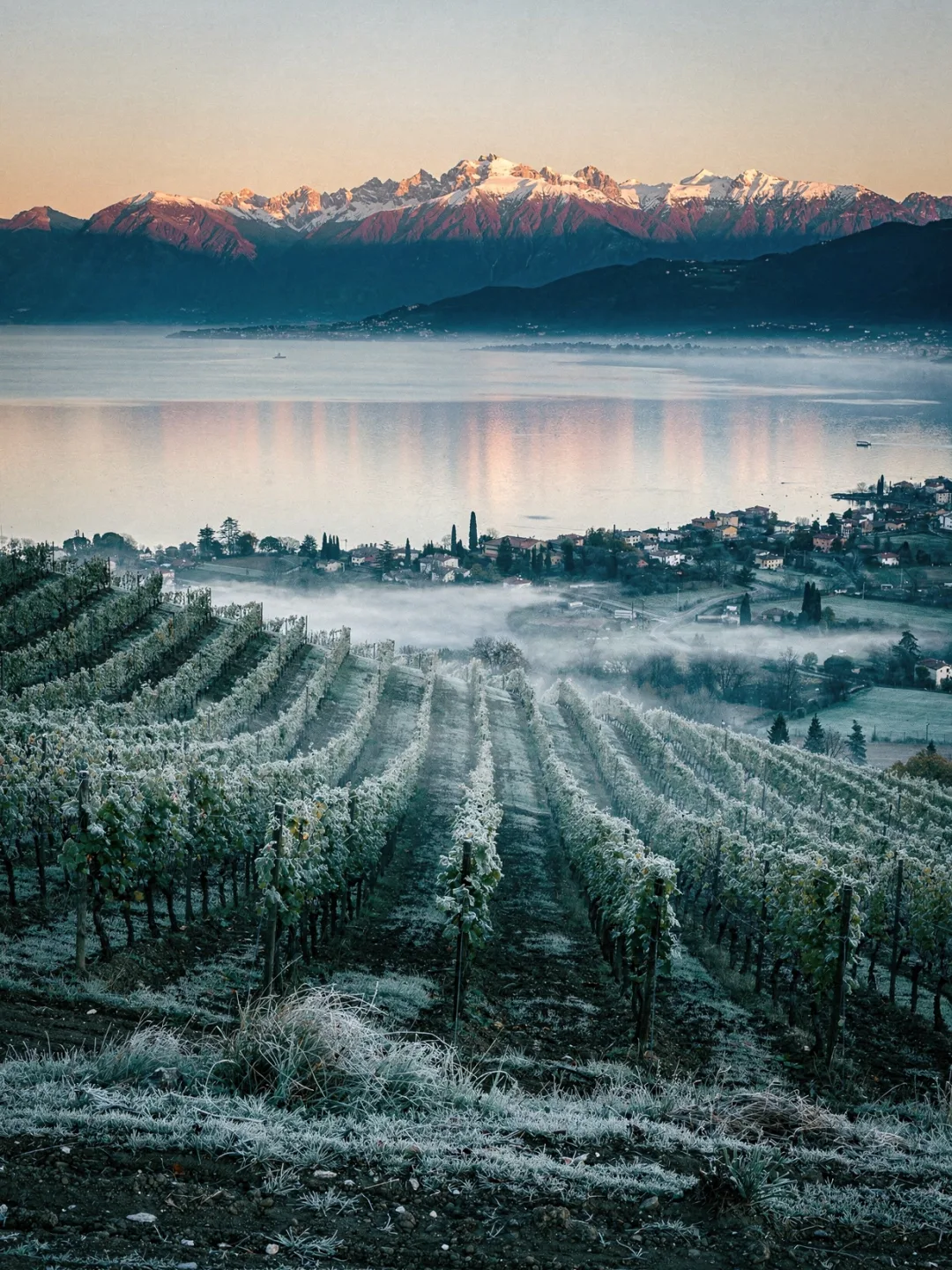
Lake Garda & the Dolomites
Climate
The Veneto doesn't have one climate. It has three: in the west, Lake Garda tempers the extremes; in the north, the first foothills of the Dolomites cool the vineyards; and in the southeast lies flat, warm alluvial plain running toward the Adriatic. A winegrower near Bardolino and one near Valdobbiadene work under almost opposite conditions. Yet both belong to the same region.
The lake is more than just scenery. It stores heat in summer and releases it slowly through autumn. As a result, frosts are rare along its shores, and the vines around Bardolino ripen longer than those just twenty kilometers further inland. The water acts like a huge, sluggish radiator with a delay of hours.
For the hills around Valpolicella, it's the wind off the Lessinia that matters most. Cool, dry air flows down from the mountains in the evening and dries the grapes laid out on wooden racks to wither in autumn. Without this airflow, mold would threaten the entire Amarone harvest before it even reaches the drying loft.
North of there, around Conegliano and Valdobbiadene, the land climbs steeply. The vineyards rise from fifty to five hundred meters, in some spots with a gradient of seventy percent — too steep for any machine, which is why the harvest here is still done almost entirely by hand. The altitude brings cool nights, and cool nights help Glera hold on to its acidity.
The temperature swing between day and night is, in fact, the true constant across the Veneto. Where it's pronounced, as on the hillsides around Soave or Valdobbiadene, acidity and aroma are preserved. Where it's small, as down in the Po Valley, the grapes grown are suited to simpler wines. This was already true a hundred years ago — people just didn't know why yet.