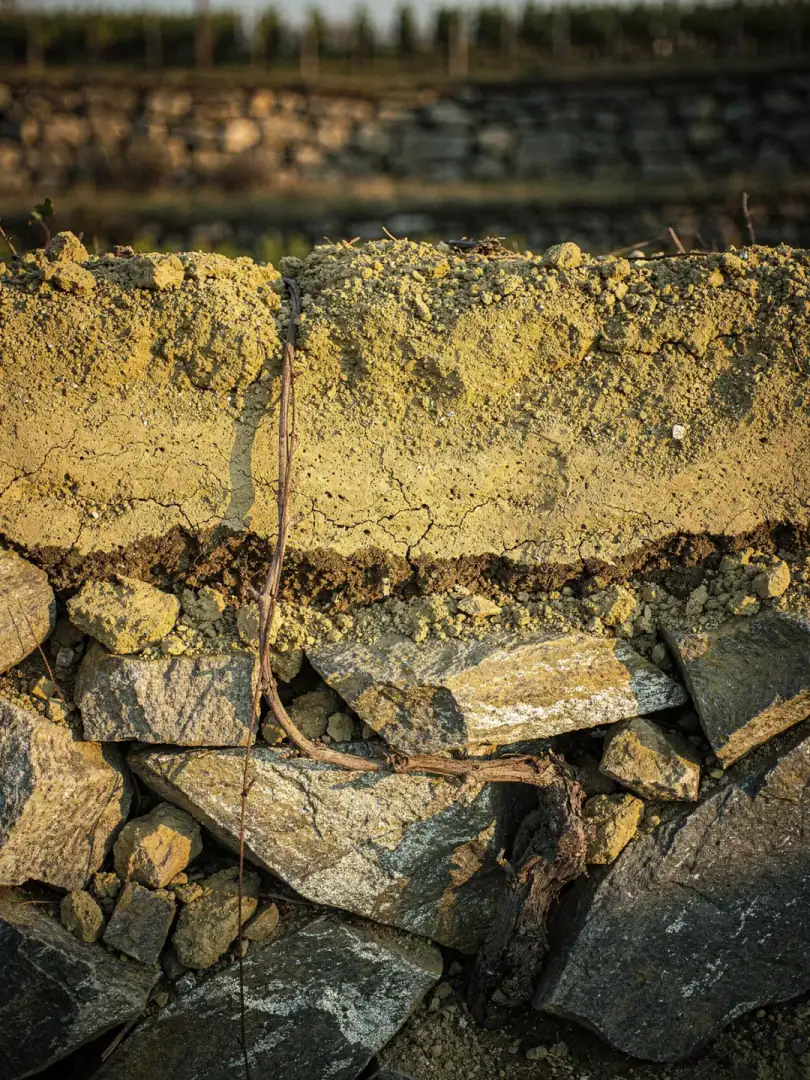
Loess on gneiss
Soils
Dig a hole in the northern Kremstal, and you dig through dust. The soil there is loess, a fine, powdery rock dust. Wind whipped it up out of the Danube valley during the ice ages and deposited it meters deep on the slopes. It's yellowish, calcareous, and so loose you can crumble it with your bare fingers.
Vine roots love this dust because water and air pass through it unhindered. Still, they grow deep, since loess stores almost no nutrients, and the deeper a root reaches, the more calmly the vine weathers a dry August. The result is a Grüner Veltliner with more richness and roundness, less sharp definition — a soil type that gives the variety its spicy breadth.
A few kilometers away, on the terraces right above the Danube, the loess gives way and rock emerges beneath it. This is Gföhler Gneiss, a pale, glimmering primary rock sometimes streaked with schist and amphibolite, and it fractures into hard slabs that a root practically has to force its way between.
These terraces carry almost exclusively Riesling. The lean rock forces the vine to produce small, concentrated berries. The stacked dry-stone walls store the sun's warmth during the day and return it to the roots at night. No other Danube region has as many terraced vineyards as the Kremstal — near Furth bei Göttweig they rise almost vertically above the river.
A persistent misconception holds that the wine tastes mineral because the root draws minerals from the rock and passes them along. That's not quite right, since rock only releases dissolved ions in trace amounts too small for anyone to actually taste. What really matters is the indirect effect through water balance and heat storage. In the Kremstal, between loess and gneiss, that indirect path is unusually short.
A thin, dark layer of fallen leaves and herbs. On the terraces, often barely a hand's width deep.
The root: Fine roots draw here on whatever the rain has just provided, and after just a few dry days they're the first to come up empty.