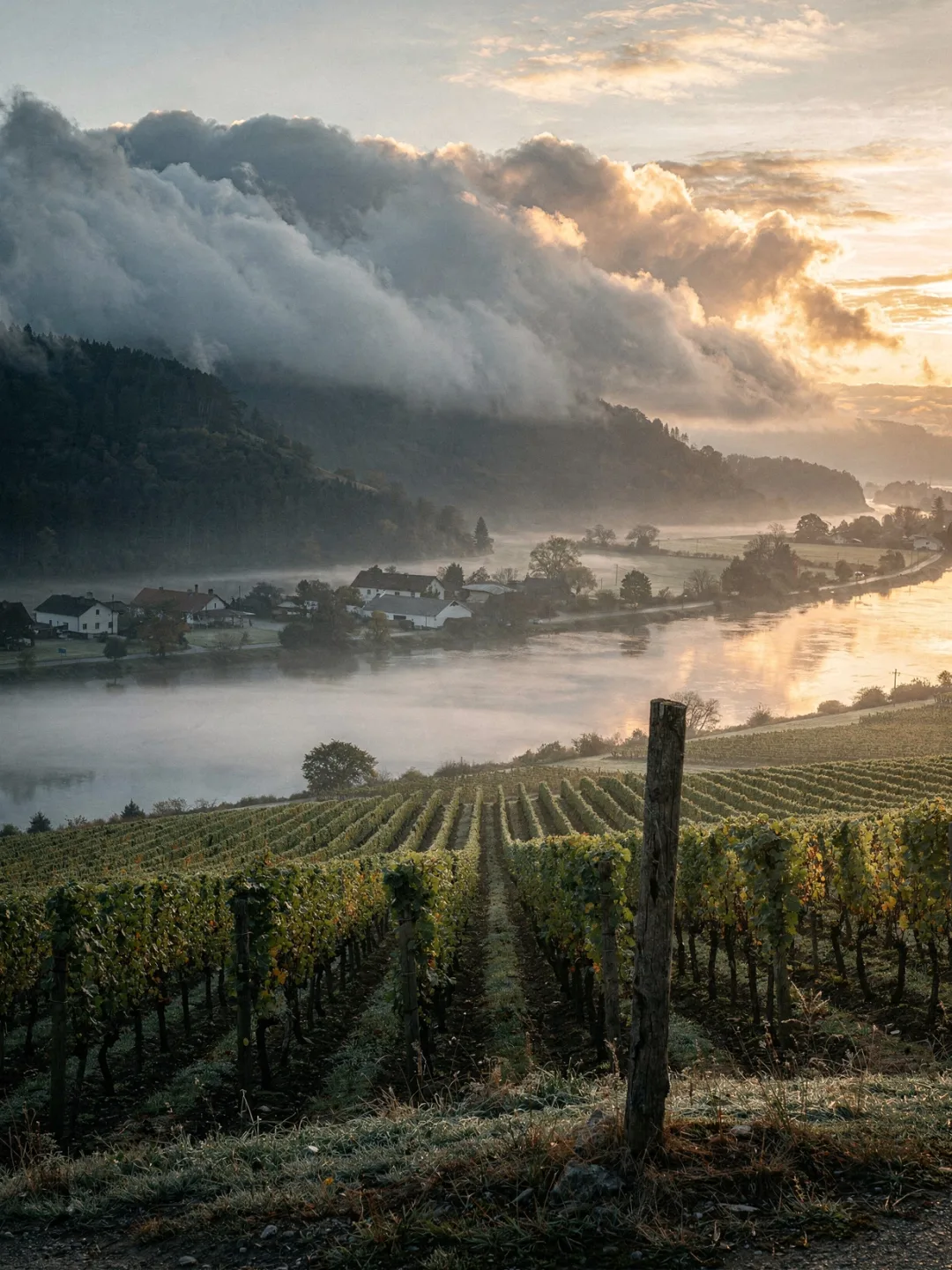
Warm meets cool
Climate
In the Kremstal, two weather worlds collide, and you can taste exactly that in the glass. Pannonian air drifts in from the east, warm and dry, the kind you'd expect from the Hungarian lowlands, while on the very same nights, cool air flows down into the valley from the higher-lying Waldviertel to the north.
The effect is considerable. On sunny September days, the region warms up quickly, sometimes past thirty degrees Celsius. The following night, the cool Waldviertel air can drop the temperature by as much as twenty-five degrees. For grape ripening, this is a stroke of luck: sugar and aroma develop during the day, while acidity is preserved at night, since the cold slows its breakdown.
Without this contrast, the wines would taste flat. Grüner Veltliner would lose its freshness, Riesling its tension, and both would come across as sluggish rather than lively. That's why winemakers in Krems and Stein talk less about hours of sunshine and more about cool nights when explaining why their wines have so much verve.
The Danube itself acts as a third element. It cuts through the region at around two hundred meters above sea level, storing warmth during the day and releasing it again at night. This provides natural frost protection for the vines along the riverbank. Further up, in the hilly north of the region toward the Waldviertel, this buffer is absent, and harvest there regularly begins later than down by the river.
This interplay gives the Kremstal two faces. Near the Danube, Riesling ripens in an almost Mediterranean-feeling microclimate. Just a few kilometers further north, at the edge of the forest, a noticeably harsher climate produces leaner, cooler wines.