Barrel Time as Law
Production
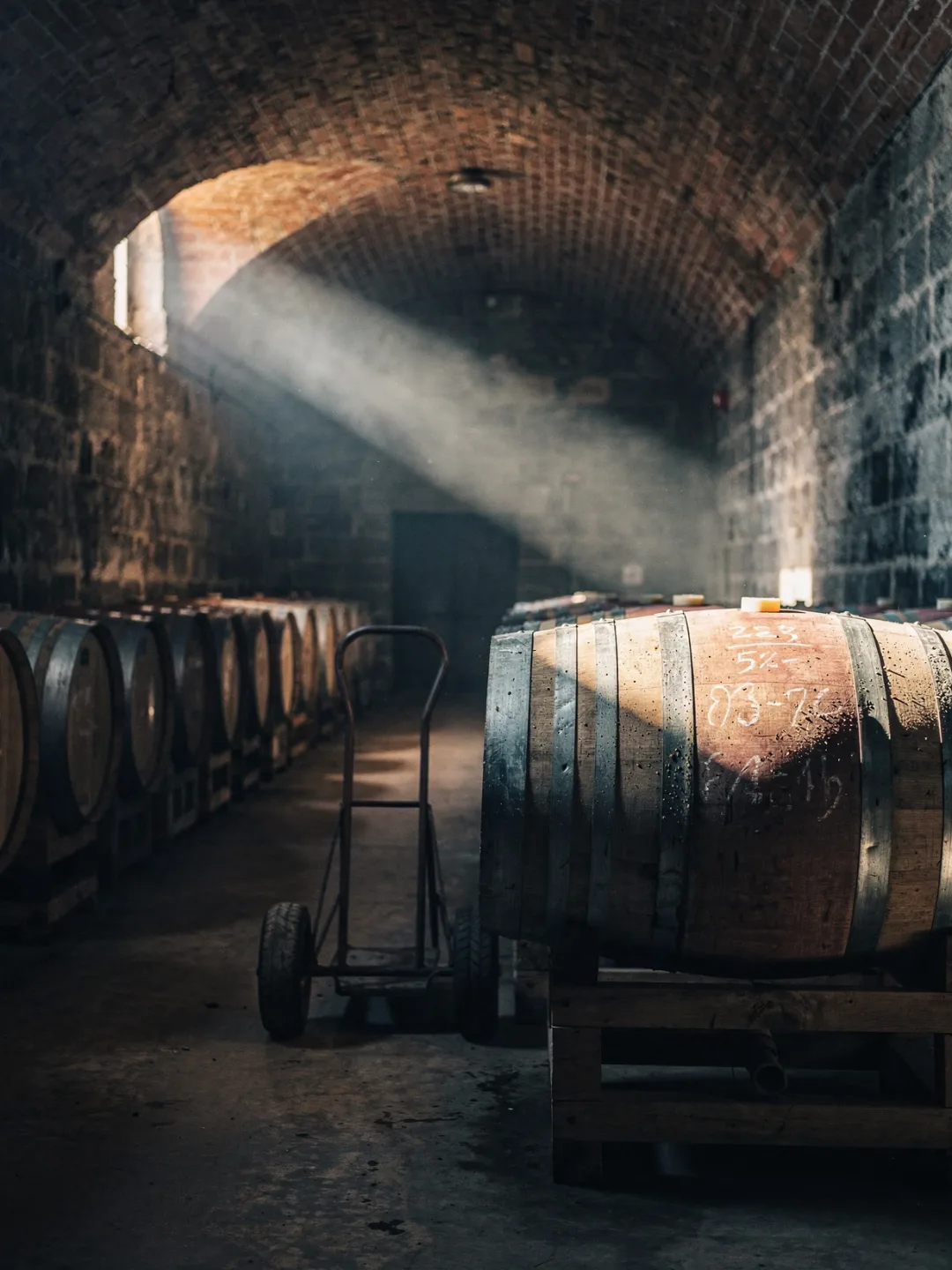
No other Spanish wine region categorizes its wines by barrel age as strictly as Rioja does. The Consejo Regulador recognizes four levels, each governed by clearly regulated minimum aging times stated on the label — verified, not simply claimed.
A Cosecha, often labeled Genérico, goes to market with no mandatory barrel aging and stays fruity and youthful. A Crianza requires at least two years of total aging, of which at least twelve months must be in a two-hundred-twenty-five-liter oak barrel, the rest in bottle. A Reserva requires at least three years total, again with a minimum of twelve months in barrel, followed by at least six more months in bottle. Strictest of all is the Gran Reserva, reserved for great vintages: sixty months total, of which at least twenty-four must be in barrel and at least twenty-four in bottle. White and rosé wines carry consistently shorter minimum aging requirements than reds.
Traditionally, Tempranillo aged almost exclusively in American oak, which lends notes of vanilla and coconut. Whole rows of it still fill the old cellars of the Barrio de la Estación in Haro. Over the past few decades, many bodegas have also turned to French oak, more restrained in aroma, with finer toasted notes. Which wood truly suits Tempranillo remains a point of debate between houses to this day.
In 2017, an additional classification system arrived, independent of barrel aging: Vino de Zona denotes origin from one of the three subzones, Vino de Municipio denotes origin from one of one hundred forty-four municipalities, and the strictest new tier is called Viñedo Singular. It requires vines at least thirty-five years old, hand-harvesting, a maximum yield of five thousand kilograms per hectare for red varieties, and approval through two separate tastings by an expert panel.
The first officially recognized Viñedos Singulares reached the market in 2019 — more than a hundred fifty years after Jean Pineau's first barrel. What was once an imported technique from the Médoc has become its own tightly regulated system of origin. Few other wine regions recognize as many classification levels as Rioja does.