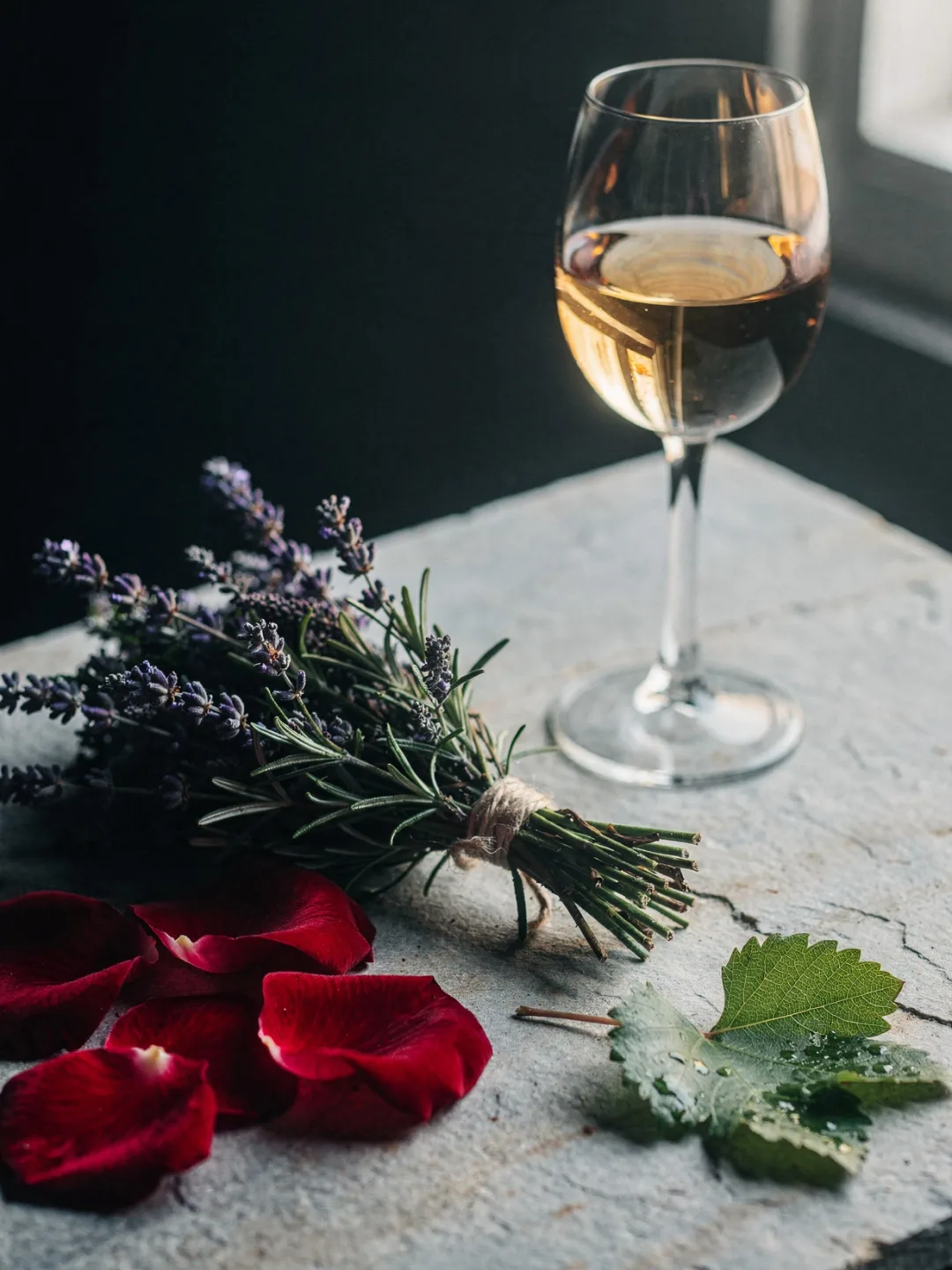
Rose to Rosemary
Flowers & Herbs
Rose aroma in Gewürztraminer, freshly cut grass in Sauvignon Blanc, a hint of lavender in a Rhône red: floral and herbal notes are among the most striking aromas in wine. They often reveal the grape variety on the very first sniff.
Terpenes: The Scent of the Blossom
Floral aromas in wine belong to the same chemical family as many fruit aromas: terpenes. Linalool smells like rose and lily of the valley, geraniol like geranium, and both compounds occur almost unchanged already in the ripe grape. In most grape varieties they're present only in traces in the berry, but in the Muscat family they occur in unusually high amounts.
Muscat grapes are therefore a special case among grape varieties: their juice tastes almost exactly, even before fermentation, like the finished wine will smell later. The terpenes come directly from the grape skin, and fermentation barely changes that. In most other varieties, by contrast, much of the aroma only develops through yeast, as the previous stop on this journey showed.
Green Herbs and Grass
Green notes reminiscent of freshly mown grass come from an entirely different group of compounds, the so-called leaf aldehydes. They form as soon as plant cells are damaged, for instance when grapes are pressed, and smell like grass or crushed leaves. Sauvignon Blanc carries this note especially often, alongside a second, even more distinctive group: sulfur-containing thiols.
One particular thiol abbreviated as 3MH smells, depending on concentration, like boxwood, tomato leaf, or blackcurrant bud. Many wine drinkers instantly associate this scent profile with Sauvignon Blanc from New Zealand or the Loire. Unlike the terpenes of the Muscat family, these thiols only form during fermentation, when yeasts release sulfur-bound precursors from the grape.
Mediterranean Herbs: Garrigue
In red wines from the southern Rhône Valley, tasters frequently describe a note called garrigue. It's named after the low, fragrant scrubland of thyme, rosemary, and lavender that grows around many vineyards there. Grenache and Syrah from this area do indeed often show a similarly spicy, herbal character.
Whether the surrounding herbs actually make their way into the grape through the air or the soil isn't scientifically well established and is rather unlikely. A simpler explanation is closer to the truth: wine and Mediterranean herbs partly produce the same terpenes, because similar plant processes generate similar aroma compounds. The wine smells like the landscape without having absorbed any part of it.
Why the Nose Needs Categories
Floral and herbal notes often sit closer together in the nose than the aroma wheel from the previous stop might suggest. Linalool itself illustrates this problem perfectly. At low concentration, it unmistakably smells like rose. At slightly higher concentration, the same compound tips, for many noses, toward soap or laundry detergent.
Right at this boundary, practiced vocabulary helps more than any chemical formula. Knowing that a scent can read as either floral or slightly soapy lets you place it more quickly and keeps the subtle shift from causing confusion. This ability to cleanly distinguish related scents becomes even more important at the next stop, which focuses on a single, extremely potent aroma compound: pepper.
When Floral Becomes a Flaw
Not every intense floral note counts as a virtue. In certain American wild vines, such as Vitis labrusca, a very forward, almost perfumed scent of grape candy dominates. Experts call this tone "foxy," named for its typically faint, slightly animal-like undertone. Genetically, it's mainly down to a single compound, methyl anthranilate, which is barely present in European cultivated vines. For many European wine drinkers, this scent comes across as off-putting rather than inviting.
Even with classic European grape varieties, too much of a good thing can tip over. Extreme skin contact with already terpene-rich varieties like Gewürztraminer sometimes pushes the floral note so far that it recalls perfume or soap rather than rose. Winemakers deliberately counteract this, for instance through shorter skin contact or cooler fermentation temperatures. In the end, floral character, like almost every aroma on this journey, comes down to dosage.
A simple rule of thumb suffices for everyday tasting. A touch of rose or orange blossom feels inviting and fresh. If a wine instead smells like a perfume bottle, the amount, not the grape variety, is usually the real issue.