The true basic tastes
Sweetness, Acidity, Bitterness, Umami
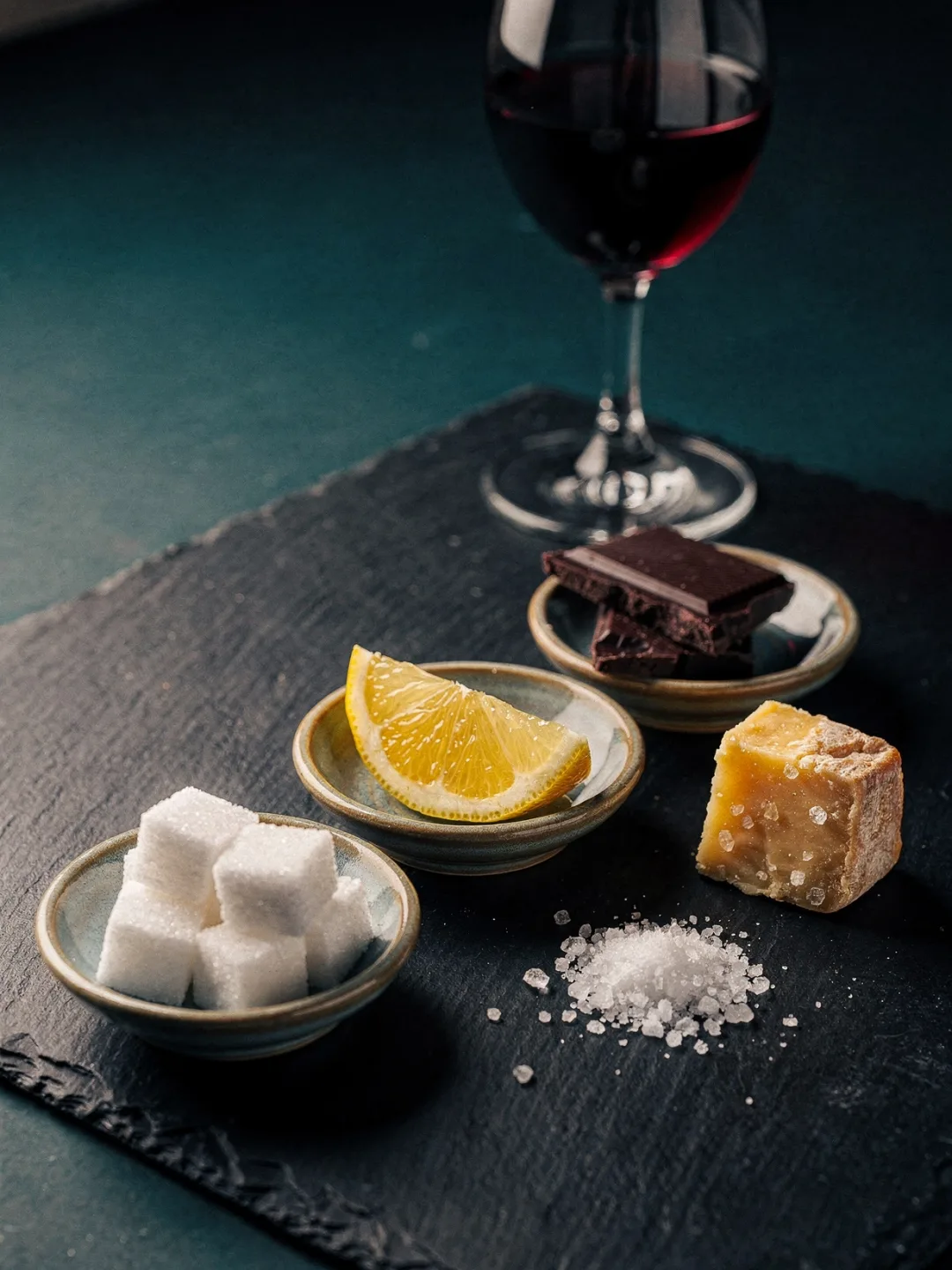
Sweet, sour, bitter, umami, and salty: these are the only five impressions the tongue actually tastes itself, everything else in a wine is really smell. Yet these same five determine the balance in the glass.
Five receptor families, one mouth
Unlike the many hundreds of aroma compounds from earlier sections, the tongue registers only a handful of basic impressions, and it doesn't need an olfactory organ to do it. Sweet and umami are perceived through a shared family of receptors, while bitterness has its own entirely separate group with roughly twenty-five different receptor types, likely because bitter compounds in nature are so often toxic that the body needs many individual warning systems.
Acidity works differently on a technical level: here, no receptors dock onto whole molecules; instead, channels in the cell membrane respond directly to free hydrogen ions, the chemical core of any acid. What ultimately reaches us as the taste of a wine is always a blend of these few tongue impressions and the many aromas perceived through the nose, orthonasally and retronasally, as the first stop on this journey already showed.
Sweetness and acidity in an endless tug-of-war
Sugar and acidity are locked in a constant balancing act in nearly every wine. Residual sugar, meaning unfermented grape sugar, noticeably softens the perception of acidity, while conversely high acidity keeps a sweet wine from feeling cloying or heavy. The two partly cancel each other out rather than simply adding together.
This exact balance explains why a German Kabinett Riesling with noticeable residual sugar can still taste fresh and never cloying: its equally high acidity perceptually offsets the sweetness. A wine with a similar amount of sugar but little acidity, by contrast, quickly feels heavy and one-dimensional, even at a lower sugar level.
Bitterness: a rare guest, often misunderstood
True bitterness, the kind measurable on the tongue, occurs in wine less often than many assume, and is frequently confused with a different sensation: the furry roughness of tannin. Tannin itself doesn't taste bitter, it merely feels dry and rough, more on that two sections ahead.
Genuine bitter compounds usually come from heavily extracted grape seeds or stems, when these stay in contact with the must too long during pressing, or from certain phenols in thick-skinned varieties. In small doses, bitterness adds an interesting counterpoint, for instance in the long finish of some Italian red wines; in large doses, it quickly comes across as a winemaking flaw in pressing.
Umami: the quiet fifth taste
Umami, the fifth basic taste, was first described in 1908 by Japanese chemist Kikunae Ikeda and was long dismissed by Western researchers, until scientists identified the corresponding receptor in the lab in 2000. It responds to glutamate, an amino acid responsible for the savory, broth-like flavor of aged cheese, mushrooms, or soy sauce.
In wine itself, umami tends to appear only indirectly, mainly in sparkling wines aged for a long time on the lees or in tertiary-aged red wines, whose amino acid content shifts slowly over the years. Umami matters most, however, at the dinner table: very umami-rich foods like mushrooms or aged Parmesan can make a tannic wine taste harsh and bitter, an effect revisited in the final stop on this journey.
Salty: the often-overlooked fifth taste
Saltiness rarely comes up in wine discussions. Wine contains almost no sodium or chloride, the classic sources of saltiness. The amount is far below any perceptible threshold. Yet some tasters describe certain wines as salty, especially those from coastal vineyards.
What they're tasting is probably not real salt. More likely, it's certain acids or amino acids that produce a similarly savory impression. Sometimes expectation alone plays a role: a wine from the coast is supposed to taste salty, so it does. This effect is well documented and studied, far beyond the world of wine.
A tiny trace of actual salt is nevertheless present in every wine. Vine roots absorb small amounts of sodium and potassium from the soil. But the quantity remains minuscule, usually well below the taste threshold for salt. This tiny trace alone doesn't create a perceptible salty impression.
So why does the idea persist so stubbornly? Salty sounds like the sea, like oysters, like a particular style of eating. That association easily carries over to the wine served alongside. A Muscadet paired with fresh oysters seems saltier than it actually is, simply through that pairing at the table. A simple test settles it for yourself: taste the same wine once on its own, once with a salty dish. Does it taste equally salty both times? Usually, the honest answer is no.