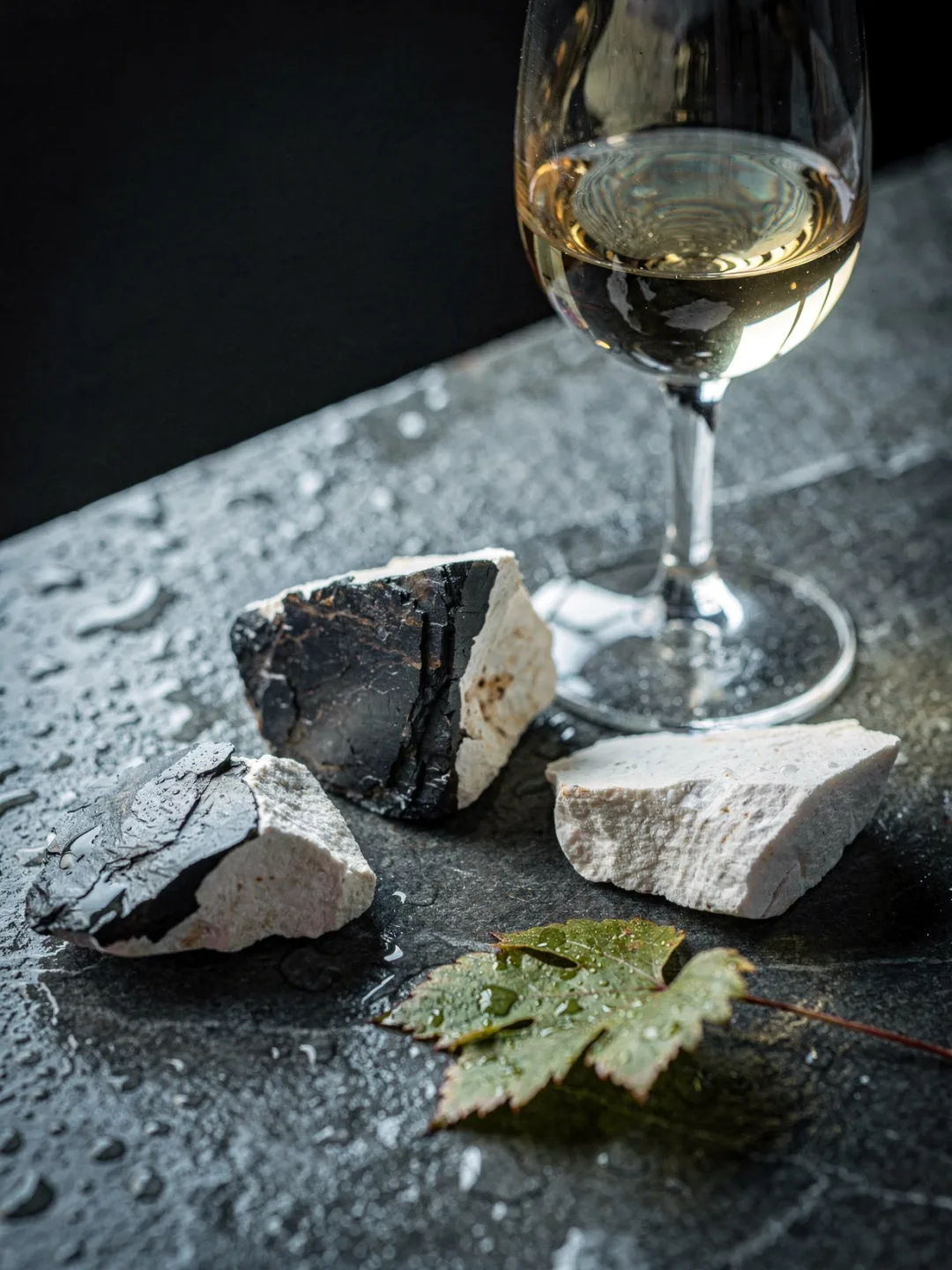
Stone doesn't taste like anything
Minerality – what's really behind it
Wet stone, flint, chalk: few words in wine are used so often and explained so rarely as minerality. Research largely agrees on one point: you can't actually taste rock itself in wine.
Why rock can't have a taste
When wine lovers talk about minerality, they often mean it as if the soil itself somehow transfers into the wine, slate, limestone, or flint directly tasteable in the glass. Welsh geologist Alex Maltman has been challenging this notion for years with a simple chemical argument: rock and minerals are almost entirely insoluble in water and therefore simply tasteless.
Vine roots don't absorb rock fragments from the soil anyway, only dissolved ions such as calcium, potassium, and magnesium. Together, these mineral compounds make up less than two hundredths of a percent of the wine's weight, an amount far below any conceivable taste threshold. The soil undoubtedly shapes a wine, but not by imprinting it with the flavor of rock.
What tasters are really tasting
So what is it that tasters describe as mineral? Several studies, including one at the University of California, Davis, found a clear link between trained tasters' minerality judgments and two quite different factors: higher acidity, especially malic and tartaric acid, and certain sulfur compounds in the wine.
A follow-up study from New Zealand confirmed the role of sulfur compounds but found no link to acidity, suggesting that the single word minerality likely bundles together several distinct sensory impressions, depending on the wine style and the taster.
The scent of flint is a scent
The aroma of struck flint, often cited as the textbook example of minerality, can actually be pinned down chemically. It mostly arises from reductive sulfur compounds, related to the thiols discussed in the section on blossom and herb aromas, just in a different composition and lower concentration.
Winemakers can encourage this note deliberately, for instance through especially low-oxygen ageing on the lees. An interesting aside: if you actually strike two real pieces of flint together, a sulfury smell does appear, but it comes from pyrite trapped in the stone and has nothing to do with the wine in the glass beyond a coincidental resemblance.
Why the word remains useful anyway
None of this means the word minerality is useless. It reliably describes a recognizable impression, taut acidity, restrained fruit, a faint smoky-sulfury undertone, that many people independently label the same way, even without knowing the underlying mechanism.
This puts minerality in the same category as other wine words like elegant or taut: genuinely felt impressions that arise from several factors acting together, rather than from one single, neatly measurable ingredient. That's also why the next stop on the basic tastes starts fresh again, this time on the tongue rather than in the nose.
Why marketing loves the word
Minerality sounds like terroir, like craftsmanship, like real earth in the glass. That's exactly what makes the word so attractive for marketing. A label reading "mineral" promises depth without having to deliver any concrete figures. No regulation dictates when a wine may carry that description.
Critical tasters therefore advise caution with this word. It describes a genuine impression, but not a measurable value. Two wines carrying the same label term can taste completely different. Your own tongue, in a direct side-by-side comparison, remains more reliable than the word itself.
A simple test can help you form your own judgment. Taste two wines of the same grape variety side by side, one labeled with this word, one without. Does the difference really taste like stone? Or more like extra acidity and less sweet fruit? Usually, the honest answer points closer to acidity than to rock.
Wine journalists, too, often use the word without explaining it further. That's rarely dishonesty. There simply isn't a better, equally short word for this particular impression. Wine regions like Chablis or the Loire wear the reputation of minerality almost like a seal of quality. That noticeably boosts sales, regardless of what individual bottles actually show in the glass. A limestone soil alone doesn't make a mineral wine, as the first half of this section has already shown.