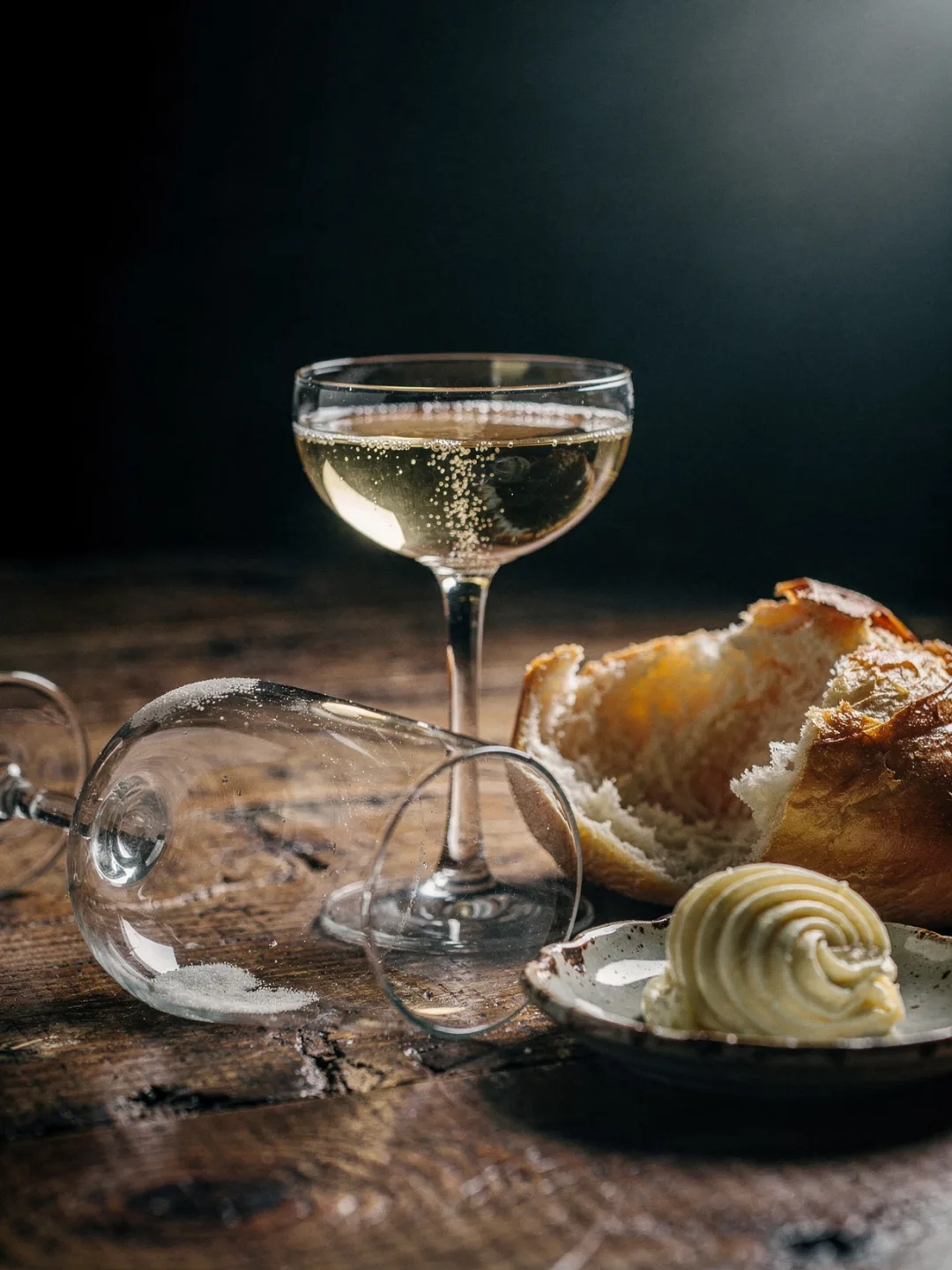
Yeast, Bread, Butter
Secondary Aromas
The scent of fresh bread in a Champagne or of butter in a creamy Chardonnay doesn't come from the grape. Microorganisms are responsible: yeasts and bacteria that work in the wine during and after fermentation.
When Dead Yeast Keeps Working
Once alcoholic fermentation ends, most yeast cells in the wine gradually die off. Instead of removing them immediately, many winemakers deliberately leave the young wine resting on this sediment of dead yeast, known as the lees, for months or even years. The dying cells gradually break down and release amino acids as well as cell wall components called mannoproteins into the wine.
This process is called yeast autolysis and is the main source of notes like fresh bread, brioche, or biscuit. It's most well known in traditionally made sparkling wine. There, the second fermentation takes place in the very same bottle that later ends up on the shelf, and the wine then ages for years on its own yeast. With some still white wines, too, winemakers deliberately stir up the settled yeast, a technique called bâtonnage. This way they extract more of these aromas along with a creamier texture.
Lactic Acid Bacteria at Work
A second, completely different group of microorganisms also shapes many wines after the main fermentation: lactic acid bacteria, above all the species Oenococcus oeni. They convert sharp malic acid into milder lactic acid, a process winemakers call malolactic fermentation, even though chemically no new fermentation in the strict sense takes place.
For red wines, this step is nearly standard practice, since it softens the acidity and makes the wine more approachable. With fresh, aromatic white wines like Riesling, however, many winemakers deliberately skip it in order not to lose the crisp fruit and acidity. As a byproduct of this conversion, a substance called diacetyl is also formed.
Diacetyl: From Pleasant to Rancid
Diacetyl is the very same compound that gives butter and popcorn their characteristic smell, and that's exactly how it smells in wine too. Its detection threshold ranges from roughly two to nine hundred micrograms per liter depending on the wine style, with Chardonnay showing the compound especially readily due to its other aromatic traits. In small amounts, this reads as a pleasant, creamy buttery note.
If the amount rises significantly beyond that, the same scent tips toward rancid butter or sickly-sweet butterscotch, and the wine's actual fruit disappears behind it. Winemakers control the amount through several levers. What percentage of the wine undergoes malolactic fermentation, at what temperature, and how long the wine then stays on the lees afterward—these are decisions made case by case.
How to Recognize Secondary Aromas
For untrained noses, yeast and oak aromas easily blur together, since both are often described as "toasty." One distinction helps tell them apart: bready, biscuity notes from yeast autolysis usually appear alongside a creamy, almost oily texture in the mouth. In sparkling wine, they're often accompanied by fine, persistent bubbles.
Oak-driven toasty notes, the subject of the next stop, rarely appear alone by contrast. They almost always come paired with noticeable tannin and a light vanilla note, since both originate from the same oak barrel. Anyone who picks up on both signals together usually knows, even before consciously thinking it through, whether a wine has been through yeast contact, barrel aging, or both.
Not Every Wine Gets Yeast Contact
Many fresh white wines and most rosés deliberately avoid yeast and oak contact. Their goal is pure, unadulterated fruit, without brioche, butter, or vanilla getting in the way. Such wines usually age briefly in stainless steel tanks, without extended contact with their own yeast, and reach the market quickly. Foregoing this contact is therefore just as much a deliberate choice as the extended yeast contact used for Champagne.
This choice is a matter of style, not quality. A simple, tank-fermented summer wine rarely benefits from weeks of yeast contact, whereas an ambitious Chardonnay often does. Which path is right depends entirely on what a winemaker actually wants to achieve with their wine. In the end, all that matters is whether the style suits the particular wine.
The label rarely gives this decision away directly. Still, a glance at the description helps: terms like "sur lie" or "aged on the fine lees" point to deliberate yeast contact. If there's no such indication at all, it's usually an uncomplicated, fruit-forward style. Anyone who tries both styles side by side, a young Sauvignon Blanc and a lees-aged Chardonnay, will usually hear the difference from the very first sip.