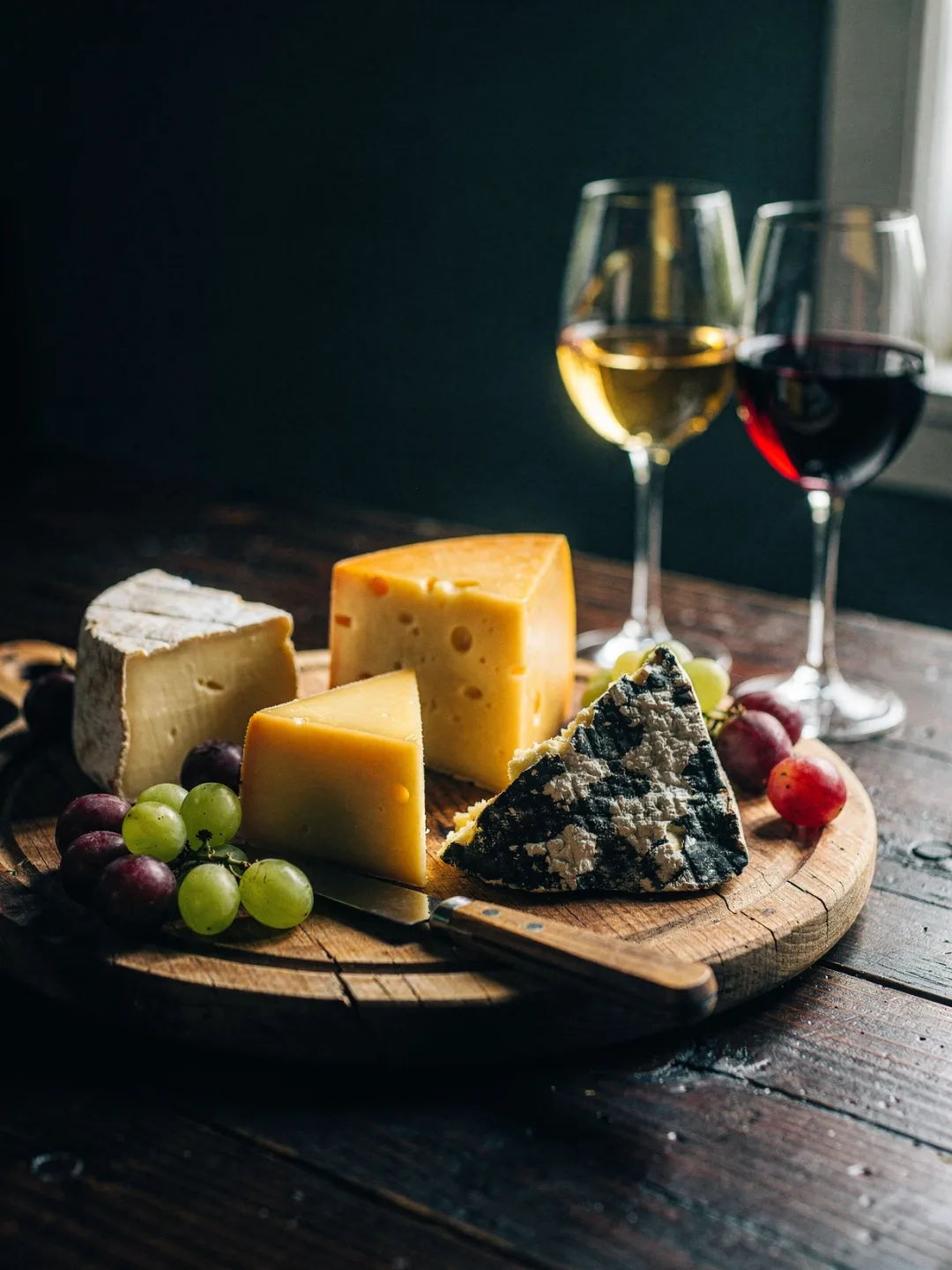
The Red Wine Myth
Cheese
Red wine and cheese are considered the ultimate pairing, yet almost every tasting shows the opposite: many red wines come across as harsher, more bitter, and less fruity next to cheese, while white wine and sweet wine are often the better choice.
Why red wine often fails with cheese
Cheese brings plenty of fat and salt, but little acidity, and this exact combination puts tannin in a tight spot. Fat does bind some of the tannin, just as it does with meat, but without acidity to counterbalance it, the wine often ends up tasting dull, and the fruit nearly vanishes behind the fat. In many tastings, white wines consistently outperform red wines with everyday cheese, even though most people expect the opposite.
This becomes especially clear with young, tannic red wines paired with mild cheese, like a creamy Brie: the cheese almost completely masks the wine's delicate fruit, leaving mostly astringency behind. A more mature, softer red wine with little tannin works considerably better, because there's no harsh element left to clash with the cheese's fat.
What actually works
Acid-driven white wines most reliably compensate for cheese's lack of counterbalance, exactly following the rule from the third stop on this journey. A goat cheese with a crisp Sauvignon Blanc, a Comté with an aged Chardonnay, a Camembert with a dry Riesling: in every case, the wine's acidity takes on exactly the job that red wine can't fulfill due to its lack of acidity.
Sweet wine forms the second reliable group, especially with intense, salty cheeses. Blue cheese like Roquefort or Gorgonzola classically meets Port or a lusciously sweet Sauternes, because the sweetness offsets the bold salt, exactly as described in the fifth stop of this journey. This combination is rightly considered one of the rare cases where almost nobody argues about the choice.
Sorting cheese by firmness
Soft, young cheeses like cream cheese or mild Brie need light, fresh white wines without much oak, because a powerful wine would instantly overwhelm their own gentle creaminess. Semi-firm cheeses like Gouda or Edam can handle considerably more, say a full-bodied white wine or a light, fruity red, because there's already a bit more structure in the cheese itself.
Long-aged hard cheese, such as aged Gouda, Parmesan, or Comté, develops its own salty, almost crystalline notes through aging, which surprisingly pair well with bolder red wines, because the cheese's long aging produces roasted and caramel notes similar to those found in an oak-aged wine. Here, unlike with young cheese, a robust red wine is entirely welcome in the glass.
The cheese board as a compromise
A mixed cheese board with soft, semi-firm, hard, and blue cheese can never be perfectly served by a single wine, because the requirements are too varied. In practice, a compromise helps: a medium-bodied, not-too-dry white wine or a light, fruit-forward red that doesn't completely fail with any cheese on the board, even if it's the perfect solution for none of them.
Anyone who wants to take the cheese board seriously should instead serve two or three wines side by side, arranged from light to bold, just as you'd eat the cheeses themselves from mildest to most intense. This order especially protects the mild cheese, which would have little left to say after an intense blue cheese.
Cheese and wine, briefly summarized
White wine beats red wine with cheese more often than most people think. Acidity is the key, not tannin. Soft cheese wants a light wine. Hard, aged cheese can also handle a bold red. Blue cheese wants sweetness above all.
Anyone serving a full cheese board shouldn't hope for one perfect wine. Two wines, one lighter and one bolder, reliably cover almost any cheese board. The order in which you eat matters just as much as the choice of bottle.
A dry Riesling with noticeable acidity makes a solid backup wine. It pairs with a surprising range of cheeses, from goat cheese to alpine cheese, without completely failing with any of them. No other white wine covers so many cheese scenarios at once.
White before red, when in doubt. Salt loves sweetness. Hard loves tannin. Soft loves nothing bold. In the end, the rule is that simple.