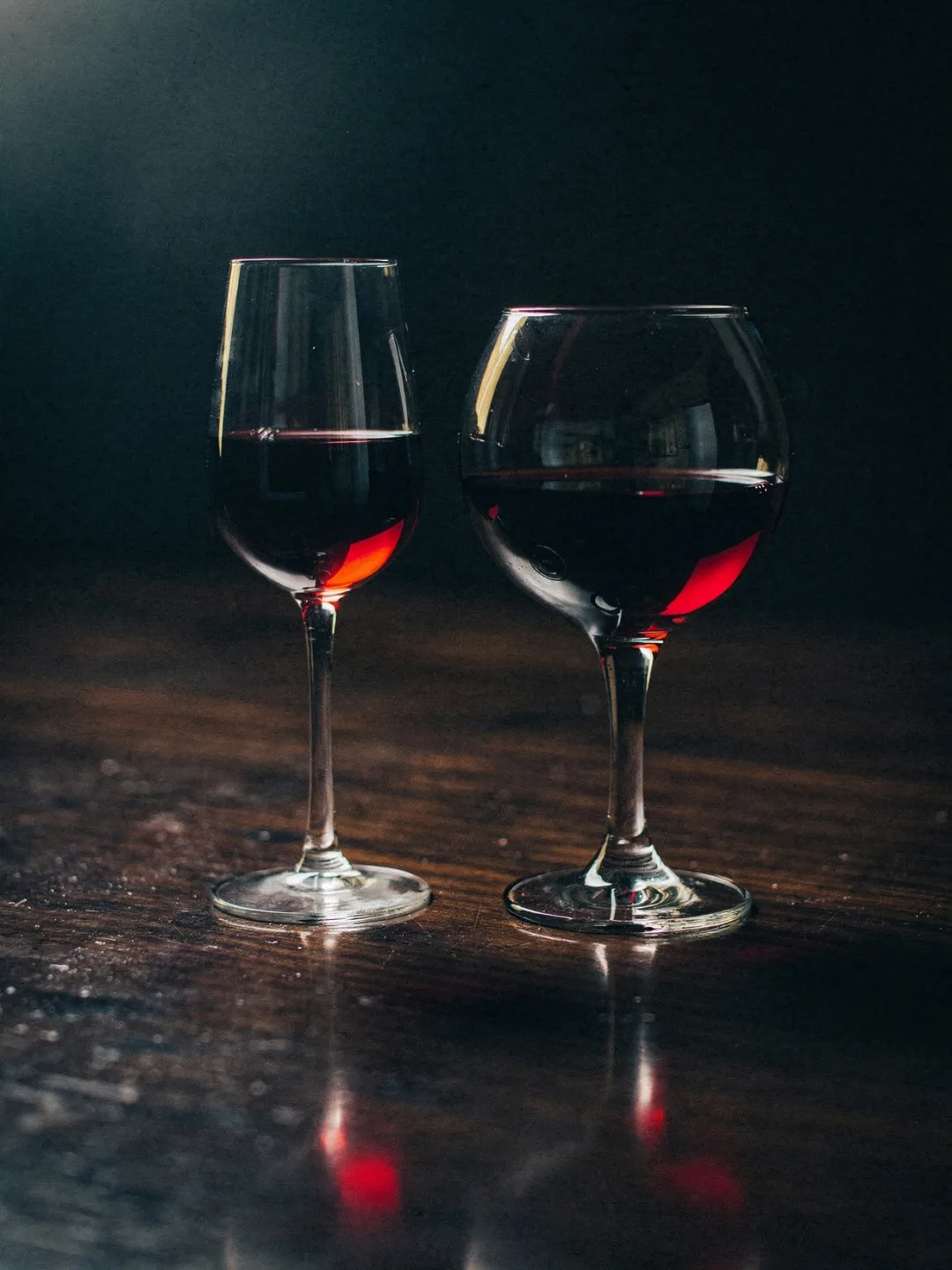
Shape meets taste
Why glass shape matters
One and the same wine tastes different from a narrow glass than from a wide bowl. That's not just imagination: the shape determines where the wine first hits the tongue, how quickly its aromas spread into the air, and whether you even smell them before you drink.
An invention from 1973
In 1973, Austrian glassmaker Claus Riedel introduced a series still regarded as a turning point today: the "Sommeliers" glasses, the world's first set designed for individual grape varieties rather than drinking habits. Riedel started from a simple observation. A glass is not a neutral vessel, but a tool that guides the flow of wine on the tongue and thereby influences which flavor arrives first.
Before Riedel, wine glasses were mainly ornaments: cut, colorful, often with gold rims. He removed the cut entirely and left only thin, clear glass, because any decoration disturbs the view of the color and allegedly even the taste. This sober style still shapes almost every serious wine glass today, whether made of crystal or plain soda-lime glass.
What the shape really changes
Three measurements determine how a glass performs: the width of the bowl's middle, the diameter of the opening, and the height of the bowl. A bulbous bowl with a narrow opening gathers the aromatic compounds like a funnel and pushes them in concentrated form to the nose before the first sip is even taken. A wide, flat bowl, on the other hand, lets the aromas escape immediately, almost as soon as the wine is poured.
The opening itself also guides the wine. A rim curved inward directs the liquid to the middle of the tongue, while a straight, wide rim spreads it more broadly in the mouth. The old idea of fixed "taste zones" on the tongue is now considered outdated, but the fact that the direction of flow shapes the first impression can be tasted for yourself with every change of glass.
How honest is the difference?
Blind tastings, where no one knows which glass they're drinking from, produce mixed results. Some tasters barely notice a difference, while others describe the same wine from two glasses as if it were two different bottles. Part of the effect really does lie in the physics of aroma compounds, and part lies in the expectation that an elegant glass in hand creates.
That doesn't make the effect wrong, just human. Anyone who puts more effort into a meal usually tastes it more consciously, and a glass that feels good in the hand turns an evening glass of wine into a small ritual. For everyday use, a good all-purpose glass is entirely sufficient; for special bottles, it's worth reaching for the matching type.
Material and wall thickness
Crystal glass contains metal oxides that allow it to be blown thinner than ordinary glass without becoming fragile. A thin rim is barely noticeable on the lip, so the wine arrives without the detour of cold glass. Thick-walled glasses from the kitchen cupboard, on the other hand, often feel clunky and make the first sip taste dull, because the lip has to pass over a wide edge first.
Lead-free crystal has almost completely replaced old lead glass without losing any ring or clarity. More important than the material, however, remains care: a fine glass with dish soap residue harms the wine more than a simple glass that comes clean and odor-free from the cupboard.
A simple test at home
Skeptics don't have to take anyone's word for it. A small experiment is enough. You need two different glasses and the same wine. A narrow glass, a bulbous glass, the same sip from the same bottle. If you smell the narrow glass first, then the bulbous one, the difference is usually immediately noticeable. The nose often notices it faster than the conscious mind.
The test also works without expensive crystal. Even two differently sized drinking glasses from the kitchen show the effect, albeit more weakly than with specially shaped wine glasses. The only important thing is the direct comparison, ideally shortly after one another and with the same wine, because scent memory only really holds reliably for a few seconds. If you leave a week between the two samples, in the end you're only comparing memories, not genuine impressions.
When a glass breaks
Good wine glasses are thin, and thin glass breaks more easily than sturdy kitchenware. That's not a design flaw, but the price of the fine shape. Anyone who regularly uses expensive glasses is best off buying a few spare pieces of the same model right away, since many series are altered or discontinued entirely after just a few years. A single surviving glass from an old set can then hardly be replaced.
Some households therefore deliberately buy a simple but solid entry-level glass for everyday use and save the delicate series for special occasions only. This spares the good pieces and at the same time takes the pressure off everyday life, where a glass tends to break more often anyway. Anyone with children or pets at home usually already knows this compromise from experience.