Sun and gradient
Elevation and slope
Two figures often matter more than climate for a vineyard: how high it sits and how steeply it tilts toward the sun. Both can be read straight off a map, long before the first vine is ever planted.
Why elevation cools
With every kilometer of elevation, air temperature drops by roughly six degrees on average. A vineyard at eight hundred meters is therefore noticeably cooler than one at sea level in the same region, even if both lie on the same latitude. Winegrowers exploit this effect deliberately to produce fresh, acid-driven wines in areas that would otherwise be too warm.
The world record for this strategy belongs to Argentina. In the province of Salta, vines grow between 1,580 and 3,111 meters above sea level. The Altura Máxima vineyard near Colomé is considered the highest in the world. At this altitude, the air is thin. Intense sunlight hits the grapes during the day, while temperatures plunge sharply at night. This swing concentrates both aromas and acidity.
Why a slope gets more sun than a field
A south-facing slope in the Northern Hemisphere stands far more directly in front of the low-hanging sun than a flat surface does. Sunlight strikes it at a steeper angle instead of grazing shallowly across the ground, delivering more energy per square meter. In the Southern Hemisphere, the same holds true for north-facing slopes. That's why the best sites in cool wine countries almost always carry this orientation to the sun.
A slope also helps with water. Rain runs off a gradient faster instead of pooling in the soil. This prevents root rot and forces the vine to dig deeper in search of moisture. Many winegrowers consider exactly this kind of stress a quality factor. A stressed vine yields less fruit, but more concentrated grapes.
When steepness demands handwork
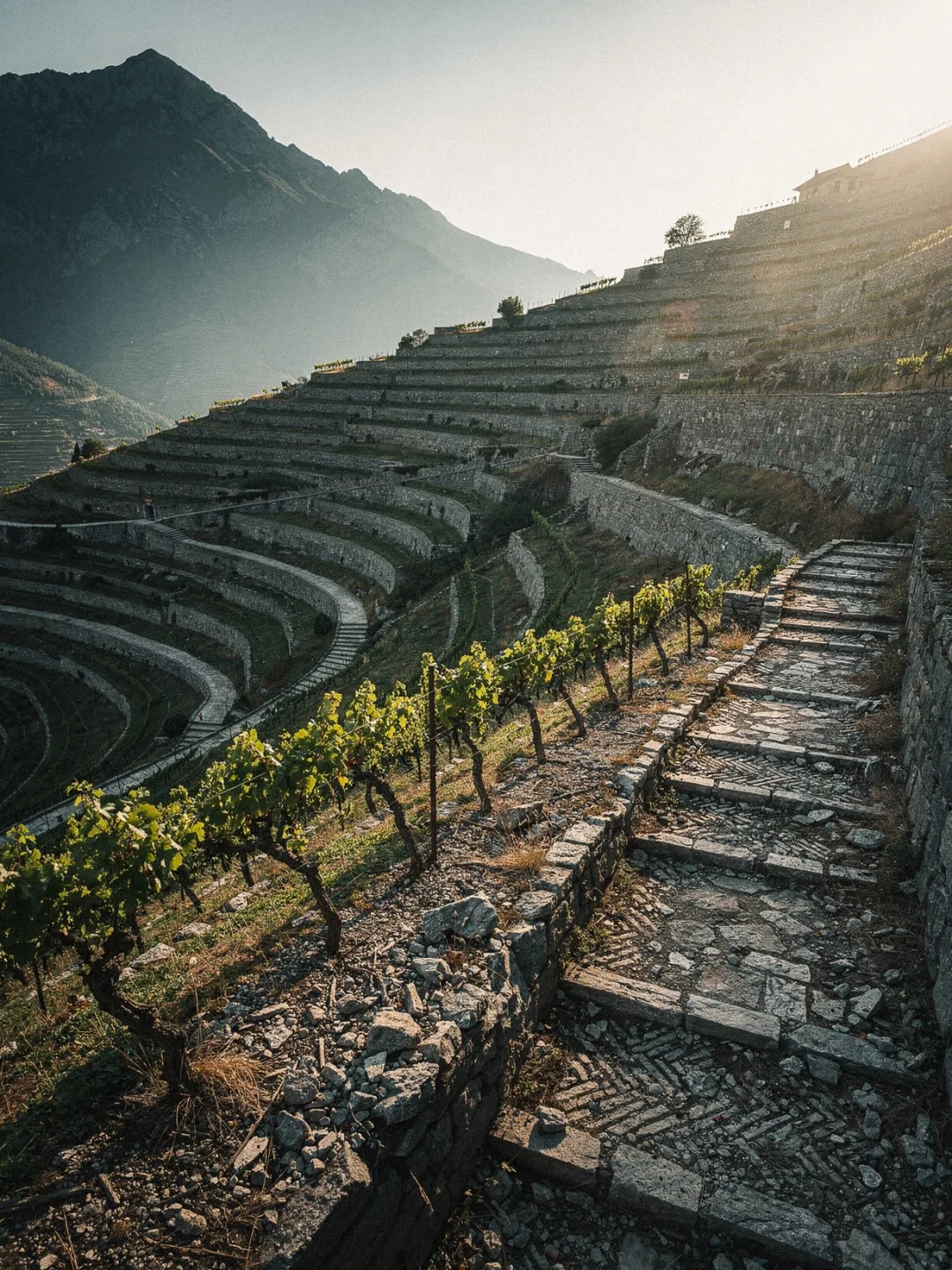
In the Mosel village of Bremm lies the Calmont, Europe's steepest vineyard, with a gradient of up to 65 percent. No machine can gain a foothold there. Every grape is cut by hand and carried down into the valley in backpack baskets or via small monorail systems. Equally extreme are the narrow terraces, held up by dry-stone walls, in Portugal's Douro Valley, where Port wine grows. Such steep sites cost many times what flat vineyards demand in labor.
The effort usually only pays off because wines from these sites are in especially high demand. Without that reputation, most steep vineyards would long since have been abandoned for economic reasons. A tractor on a flat field finishes in an hour what a steep site requires a full day of handwork to accomplish.
Cold air collects below
In narrow valleys, cold, heavy air flows down the slope on clear nights just like water. It gathers at the lowest point. Vines higher up the slope are therefore often spared from frost. That same night can destroy tender young shoots down in the valley floor. For this reason, many of the best parcels on a steep slope aren't at the base. Instead, they sit in the middle or upper third of the slope.
Exposure is more than just south-facing
Besides a southerly aspect, it also matters whether a slope faces east or west. East-facing sites catch the gentle morning sun and cool back down by afternoon, which preserves acidity. West-facing sites, by contrast, soak up the more intense afternoon sun and grow warmer as a result, which can benefit late-ripening varieties. These subtle differences explain why two vineyards just a few hundred meters apart can produce completely different wines, even though soil and climate appear identical at first glance.
Two levers, one goal
Elevation and slope rarely act alone. Often a winegrower combines both deliberately. A high but flat vineyard stays cool, but loses solar intensity. A low but steep south-facing slope wins back exactly the warmth that elevation would otherwise take away. Anyone who reads both levers together often understands a vineyard better than through any single soil analysis.
An example makes this tangible: a vineyard at six hundred meters, on a gentle east-facing slope with only a ten percent gradient, can end up ripening in a way quite similar to a vineyard at four hundred meters on a very steep, south-facing slope with a forty percent gradient, because both paths can mathematically arrive at the same heat sum. In the end, only one thing counts. Heat sum beats any single figure.