Softer Thanks to Bacteria
Malolactic Fermentation and Lees Aging
After alcoholic fermentation, a wine is often still sharp-edged. A second, much quieter fermentation, driven by bacteria rather than yeast, softens its acidity. Time spent on the dead yeast cells also gives it extra texture and depth.
What happens during malolactic fermentation
Grapes naturally contain mostly malic acid, the same sharp acid found in a green apple. Certain lactic acid bacteria can convert this malic acid into a noticeably milder acid. It's called lactic acid, the same acid found in yogurt. The main organism at work here is a species called Oenococcus oeni, a bacterium that occurs naturally in almost every winery cellar in the world. This process is called malolactic fermentation, or malolactic for short. Strictly speaking, chemically it's more of a conversion than a fermentation in the narrow sense, since no alcohol is produced, only a milder acid and a bit of carbon dioxide.
The result is clearly noticeable in the glass. A wine before malolactic fermentation often tastes green, sharp, and pointed in its acidity. Afterward, it feels rounder and softer, sometimes almost creamy. A hint of buttery aroma can develop as well, caused by a compound called diacetyl, particularly pronounced in some Chardonnays. Red wines almost always go through malolactic fermentation, since their tannins generally benefit from a bit of extra softness. Many fresh, fruit-forward white wines, on the other hand, deliberately skip it to preserve their crisp acidity.
Who decides whether malolactic fermentation happens?
The bacteria responsible for malolactic fermentation are, like yeast, partly present in the cellar naturally. But they can also be added deliberately. Warmth above roughly sixty-four degrees Fahrenheit and lower acidity both encourage malolactic fermentation to start, and these are exactly the conditions that typically already exist in the cellar following the warmer red wine fermentation. That's why it kicks in almost automatically for many red wines right after alcoholic fermentation. It's no coincidence.
Anyone who wants to deliberately preserve a wine's fresh, green acidity actively suppresses malolactic fermentation. This is achieved by cooling the wine, by using a higher level of sulfur dioxide, which inhibits the bacteria, or through fine filtration, which mechanically removes them from the wine before they can even become active. So it's decided right there in the cellar whether a wine will later come across as sharp and crisp or soft and round. Both approaches are equally legitimate, depending on the style a producer is aiming for.
Lees Aging: Time on Its Own Sediment
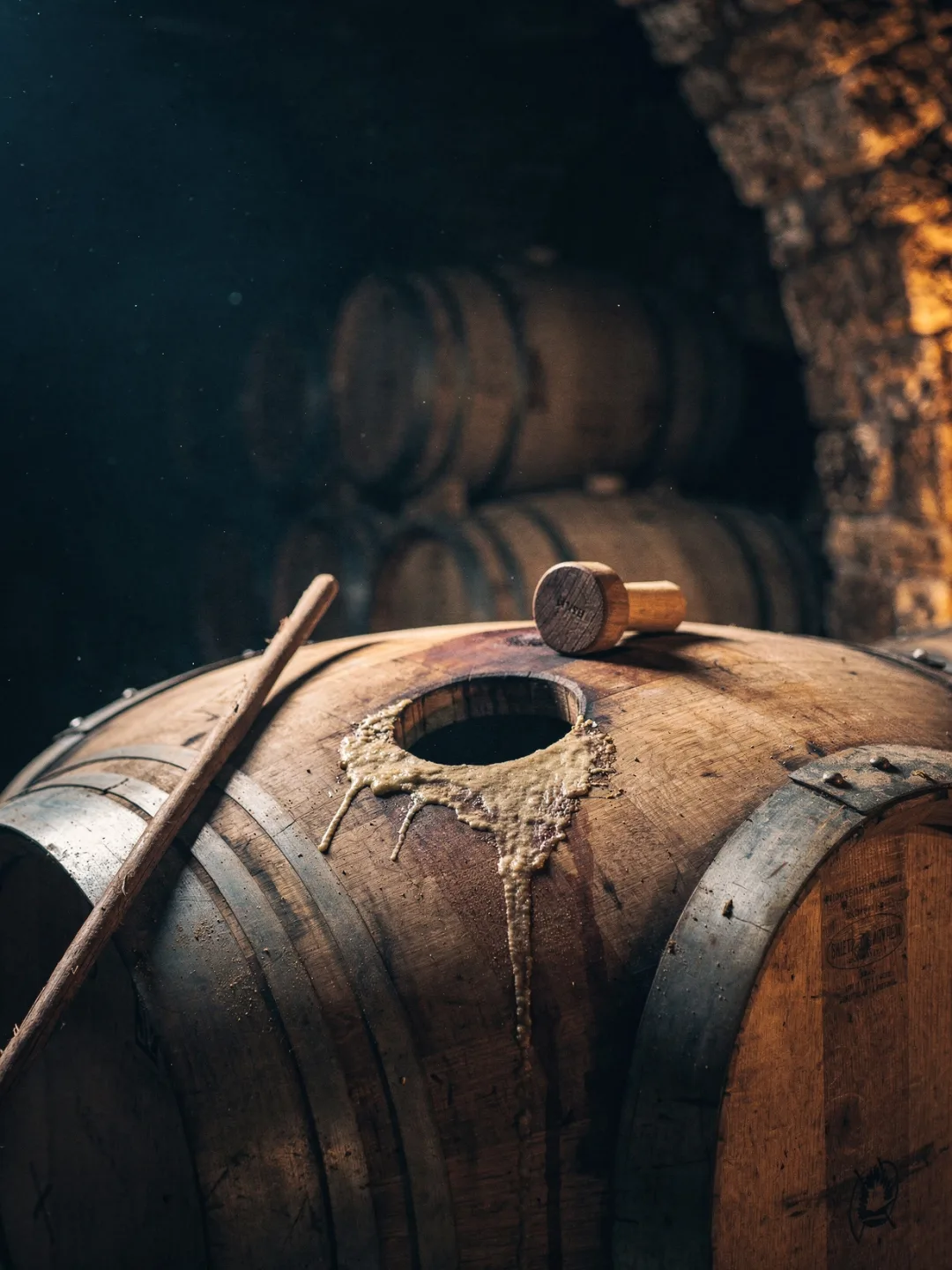
After every fermentation, the yeast cells eventually die off. They sink to the bottom of the tank or barrel as a fine sediment known as the lees. Rather than separating the wine from this sediment right away, many cellar masters deliberately leave it resting on the lees for several months, since this adds extra flavor and structure to the wine. This process is called lees aging, or sur lie in French. Some wines rest in the cellar this way for a full year before ever being bottled.
During this time, compounds from the dead yeast cells slowly dissolve into the wine, a process called autolysis. It gives the wine more body and a silkier texture, and aromas some describe as bready or nutty also emerge from it. Some cellar masters stir the lees regularly with a rod inside the barrel, a process called bâtonnage, to further intensify the contact between wine and lees. Stirring too often, however, can also bring out unwanted sulfurous notes.
Where malolactic fermentation and lees aging work together
In many full-bodied white wines, both processes run in parallel within the same barrel. Malolactic fermentation takes the edge off the acidity, while simultaneous lees aging builds texture and aroma, two processes that complement rather than compete with each other. A wine like this then needs almost no additional sweetness or fruitiness to feel rounded. Acid reduction and lees contact have already taken care of that. Further intervention is rarely needed.
How long this interplay lasts, and in what vessel it takes place, plays a major role in shaping the finished style of a wine. That's exactly where the next stop begins, with the vessel itself. Wood carries its own distinct aromas and also lets oxygen through slowly. It transforms a wine yet again, in a way entirely different from what malolactic fermentation and lees aging alone could achieve.