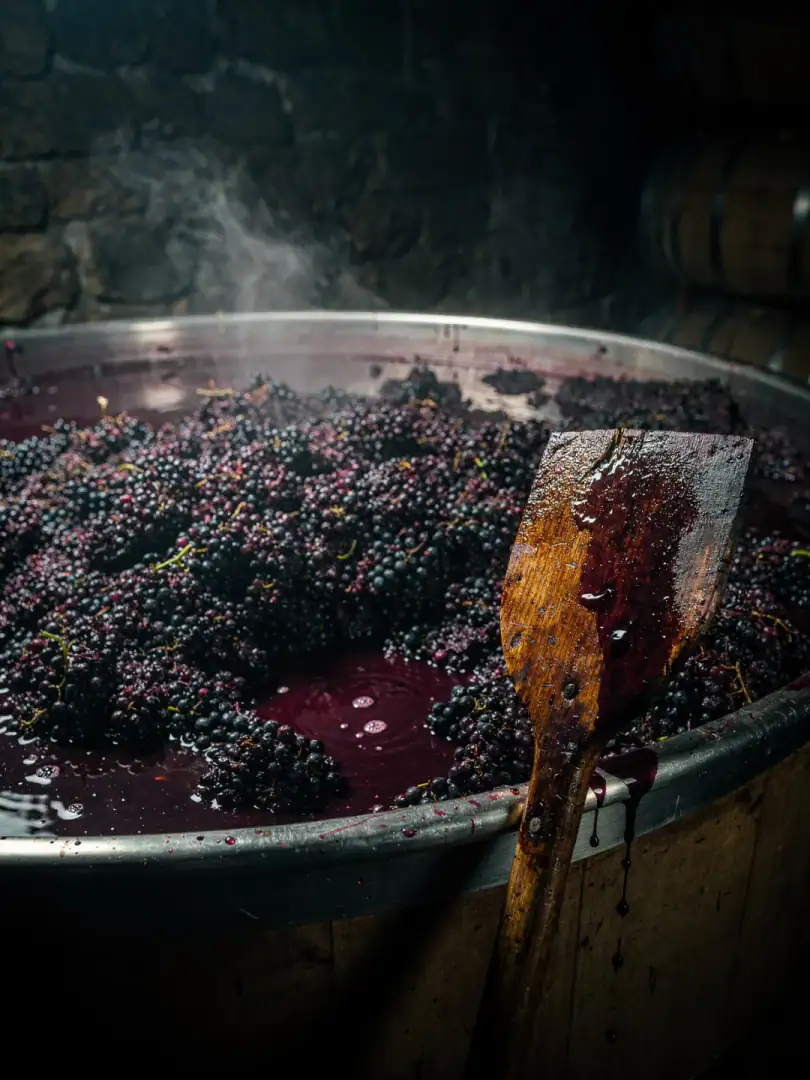
Color Through Maceration Fermentation
How Red Wine Is Made
Red wine gets its color not from the juice, but from the skin. In red winemaking, the juice ferments for weeks together with the skins and sometimes the seeds—a process called maceration fermentation, in which alcohol acts like a solvent, extracting color and tannin from the skin.
The Must: Juice, Skins, and Seeds Together
Unlike white wine, red grapes usually aren't pressed immediately after harvest. Instead, they're lightly crushed so the juice is released, while the skins, seeds, and often some of the stems remain in the same vessel. Some producers remove all the stems, while others deliberately leave part of them in the must for extra structure and freshness. This mixture of juice and solid matter is called the must, or mash. It forms the foundation for everything that follows. Fermentation begins within it, with juice and skins in constant contact, often for one to three weeks.
This extended contact is exactly what sets red wine apart from white. As soon as the yeasts convert the sugar into alcohol, the resulting alcohol acts like a solvent. It draws the red and blue pigments, as well as a large portion of the tannins, out of the skins and into the juice. The longer and more intense this contact, the darker and more tannic the resulting wine becomes. This gives winemakers a fine tool for deliberately shaping the style of a red wine.
The cap of skins must constantly be pushed back down
During fermentation, the carbon dioxide gas being produced rises and carries the skins along with it. This forms a solid cap several centimeters thick on the surface, known as the pomace cap or cap of skins. It can grow to be several feet thick, depending on the size of the fermentation vessel. If it sits dry above the juice, it dries out and can attract acetic bacteria. That's why it needs to be brought back into contact with the juice regularly, several times a day during active fermentation. Without this work, the cap would spoil quickly.
There are two classic techniques for this. In punching down, known in French as pigeage, the cap is pushed down into the juice from above using a rod or even by foot. In pumping over, or remontage, juice is instead pumped from the bottom and poured back over the top of the cap. Some automated systems now handle pumping over with a timer and a pump. Both methods release additional color and tannin, but they differ in intensity: pigeage extracts more forcefully, while remontage works more gently and evenly.
When is the wine pressed, and how much force is too much?
After the desired time on the skins, the wine is separated from the solid matter. This moment marks the end of maceration. The free-run wine, which flows out without any pressure, is generally considered the finest portion. Some cellar masters even age the free-run wine separately in its own barrels. Whatever remains in the skins afterward is pressed. Stronger pressure releases more color and tannin, but also more harsh, bitter compounds from the seeds and stems.
Cellar masters therefore have to weigh how hard to press. Press too gently, and color and structure are left unused in the skins. Press too hard, and the wine turns coarse and bitter. Striking the right balance takes experience. Depending on the desired style, press wine and free-run wine are either aged separately or blended back together in a specific ratio. This is an early, small-scale form of blending, something we'll return to in much more detail later on this journey.
Warmer than white wine, but not without limits
Red wine typically ferments at warmer temperatures than white, often between seventy-seven and eighty-six degrees Fahrenheit, because warmth speeds up the extraction of color and tannin from the skins. Cold, by contrast, would slow fermentation down unnecessarily. Still, it can't get too hot. Above roughly ninety-one degrees Fahrenheit, the yeasts risk dying off before all the sugar has fermented, resulting in an unwanted, unfinished, overly sweet fermentation.
Some cellar masters therefore deliberately alternate between cooler and warmer phases. First comes a cold soak before fermentation actually begins, which draws out aroma rather than tannin, followed by a warmer main fermentation. What happens after this maceration, which yeasts are actually at work, and what can go wrong, is the subject of the next stop. Only there does it become clear how well the decisions made in the cellar truly fit together.