Aging Without Wood
Steel, Concrete, and Amphora
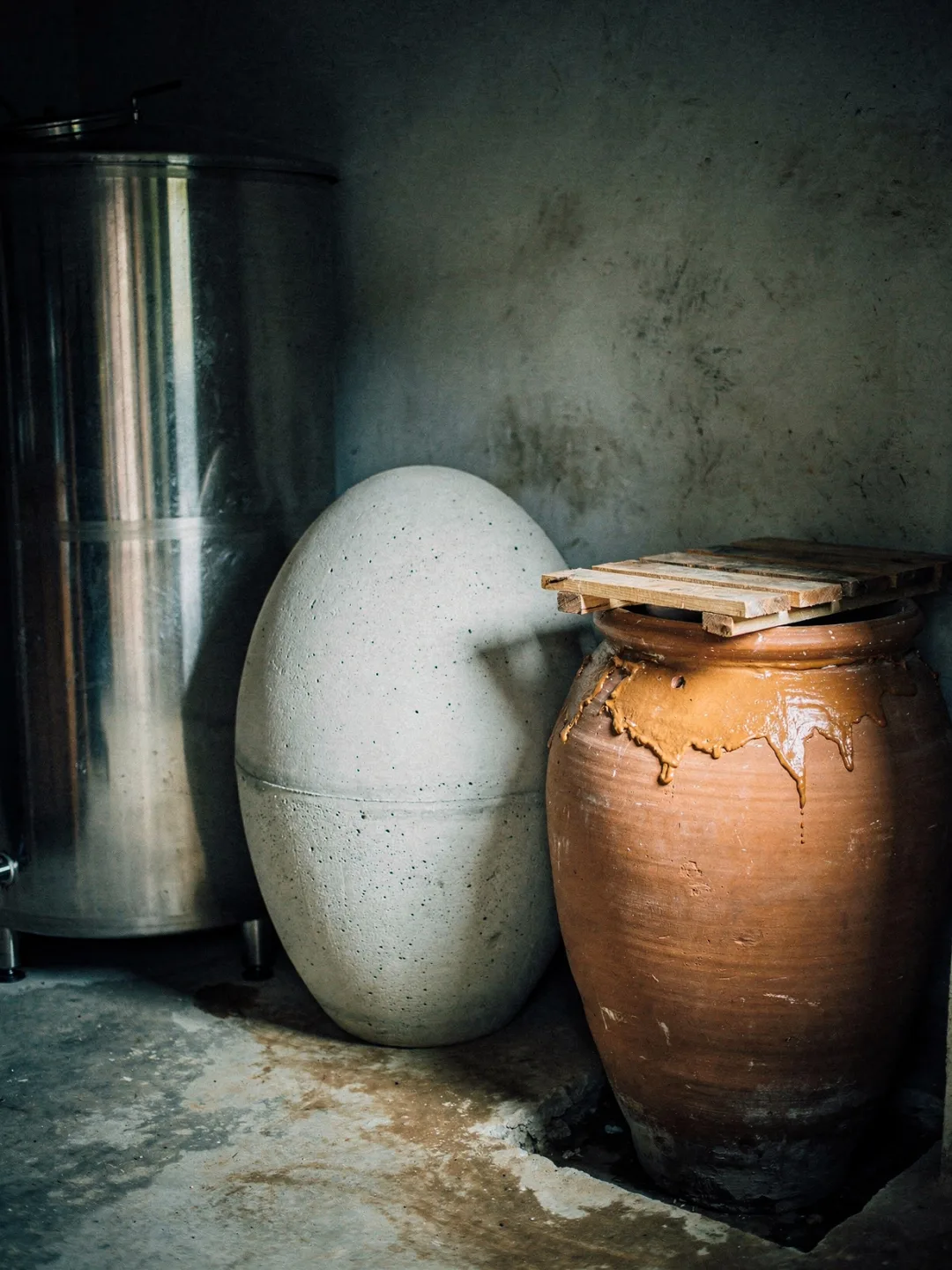
Not every wine is meant to taste of the barrel. Steel, concrete, and fired clay age wine in their own distinctive ways, without the vanilla and toasty aromas of oak. In return, they bring their own effects on temperature, texture, and, in the case of the amphora, even on color.
Stainless Steel: Cool, Neutral, Controllable
Stainless steel tanks have been an essential part of modern wine cellars since the mid-twentieth century. They impart absolutely no flavor of their own to the wine. They're also easy to clean and, thanks to built-in cooling jackets, can usually be regulated to precisely the desired temperature. For fresh, fruit-forward white wines that are meant to showcase their own aromas, steel is therefore often the first choice. It's also hard to beat for cost reasons when it comes to large volumes of everyday wine, especially since the tanks last for decades without any loss of quality.
The drawback of steel is at the same time its greatest advantage. Because it's completely airtight, no oxygen exchange takes place inside the tank whatsoever. A wine can stay practically unchanged and fresh in it for months. However, it also doesn't develop the additional depth and softness that a barrel can lend through slow oxygen contact. For many simple and mid-range wines, that's exactly what's wanted. For more complex wines, though, it's often not enough.
Concrete: A Middle Ground with Its Own Character
Concrete tanks, often built in the shape of large, oval eggs, combine properties of both steel and wood. Like steel, they impart no foreign aroma to the wine. Unlike steel, however, they're slightly porous and thus allow a bit of oxygen through, similar to a very large, old wooden barrel. Their thick walls also act as a temperature buffer, so that day-to-day fluctuations barely register inside. For this reason alone, some producers swear by concrete, especially for wines that need a long, calm aging period.
The oval, egg-like shape of many modern concrete tanks isn't a pure design flourish. Without sharp corners, temperature differences create a gentle, natural circulation inside. This keeps the wine and its fine lees in constant, gentle motion, entirely without mechanical stirring. For wines that are meant to gain some structure and oxygen contact without tasting of wood, concrete has therefore become noticeably more popular in recent years.
Amphora and Qvevri: The Oldest Method of All
Long before steel or barriques existed, wine was aged in large clay vessels. In Georgia, this method is still practiced today. A clay vessel called a qvevri is hand-thrown and can hold up to two thousand liters. It's buried completely underground, and its interior is lined with beeswax. The surrounding earth keeps the temperature remarkably steady over months, entirely without any technology. No cooling or heating is needed, an advantage that still makes the method attractive today.
In a qvevri, wine often ferments and ages together with the entire mash, including skins and seeds, even for white grape varieties. This gives it a deep color and pronounced tannins, quite similar to modern orange wine. UNESCO officially recognized this thousands-year-old Georgian method as intangible cultural heritage in 2013. This is a rare example of a winemaking technique itself being considered cultural heritage, rather than merely a craft.
A Vessel Is Always a Stylistic Choice
Steel, concrete, wood, and clay differ mainly in three respects. They allow different amounts of oxygen through, contribute different amounts of their own aroma, and buffer temperature fluctuations to different degrees. No vessel is fundamentally better than another. Each suits a different wine style and a different intention on the part of the winemaker, and this choice begins long before the first grape ever reaches the cellar.
Many producers today deliberately combine several vessels for the same wine, for instance aging part in steel for freshness and part in concrete or wood for structure, before blending them back together later. This very act of combining different lots, often even different grape varieties, is the next major task in the cellar. It's called blending.