The short answer
Gutedel is called Chasselas in Switzerland. It's the same white grape variety. Its wines are usually mild and tend to smell rather quiet. In Germany, it grows mainly in Markgräflerland.
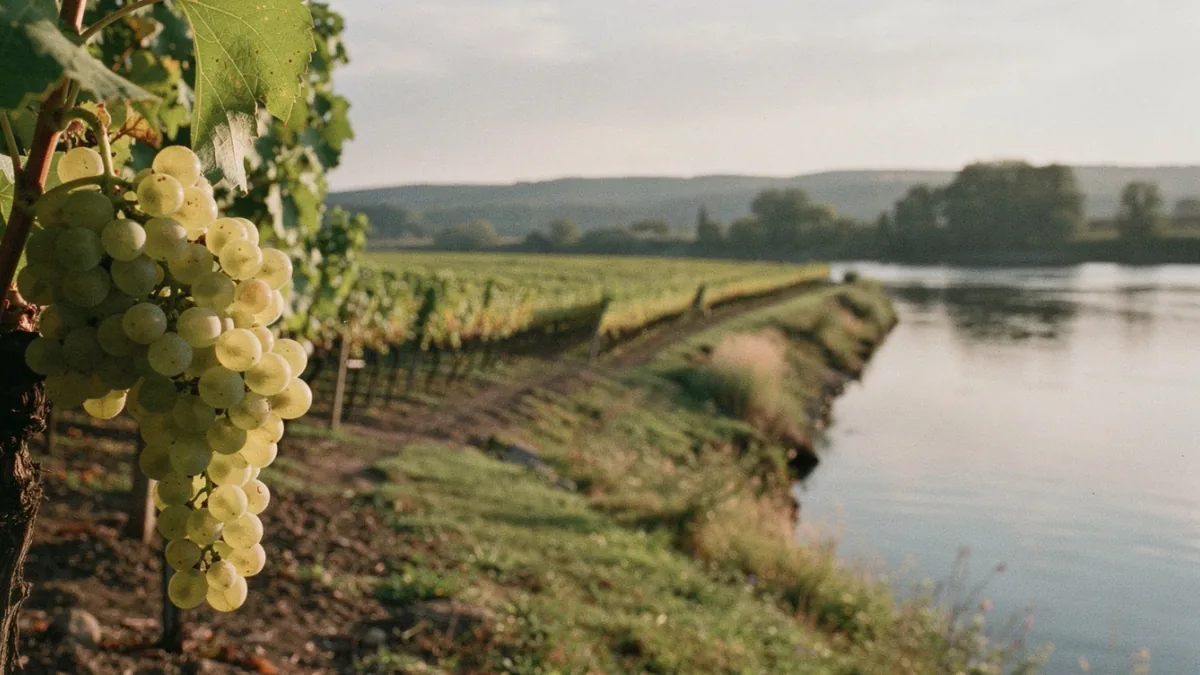
Little aroma isn't little character
Gutedel doesn't stand out with loud fruit. If you're looking for the punch of a Sauvignon Blanc, you're at the wrong address here. The variety is also at home in French-speaking Switzerland.
The word mild gives you a direction, but not a guarantee for every bottle. Producer, vintage, and aging all play a role. Ask about the specific style, especially when it comes to acidity.
Mild means in practice: not much happens when you smell it. The impression only forms in the mouth. That requires a bit more attention than a wine that jumps out of the glass at you. Take the first sip calmly. Wait a few seconds and pay attention to what lingers. Served very cold, such a wine becomes even quieter. So let it warm up a little in the glass.
The two names cause confusion on the shelf. A bottle from Markgräflerland says Gutedel. In French-speaking Switzerland, you'll encounter the same variety as Chasselas. If you can't find one in the store, ask for the other. These aren't two related varieties with their own styles. It's one name in two languages.
Trying out a quiet companion
A light Gutedel pairs well with a delicately spiced dish or a simple snack. With very rich sauces, it's better to try a sip beforehand.
The restraint suits beginners especially well. You don't need to immediately identify five fruits in the glass to observe something meaningful. Pay attention to three things. Does the wine feel fresh enough? Is it pleasantly light? And do you prefer it with food rather than on its own? If you like a bottle, remember the name of the producer. Chasselas alone is too vague for your next search.
Because this wine doesn't push itself forward, it holds its own well next to spicy dishes. That's also its weakness. Behind a very rich sauce, it nearly disappears. Test this on a small scale before serving it to a whole group. One sip of wine, one bite, then another sip of wine. If the second sip feels empty, the pairing doesn't work.
The note about the producer is more than bookkeeping. With this variety, the range of styles is wide, and vintage as well as aging play a role. The producer's name is your only trail back to a similar wine. A photo of the label is completely sufficient for this. Add three words about why you liked the bottle.
How to find a Gutedel you'll enjoy
The following four steps build on each other: each answer makes the next question easier.
The order isn't a coincidence. If you clarify the style first, the conversation at the counter becomes short and useful. If you start with the price, you'll get a bottle, but not necessarily the right one. Take the four lines as a memory aid. It's not a test.
| Step | Specific question or action |
|---|---|
| In conversation | Light and understated, or a more robust expression? |
| On the label | Chasselas is another name for the same variety. |
| While tasting | Do I like a restrained aroma? |
| Your comparison | Judge not just aroma intensity, but the overall impression. |
Mild isn't the same as thin
Mild is often confused with sweet. What's meant, first of all, is a wine without rough edges. It doesn't hit you with acidity or loud aromas. How much residual sugar is actually in the bottle is a different question. The producer or the shop staff can answer that. If you want low acidity, it's best to say so directly.
The second misconception: little aroma is a shortcoming. A quiet wine isn't a bad wine. It's just built differently. Some varieties present their calling card through the nose; this one tends not to. If you're used to a very aromatic profile, deliberately lower your expectations before you raise the glass.
How to compare two bottles
You learn the most from two bottles side by side. Take two producers, ideally a Gutedel from Markgräflerland and a Chasselas from Switzerland. Same glasses, same temperature, both opened at the same time. Just switching between the glasses shows you differences. With a single bottle, they would have escaped you.
Try the two first without food, then with a light snack. Sometimes the ranking flips. A wine that seems too quiet on its own sits just right next to bread and cold cuts. Note which bottle won in which situation. That information is more useful than any general style description.