Jory & Willakenzie
Soils
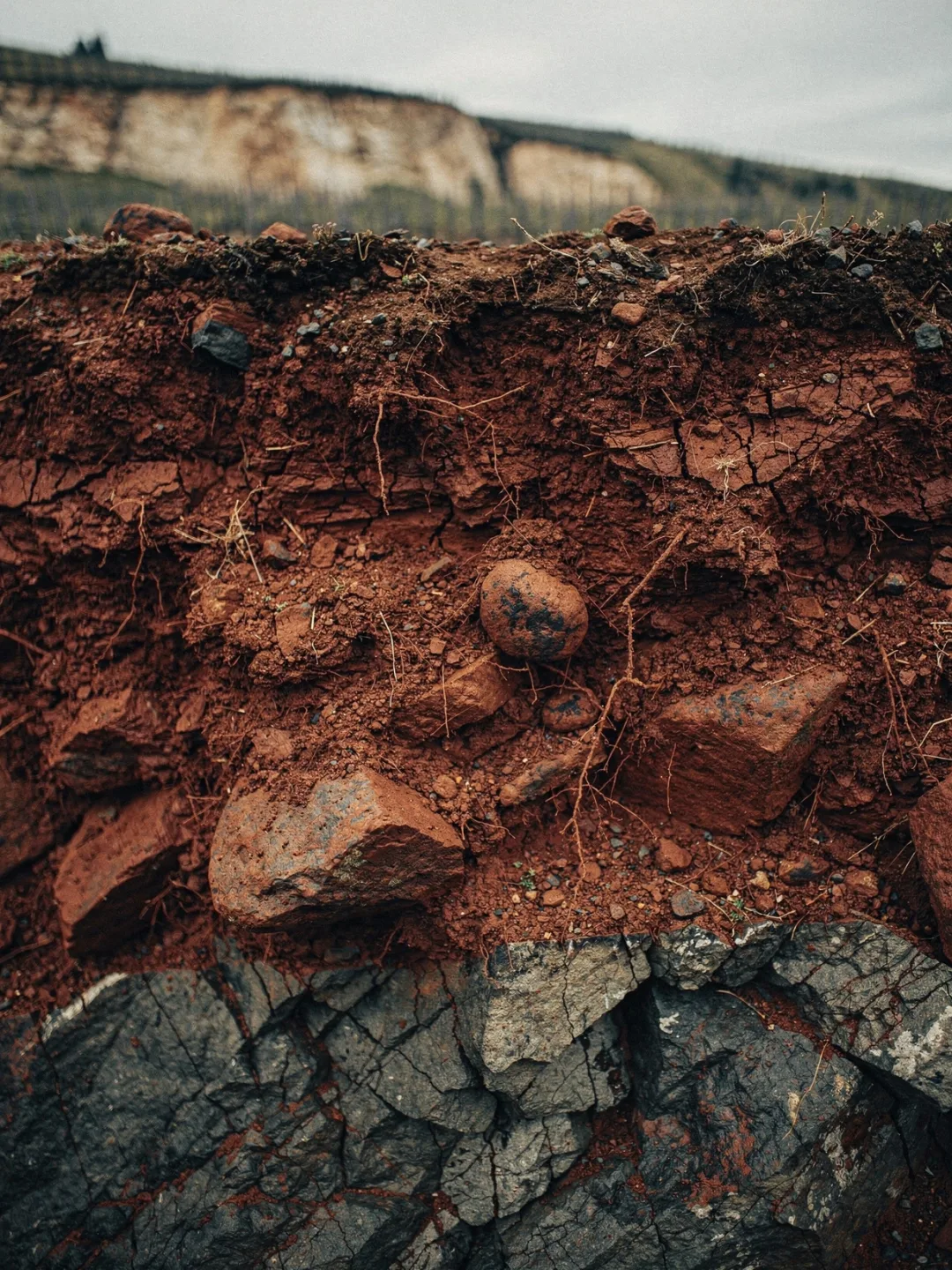
Dig a hole in the Dundee Hills. After just a few shovelfuls you'll hit a color that looks more like brick than ordinary farmland soil, and that's exactly what Jory is – officially Oregon's state soil since 2011, named after a hill in the neighboring town. It covers more than 300,000 acres, over 120,000 hectares, on both sides of the Willamette Valley. That's a lot.
Its story begins with lava rather than the sea. Around fifteen million years ago, enormous basalt flows rolled from what is now Idaho all the way to the Portland area, and what remained weathered over millions of years into deep red, iron-rich clay. That very iron, along with some magnesium, gives Jory its striking color.
For the vine, Jory is an obstacle course. Nothing comes easy here. The clay holds water well but still prevents waterlogging, because the layers beneath consist of shattered, ancient basalt rock, and roots keep finding new cracks within it. Wines from Jory soils therefore often taste of red fruit – cherry, plum, red currant – with an earthy, almost spicy depth underneath.
Just a few kilometers to the west, the lava ends and the sea begins. The change is abrupt. In the hills of Yamhill-Carlton and Ribbon Ridge lies Willakenzie, a fine-grained sandstone and siltstone that was seafloor around fifty million years ago and was pushed upward by the movement of tectonic plates. It holds less water than Jory. This forces the vines into lower vigor, resulting in thinner, more concentrated berry skins.
Anyone tasting both wines side by side notices the difference without much practice. Jory produces rounder, brighter, cherry-forward Pinot Noirs; Willakenzie yields darker, tighter ones with a hint of salinity that some winemakers attribute to the rock's marine origins. Both soils often lie just one hill apart, and that very proximity makes the Willamette Valley one of the most varied stretches of Pinot Noir country in the world.
A thin, dark layer of decomposed leaves and grass. In the Dundee Hills, rarely more than a hand's width deep.
The root: This is where the fine roots sit. They take in whatever the Pacific rains happen to bring – and are the first to dry out in summer.