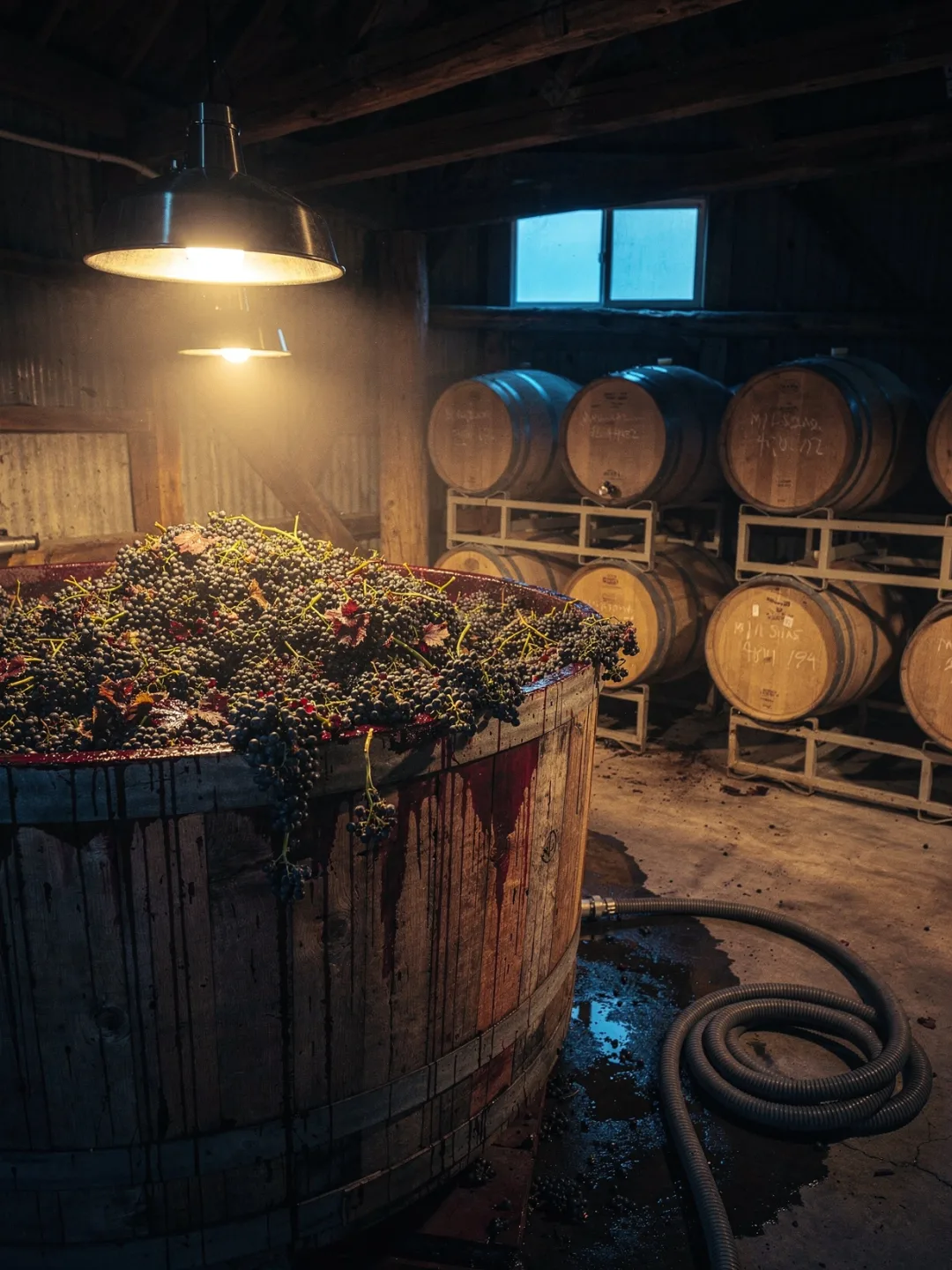
Whole cluster, old barrels
Winemaking
In the cellar, one rule often applies in Oregon: do as little as possible. Many winemakers in the Willamette Valley let the grapes ferment using their own wild yeasts from the skins rather than adding a cultured yeast, because the wild strains supposedly give the wine more of a sense of place. This isn't proven everywhere. Still, the tradition traces back to David Lett and his winery, Eyrie Vineyards, who intervened as little as possible even back in the sixties.
Some grapes go into the fermentation vat still attached to their stems, rather than being fully destemmed first. Winemakers call this whole-cluster fermentation. It sounds more technical than it is. It adds more structure and a spicy note, sometimes reminiscent of black pepper, to the finished wine. Too much stem, however, tastes bitter and green, which is why the exact proportion varies widely from winery to winery and usually remains a closely guarded secret.
For aging, French oak dominates, but new wood is rare. Most barrels have already seen two or three vintages and therefore give off little vanilla or toasted aroma. They let the delicate red fruit of Pinot Noir speak for itself. A new barrel would otherwise overwhelm such a light wine entirely.
Out in the vineyard, Oregon has gone further than almost any other US state. That's a lot for the US. Nearly half of the state's vineyard acreage now carries a sustainability certification, from the Dundee Hills to the Rogue Valley, more than in any other major wine region in the country. Much of this runs through LIVE, a program founded in 1997 by Oregon winemakers themselves, promoting viticulture with as little fertilizer and spray as possible. More than half of all biodynamically certified vineyard land in the entire US – farmed organically, following the lunar calendar, and using its own compost instead of synthetic fertilizer – lies in Oregon alone. The state otherwise accounts for only a small share of American vineyard acreage.