Mostly Without Smoke
Malt & Peat
Smoke is the exception in England, not the rule. Unlike on Islay, hardly any English distillery has its own peat bog on the doorstep, so typical English malt tends to be unpeated: grain sweetness and cask notes take center stage, not smoke.
Still, the rules don't ban peat outright. The regulations for English whisky expressly allow malt dried over an open fire, which gives it a smoky taste, just as with the Scottish model. So far, though, few distilleries have gone this route, since English drinkers tend to prefer fruitier, milder styles. Most English maltings now dry their malt in modern, indirectly fired kilns that run on gas instead of open flame. That keeps the smoke content at zero and leaves the malt pale and mild.
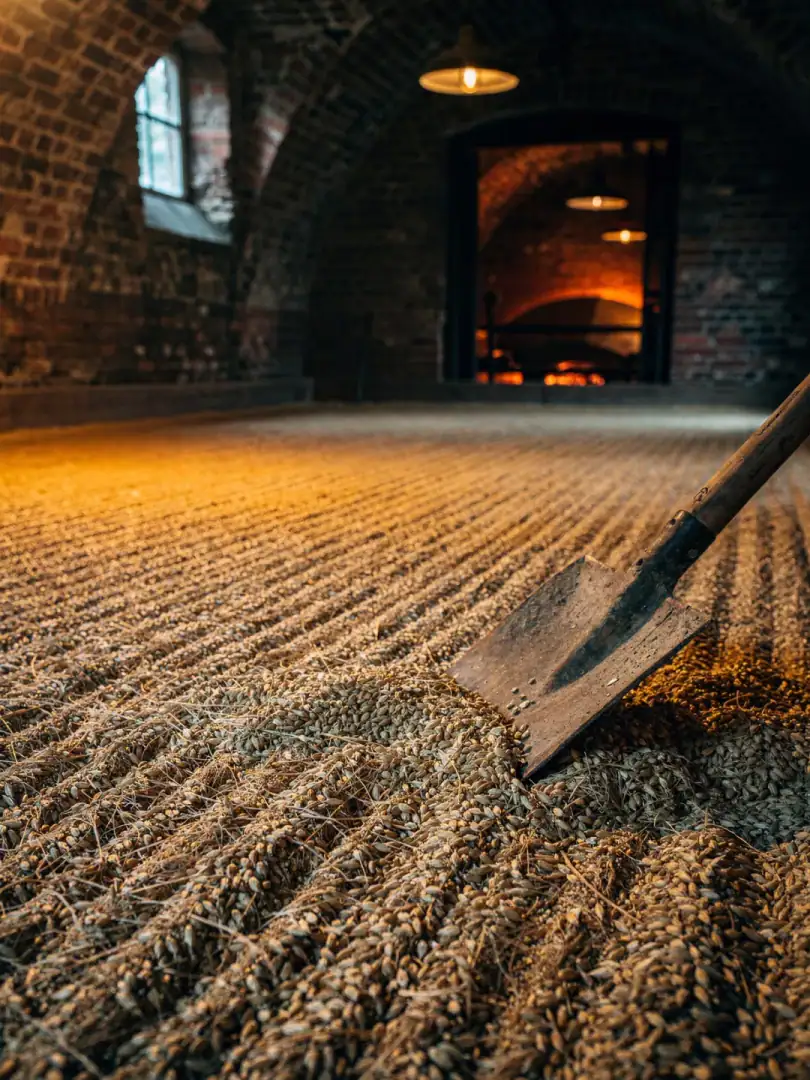
The grain is usually malted off-site, at specialized maltings. For Maris Otter from Norfolk, that's only partly true: some of the harvest is still floor-malted the traditional way, turned by hand before the kiln halts germination. It's more labor-intensive than modern drum malting, but it gives the malt a round, slightly biscuity note that brewers and distillers alike value.
Beneath the barley fields of Norfolk, there's no peat bog at all, just flat, sandy soil over chalk. The topsoil is thin and light, followed by sand and gravel, and finally the chalk layer from which the distilleries draw their water. Together, these three layers explain why Norfolk's barley grows dry and mineral, without the peaty note familiar from Scotland.
Thin, sandy upper layer where Maris Otter barley takes root.
The root: Sparse, well-drained soil forces the plant to root deep and produce small, dense grains.