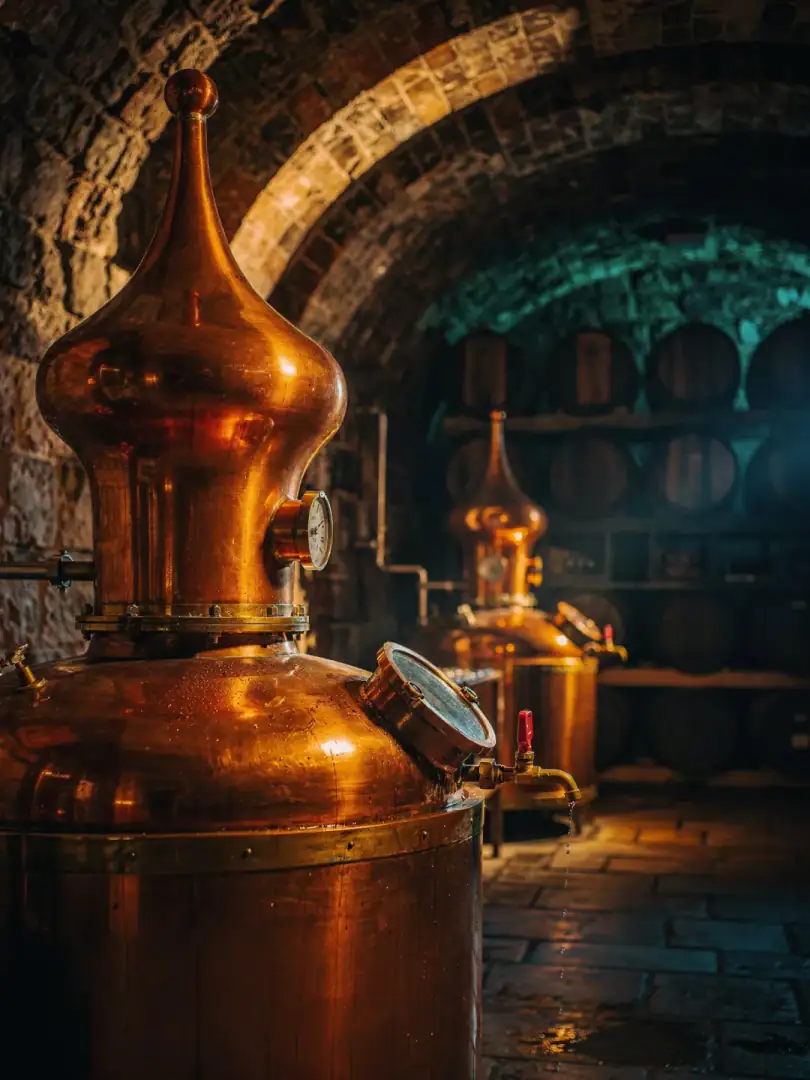
A Still from Lake Constance
Distillation
In Appenzell, a copper Holstein still has stood since 1979, built by a coppersmith from Lake Constance. For nearly forty years, the Locher brewery distilled its entire whisky output in it, until growing demand in 2015 outstripped the capacity of the single still.
Since then, additional Holstein stills stand in an adjoining vaulted cellar, shoulder to shoulder with the old one. All work on the same principle: the mash is distilled twice, once coarsely to produce the low wines, and once finely for the actual whisky distillate. The master distiller separates heads, heart, and tails by hand, and only the heart ultimately goes into the cask.
Other Swiss distilleries rely on smaller setups: Langatun in Aarwangen, for instance, uses copper pot stills, as commonly found in farm distilleries and former breweries. The switch from brew kettle to whisky still came easily to many, since the basic technique stays the same: heat the mash, vaporize the alcohol, cool and collect the vapor. Only the starting product changes.
Column stills, as used by large whiskey producers in North America, are almost entirely absent in Switzerland, since operations stay small and batches remain modest. Double distillation in pot stills suits the artisanal approach with which nearly every Swiss distillery once began.
Some small distilleries deliberately keep their equipment compact, often housed in former stables or vaulted cellars. This keeps investment manageable and matches the size of most batches in the country. Even so, the number of stills in the country keeps growing year after year.