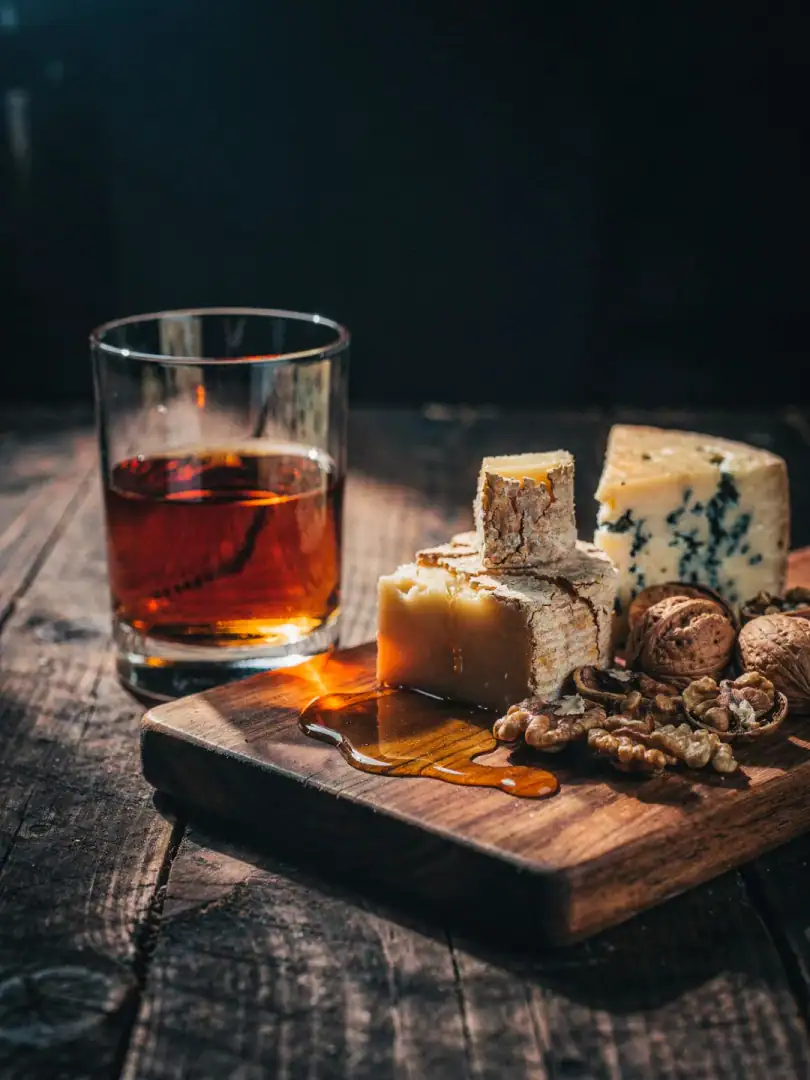
Cheese and Whisky
Which Whisky Pairs with Cheese?
Cheese and whisky are connected by a simple principle: both mature over years, gaining depth, spice, and sometimes sharpness along the way. Anyone who matches age with age and intensity with intensity can find a whisky for almost any cheese that carries it rather than overwhelming it.
Why Maturation Is the Shared Language
A young Gouda and a young whisky share the same restraint: mild aromas, few rough edges, easily accessible to any palate. As both age, they change in similar ways, since enzymes, bacteria, and cask wood slowly act on the base product over years, constantly generating new aromatic compounds.
A two-year-aged mountain cheese brings crystalline structure, spice, and nutty notes, quite similar to an old single malt with long cask maturation. This parallel aging makes age-to-age matching one of the most reliable rules of thumb when pairing: young cheese with young whisky, aged cheese with aged whisky.
A glance at the label often helps. If it states a long maturation period, an older whisky usually suits it better too. If it's a young product, a lighter bottling is often enough. This simple mnemonic works surprisingly reliably. It doesn't replace tasting, but it saves a lot of time when shopping.
Hard Cheese: Crystalline Structure Meets Cask Strength
Very aged hard cheese, such as a long-matured mountain cheese or a bold Cheddar, develops an almost salty, crystalline structure with noticeable protein crystals under the tooth. This intensity calls for an equally bold whisky, ideally with high alcohol strength, so the cheese doesn't simply steamroll the glass.
Cask-strength bottlings — that is, whisky not diluted down to the usual forty percent — are especially well suited here, since they bring enough substance to remain noticeable alongside so much cheese. A few drops of water in the glass help open up the aromas further without losing the necessary power.
Small salt crystals in the cheese also deserve attention. They only form after a very long maturation period within the wheel. It's precisely these crystals that deliver the boldest bite in the whole cheese. An equally bold whisky alongside holds up well against this bite. A whisky that's too mild, by contrast, would quickly get lost.
Blue Cheese: Taming the Special Case with Sweetness
Blue cheese like Roquefort or Stilton carries a sharp, salty, sometimes almost biting pungency that overwhelms most dry whiskies. Here, contrast helps rather than complement: a sweet sherry-cask or port-cask whisky balances out the sharpness of the cheese, much like sweet port classically does alongside blue cheese.
This combination of sharp pungency and balancing sweetness is considered among connoisseurs to be one of the most intense pairings of all, since both sides are so opposed that neither simply drowns out the other. Anyone who enjoys blue cheese should try this pairing at least once before forming a final judgment.
Anyone trying this pairing for the first time should start small. A tiny piece of cheese is entirely enough for a first impression. A small sip of the sweet whisky follows after. This way, the interplay can be observed calmly, without overwhelming the palate right away.
Soft Cheese: Why Less Is Often More
Soft, mild cheese like a young Brie or Camembert brings creamy texture and little inherent sharpness, which is why an overly bold, heavily smoky whisky quickly overpowers it. Here, a lighter, mild whisky from a used bourbon cask is worthwhile, one that accompanies the creaminess rather than drowning it out.
Serving temperature also plays a role with soft cheese: a whisky that's too cold feels harsh next to creamy cheese, while room temperature brings the aromas of both sides together better. Small details like this often decide the overall enjoyment more than the choice of bottle itself.
The order on the cheese board is also worth a thought. Mild cheese belongs at the beginning, bold cheese at the end. This way, the palate stays receptive longer for the subtle nuances. Anyone starting the other way around barely tastes the mild varieties by the end.