Numbers on the label
What does cask strength mean in whisky?
The age statement and cask strength on the label come directly from the cask: the year indicates the youngest cask in the blend, while cask strength means whisky with no water added at all.
What the age statement really means
If a number like "12" or "18" appears on the bottle, under the Scotch Whisky Regulations 2009 it always refers to the youngest cask in the bottling, not an average. So if a bottle contains ninety-five percent eighteen-year-old whisky and five percent twelve-year-old whisky, the label may still only state "12 Years".
This rule applies in much the same way in other countries with similar regulations, such as the Irish Whiskey Technical File 2014 or Japan's JSLMA standard from 2021. The age statement is therefore a guaranteed minimum, not a marketing promise.
When there's no number on the bottle
Bottles without an age statement, often abbreviated as "NAS" for No Age Statement, aren't a sign of poor quality but usually a deliberate choice. This allows distilleries to blend older and younger casks without being bound to the lowest number in the mix, giving them more freedom in shaping the final flavor.
Especially for young distilleries or when cask stocks are limited, NAS is often the only way to offer a well-rounded, complex product at all, without waiting years for enough sufficiently matured casks.
What cask strength means
When a whisky is bottled straight from the cask without dilution with water, it's called "Cask Strength". While standard bottlings are usually reduced to forty to forty-six percent alcohol, cask strength typically ranges between fifty-five and sixty-five percent, depending on the cask and age.
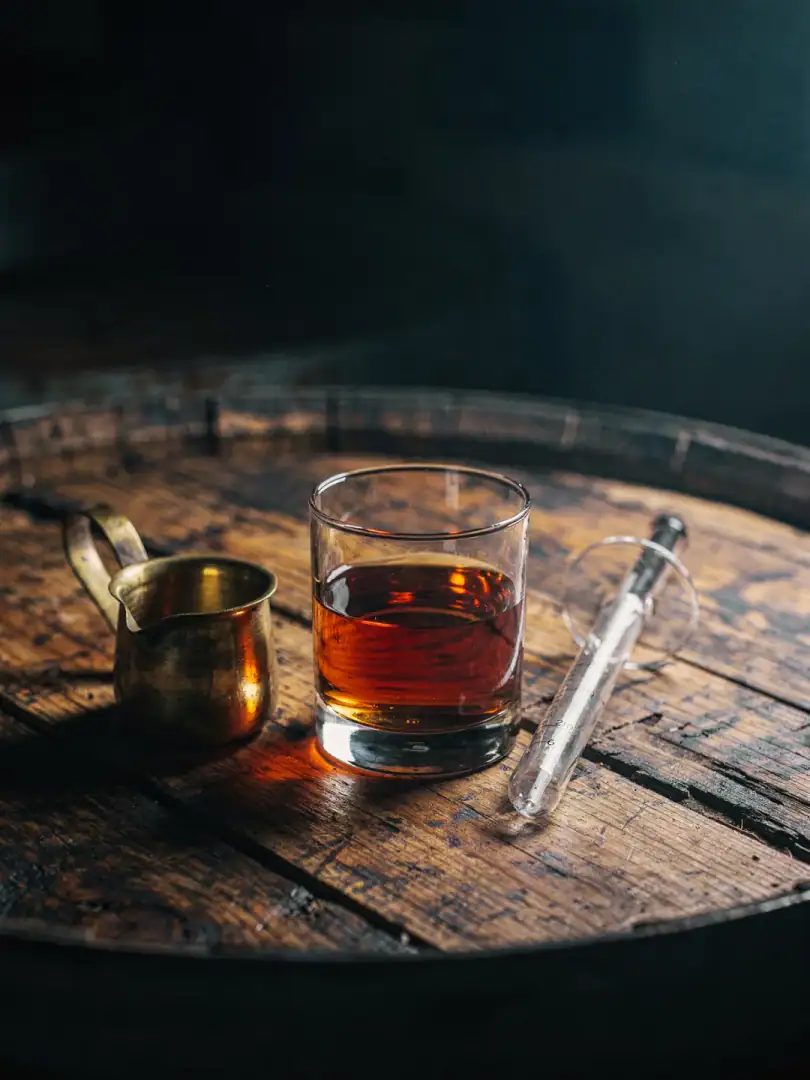
Because no water is added, cask strength whisky often tastes more intense and concentrated, but it can also come across as sharper and more alcohol-forward. Many connoisseurs therefore dilute such a whisky themselves in the glass, drop by drop, to find the strength that suits them.
Why both figures lead back to the cask
Both the age statement and cask strength ultimately tell the same story as the rest of this journey: how long the whisky rested in which wood at what temperature, and how much of that remains in the end. Every number on the label is a direct result of the earlier stops, from the type of wood to the warehouse.
Once you understand cask maturation, you read a label differently. The year, the alcohol content, and terms like Sherry Cask or Bourbon Barrel are no longer just marketing words, but the last visible clue to years of slow work shaped by wood, time, and climate.
Chill filtration and natural colour: two terms from the label
Many cask strength bottlings carry two further terms: "Non-Chill Filtered" and "Natural Colour". Both are closely tied to the cask and its maturation. Standard whiskies are usually chilled and filtered heavily before bottling. In this process, a fine filter removes fatty acids that could cause cloudiness in cold conditions.
These fatty acids come directly from the cask wood and actually contribute to the flavor. During chill filtration, they're lost along with the cloudiness. Cask strength bottlings therefore usually skip this filtering step deliberately. This keeps the whisky fuller in flavor, though it may turn slightly cloudy when chilled.
The second term, natural colour, concerns the whisky's hue in the glass. Many standard bottlings receive a touch of caramel colouring to even out the colour across different casks and batches. This barely affects the flavor but gives a more consistent look from bottle to bottle. Cask strength bottlings usually skip this too, showing the colour exactly as the cask left it.
These three terms, cask strength, natural colour, and unfiltered, often appear together on labels. Together, they promise a bottling that's as unaltered as possible, straight from the cask into the glass. For some drinkers, that's precisely the appeal of such bottles. Others prefer the milder, more consistent standard bottling at forty to forty-six percent.
None of these terms are strictly regulated by law, unlike the age statement or minimum maturation period. They rest on the voluntary practice of many, though not all, distilleries. Still, reading a label carefully quickly reveals how close a bottling stays to the original cask contents. And with that, this whole journey comes full circle: at the end, it's always the same cask where everything began.