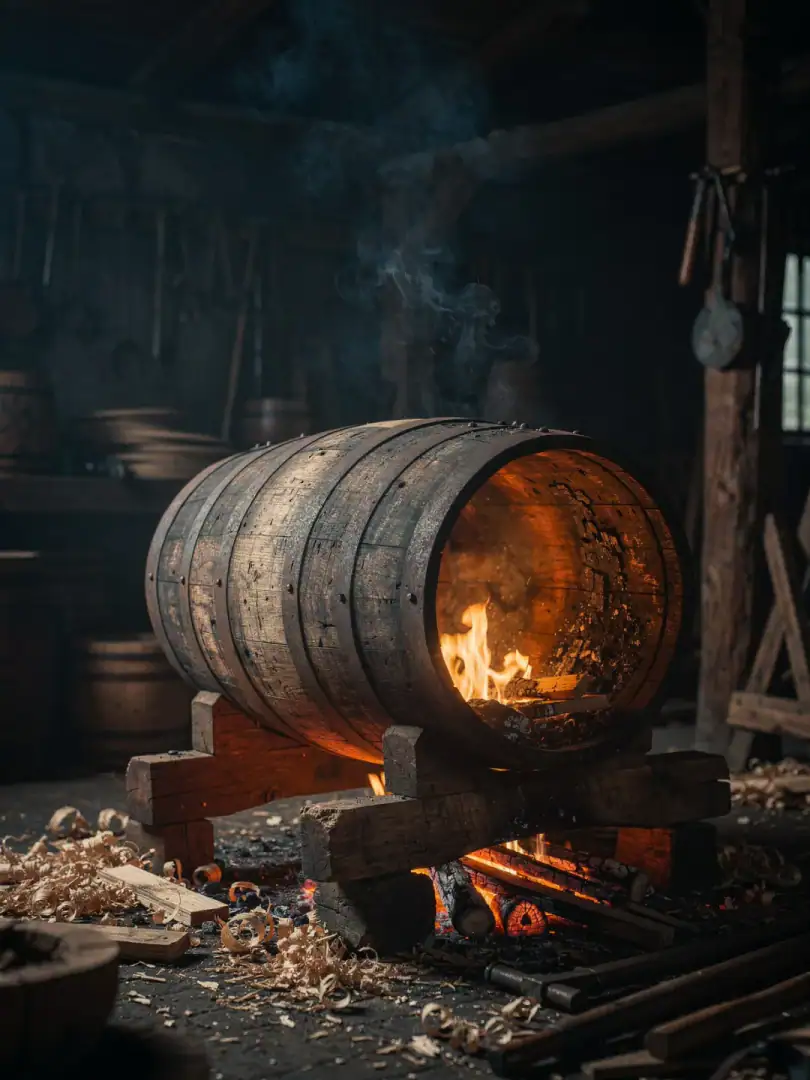
Fire Shapes Wood
What's the difference between toasting and charring?
Before a cask ever sees whisky, its interior is heated. Toasting roasts slowly, charring burns openly with fire. This difference determines how much vanilla, caramel and roasted aroma later migrates from the wood into the whisky.
Toasting: the slow roast
Before an empty cask is allowed to see whisky, its interior is deliberately heated. In toasting, this happens slowly, over an open flame or with heating rods, usually for fifteen to forty-five minutes depending on the desired result. Cooperages control temperature and time precisely to caramelise the sugars in the wood.
This breaks down cellulose and lignin in the wood, releasing more vanillin, caramel and spice notes. Toasting is mainly used for wine and sherry casks; some whisky casks are additionally toasted before later being charred as well.
Charring: the open flame
Charring goes a step further: open flames burn the inner wall for seconds up to a few minutes, until a black layer of char forms. In the US, this is even required by law, 27 CFR Part 5 mandates new, internally charred oak casks for bourbon.
Cooperages distinguish char levels one through four, from a light scorch to a thick, cracked layer known, due to its texture, as "Alligator Char". The higher the level, the thicker the char and the more roasted aromas, such as smoke, roasted coffee and dark caramel notes, later appear in the whisky.
The char layer as filter
Beneath the black char layer lies a red layer of caramelised sugar, responsible for many of the sweet vanilla and honey notes in the finished whisky. The char itself acts like an activated charcoal filter, binding sulphurous, unpleasant compounds from the young spirit.
That's why the same new make spirit often tastes rounder and sweeter in a heavily charred cask than in one that's only been toasted, even though both come from the same oak. This heat treatment shapes a large part of the later character, long before the first drop of whisky even flows in.
Rejuvenation: a second chance for the cask
Old, exhausted casks that barely release any aroma anymore can be saved through rejuvenation: the inner wall is shaved off and then re-charred or re-toasted, so fresh wood comes into contact with the whisky again. This extends a cask's lifespan beyond its first or second fill.
Rejuvenated casks sit between a tired refill cask and a truly new one, they give more aroma than a many-times-used cask, but usually less than a fresh one. For distilleries, this is a cost-effective way to get more impact out of their existing cask stock.
STR casks: a fast alternative to the sherry cask
Alongside rejuvenation, there's a more modern method called STR, short for Shaved, Toasted, Re-charred. Here, the inner wall of a used cask is first shaved thin until fresh wood is exposed. This is followed by controlled toasting, and only afterwards is the surface lightly charred once more. This combination is meant to bring together the best of both heat treatments.
STR casks often originate from wine or sherry casks that are converted for whisky. The method became especially well known among young distilleries that don't own decades-old casks. Without long storage time in the warehouse, STR casks are meant to make a whisky seem mature and rounded quickly anyway. Critics argue that the original character of the new make spirit is lost faster this way than through traditional maturation.
Proponents counter that STR casks are especially useful for distilleries in warm climates. There, maturation runs faster anyway, as a later stop on this journey will show. An actively prepared cask simply keeps pace with that speed better than a tired, many-times-used cask. In the end, STR remains just one of many ways to be creative with a limited cask stock.
Some craft distilleries now rely almost entirely on STR casks, because classic sherry butts are too expensive or too scarce. Others use them deliberately for only part of their cask stock, combined with classic bourbon or sherry maturation. So STR remains one tool among many, not a replacement for the classic methods on this journey. Which choice a distillery makes ultimately depends mainly on available budget and the casks on hand.
Anyone reading STR cask in a bottling's name knows: here, speed took priority over tradition. That doesn't automatically make the whisky worse, just different in how it came to be. For your own tasting, in the end all that matters is how the whisky actually tastes in the glass. The method behind it remains secondary to the enjoyment itself.