Four directions
Smoke aromas
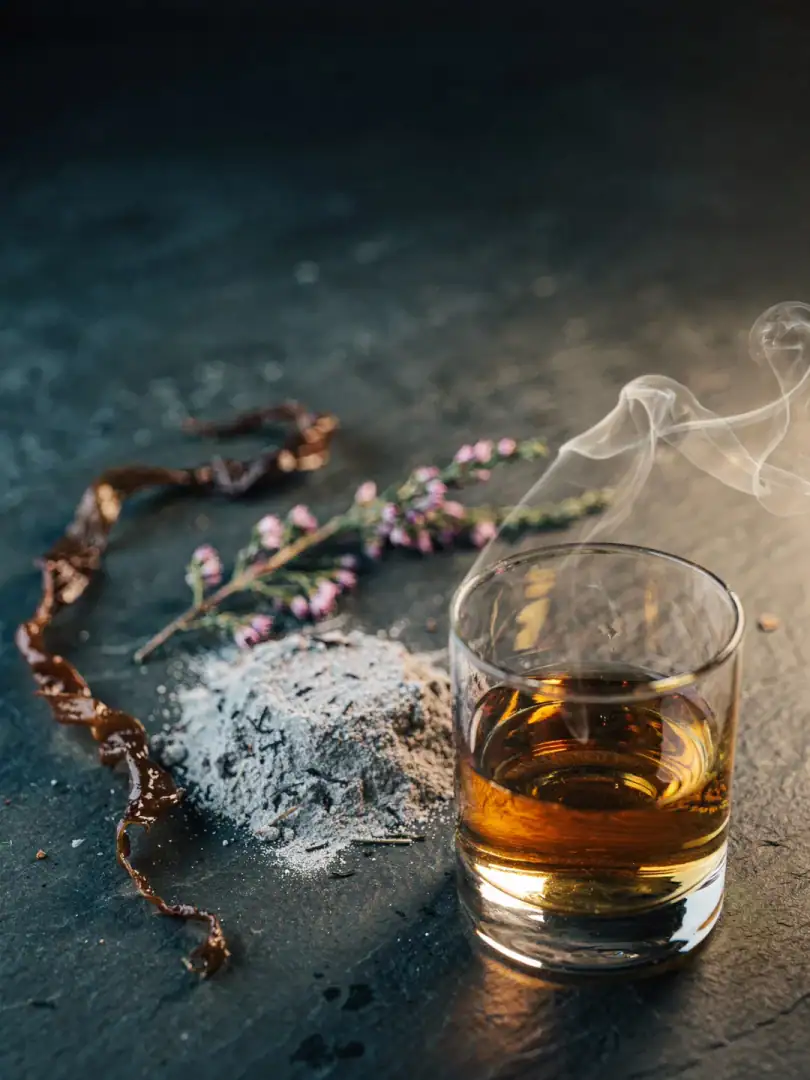
Medicinal sharpness, cold ash, salty seaweed, sweet hearth smoke: smoke in whisky bundles together quite different notes. Which direction dominates depends on the peat, the kiln, and the cask, not on the ppm figure alone.
Medicinal: iodine, bandages, disinfectant
Some smoke aromas strongly recall medicinal settings, iodine tincture, bandages, or disinfectant. This note often comes from phenolic compounds found especially in coastal, seaweed-rich peat. Laphroaig is considered a textbook example of this medicinal tone, some drinkers love it instantly, others need several attempts.
Anyone who enjoys this direction should look specifically for Islay whiskies with a strongly peat-forward profile. Anyone who tends to dislike it will find milder smoky variants elsewhere, without having to give up smoke entirely.
Ash and soot: cold, dry, earthy
A second direction recalls cold hearth ash or a spent campfire, dry and slightly bitter rather than sweet or salty. This note often comes from peat with a high proportion of woody plant remains, as found inland in Scotland. It tends to feel more subdued and suits whiskies that aren't primarily marketed on their smokiness.
In some Highland and Speyside bottlings, this ashy note only appears in the background, as a quiet undertone behind fruit or caramel, rather than taking center stage.
Seaweed and salt: a maritime note
Coastal peat, such as that found on Islay or some Orkney moors, often brings a salty note reminiscent of algae or wet rope. This maritime side is often intensified further when the casks are stored right on the coast and salty air seeps through the wood.
Anyone seeking this note will typically find it in whiskies whose entire production chain, from peat to warehouse, is located on the coast.
Sweet smoke: caramel meets hearth
Not all smoke feels harsh. Some whiskies show a sweet side reminiscent of warm hearth smoke or smoked sugar, often amplified by maturation in sherry or bourbon casks. The sweetness from the wood doesn't mask the sharper smoke notes, but rather settles over them like a second layer.
Many newcomers consider this combination a more accessible way into smoky whisky, because the sweetness cushions the medicinal or ashy sharpness.
Smoke alongside fruit and sweetness
Smoke rarely stands alone in whisky, it always meets other aromas from barley, yeast, and cask. Fruity notes formed during fermentation through esters, such as apple, pear, or citrus, often act as a counterweight alongside robust smoke: they soften the sharpness without masking it, giving the overall impression more depth. Many experienced tasters see this exact interplay of smoky and fruity as a sign of a particularly successful smoky whisky, because both sides remain perceptible side by side, rather than one covering the other.
Spice notes such as pepper or ginger also stand out clearly in some smoky whiskies, for instance in bottlings from the Scottish island of Skye, known for a spicy-maritime rather than purely ashy smoky side. Anyone who pays deliberate attention to these secondary tones while tasting, rather than perceiving smoke as the only characteristic, usually discovers far more variety within the smoky whisky category than the first impression suggests.
Smoke changes in the glass
Smoke doesn't always stay the same in the glass. Right after pouring, it often feels sharpest and almost biting. After a few minutes in the air, softer tones emerge while the initial sharpness recedes. Anyone who drinks too quickly misses this transformation entirely and often judges the whole whisky prematurely.
Temperature also noticeably changes the impression: whisky that's too cold shows barely any aroma, while whisky that's too warm often just feels harsh. Room temperature, without ice, is almost always considered the best starting point for smoky whiskies. From there, water and time allow further fine-tuning.
Some tasters deliberately mix two whiskies in the glass, a smoky one and a mild one, to find their own intermediate step. This seems unusual, but it shows well how flexibly smoke interacts with other aromas. Even small amounts are often enough to make a mild whisky noticeably smokier.