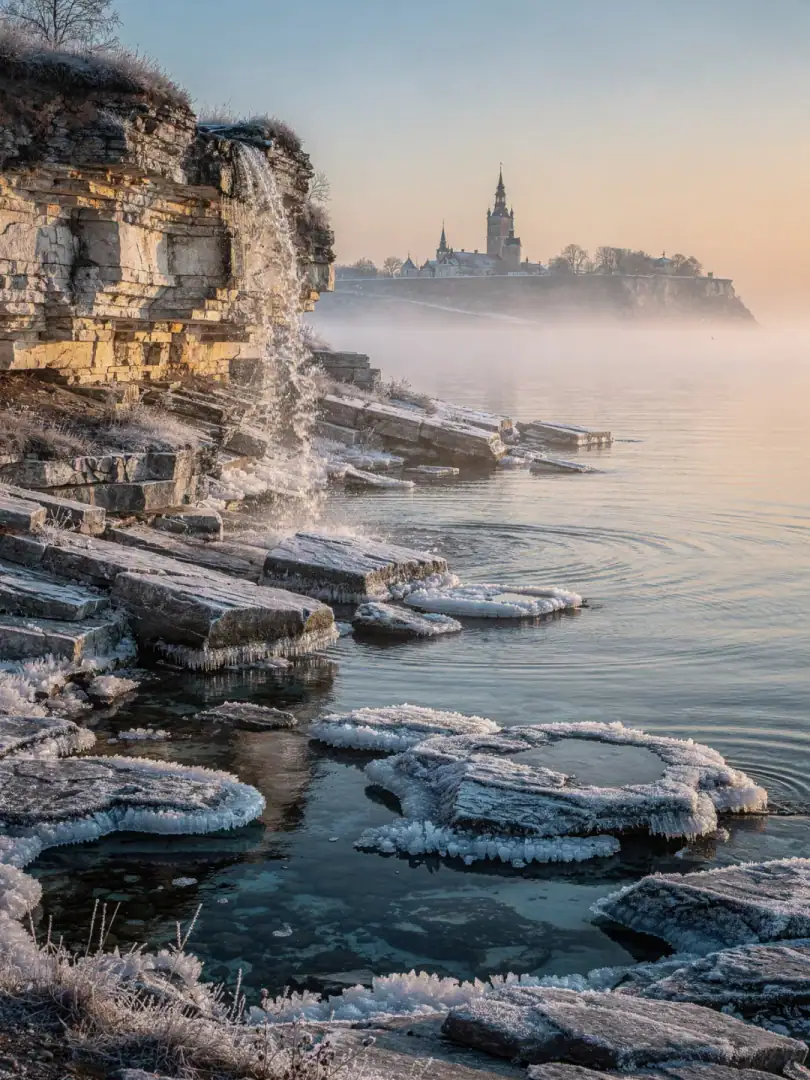
Limestone Filters Water
Water & Climate
North of Tallinn, the landscape drops away sharply. The North Estonian Klint is a roughly 1,200-kilometer limestone escarpment that stretches from Sweden all the way to Russia. Here, just outside the city, it rises several dozen meters above the Baltic Sea, clearly visible from any ship entering the harbor.
Tallinn's Old Town itself sits partly on lower-lying land below the Klint and partly on the limestone plateau of Lasnamäe. Its Ordovician building stone already supplied the material for city walls and churches in the Middle Ages. What was building material for masons is, above all, something else for distilleries: a giant natural filter.
Rainwater seeps through the fissured limestone and loses its cloudiness along the way. It absorbs minerals before reaching deeper aquifers. Estonia covers most of its drinking water needs from exactly this groundwater. Its purity is taken for granted in the country, something people only learn to appreciate once it's contaminated.
At the same time, this same fissured structure makes the karst vulnerable. Pollutants that seep in from above spread quickly and are nearly impossible to remove. Distilleries like Liviko in Tallinn, which depend on this water, have every reason to keep a close eye on the condition of the fields above the groundwater.
The climate to go with it is cool and changeable, with short summers and long, often gray winters near the Baltic Sea. For fermentation, that means consistently cool cellar temperatures. Distilleries further south have to create such temperatures with elaborate technology; in northern Estonia, the climate delivers them almost year-round, free of charge.