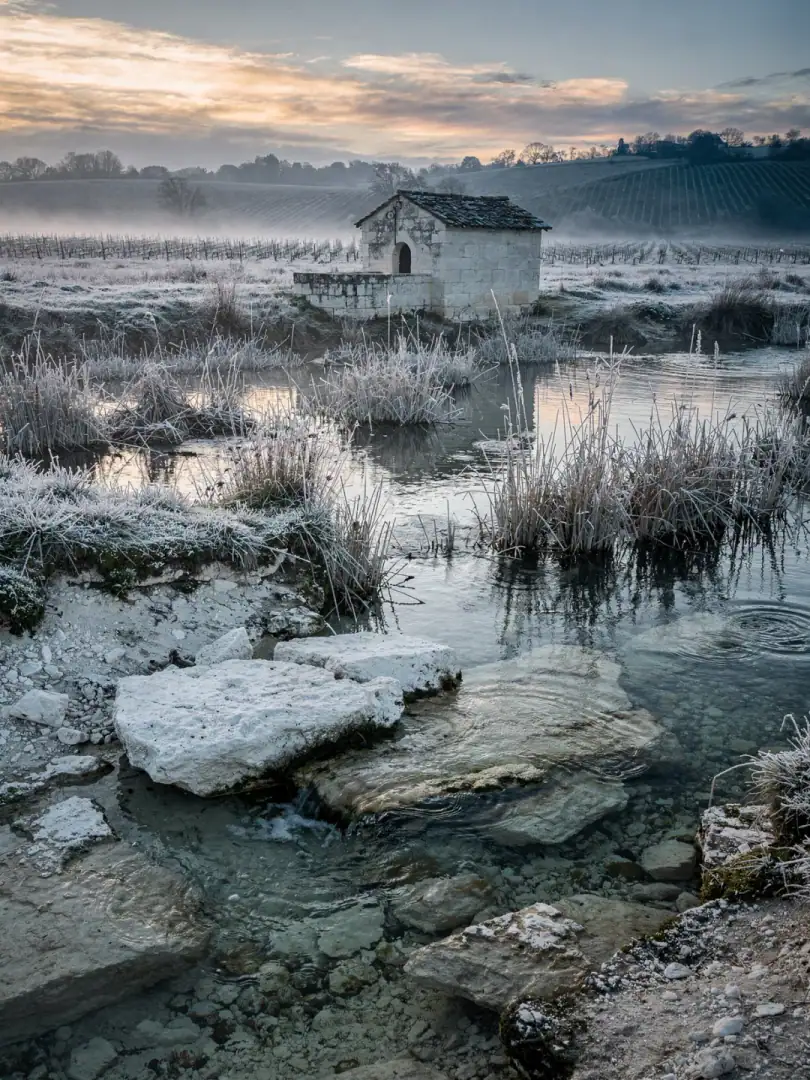
Spring near Cognac
Water & Climate
Between the wheat fields of Picardy and the spring that will later be blended into the vodka lie more than three hundred miles. The water comes from a natural aquifer beneath Gensac-la-Pallue, a small village in the Charente near Cognac, drawn from a depth of roughly a hundred and fifty meters. This depth shields the spring from surface fluctuations.
The Charente is limestone country: the same chalk that gives Cognac's wines their mineral character naturally filters the spring water here. According to the distillery, the water is then additionally passed through double reverse osmosis, which lowers its pH from 7.5 to 5. Whether this actually changes the taste is difficult to verify from the outside; only what the company publishes about it is documented.
Climatically, both regions sit within Western Europe's temperate maritime zone, though with real differences: Picardy is cooler and wetter, ideal for winter wheat that germinates in moist soil over several months. The Charente is milder and sunnier, a climate that has made winemaking for Cognac possible for centuries. The vodka thus links two climate zones that otherwise have little to do with one another.
For the distillery, one thing matters above all: consistent water quality throughout the year. An aquifer beneath a thick layer of limestone barely fluctuates with surface weather, unlike an open river. That makes the spring near Cognac a far more reliable ingredient than rain over Picardy could ever be. A river reacts within a single downpour, while a deep limestone aquifer takes years to respond.