Charcoal & Sand
Filtration
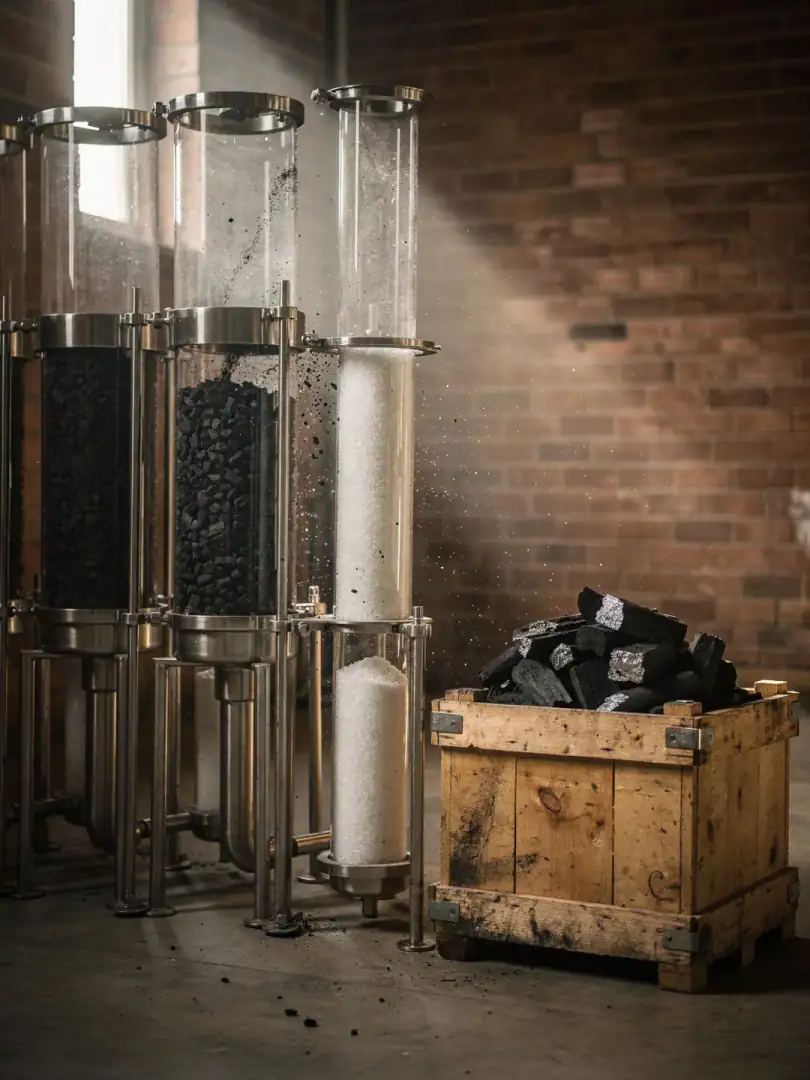
After rectification, the vodka is technically drinkable already, but often still tastes sharp and unrefined. Many distilleries in Poland therefore pass it through columns of activated charcoal, usually made from birch wood, before bottling.
The charcoal binds some of the remaining fusel oils and sulfur compounds to its porous surface. This softens the flavor without altering the alcohol content itself. Some operations additionally run it through quartz sand or fine cellulose filters to remove any last traces of haze.
What filtration cannot do is transform ethanol into something else, or turn a simple raw spirit into a high-quality distillate. Marketing claims about supposedly "seven-times filtered" vodka usually just describe how many times the liquid was pumped through the same layer of charcoal or sand. That alone says nothing about how pure it ends up being.
Cold filtration is still common, though, because certain fatty acids and haze particles settle out more easily at low temperatures. Fine filters can then remove them. This mainly improves the clarity of the bottle and the texture on the tongue, less so the pure alcohol content.
For potato vodka from around Poznań, this means: birch charcoal and sand smooth the rough edges of the raw spirit without completely swallowing the potato's earthy base note. Even Luksusowa, whose tubers come from Wielkopolska, includes this step as a fixed part of the process. It's precisely this balance between smoothness and recognizable character that separates a good bottling from a mediocre one.