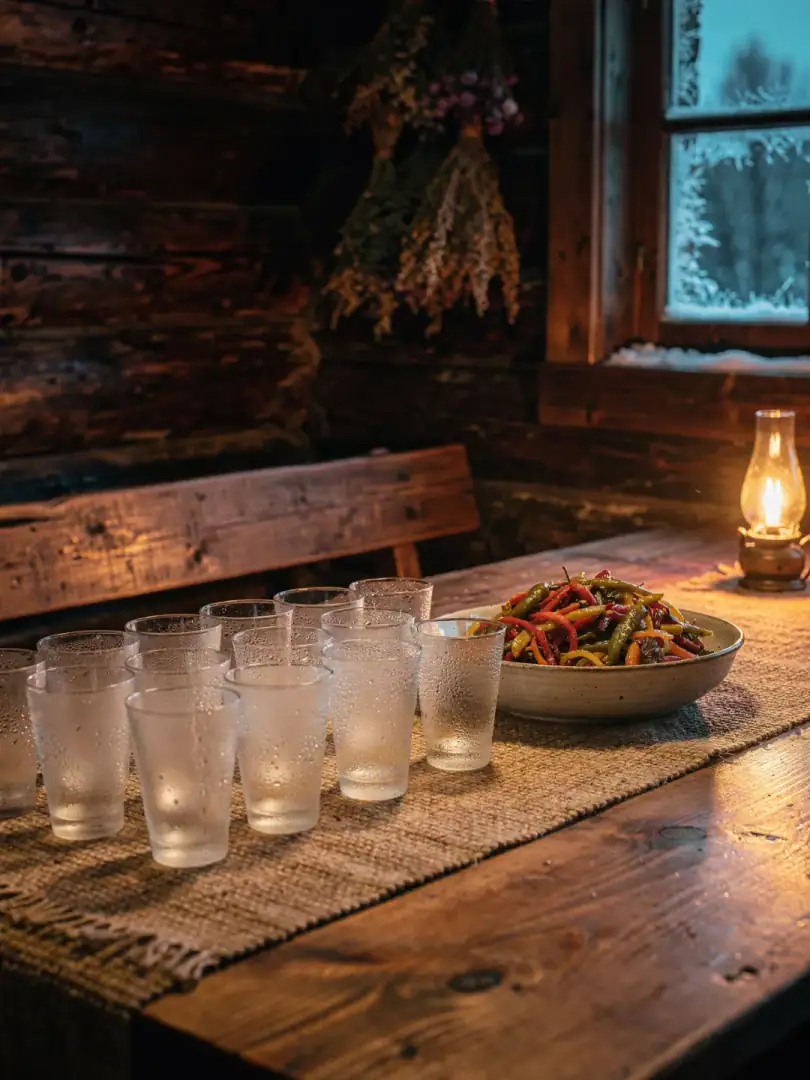
Borderland in a Glass
Drinking Culture
At a Podlachian table, Polish hospitality meets Belarusian, Lithuanian, and Tatar customs. Vodka is drunk ice-cold and neat everywhere, never on ice, which would only dilute it. A short toast usually precedes the first sip, often simply na zdrowie. Sometimes it grows longer, if the host cares to make it so.
Among the Tatars of Kruszyniany and Bohoniki, vodka belongs to secular celebrations. Their ancestors settled in this area starting in the seventeenth century. The mosque, one of the oldest in Poland, remains separate from this custom. Shared celebrations, where neighbors of different faiths sit together, are still common in this borderland region today.
Drinking happens in small rounds and from small glasses. Large quantities all at once are rare; instead, the evening stretches over many hours. Anyone who drinks too fast, or leaves a glass untouched, is quickly noticed. In Podlachia, the rules of the round apply equally to everyone.
Festivities like the annual gatherings along the Tatar Trail between Kruszyniany and Bohoniki show this closeness especially clearly. There, food, vodka, and neighborliness are tightly woven together. No one drinks alone; the glass passes from hand to hand. Anyone who declines needs a good reason.
This restraint carries over to the food as well: a glass accompanies the evening, it isn't meant to dominate it. Children and elders naturally sit at the table too, even if they don't drink themselves. This way, vodka remains part of the gathering throughout the evening, not its sole purpose.