Charcoal Instead of Gold
Filtration
Charcoal has no smell of its own, yet it changes everything that flows through it. Rectified alcohol is already very pure, but it still carries traces of fusel oils and other flavor compounds that can leave a sharp or bitter aftertaste. Activated charcoal, often made from birch wood, binds such compounds to its porous surface, letting mainly alcohol and water pass through.
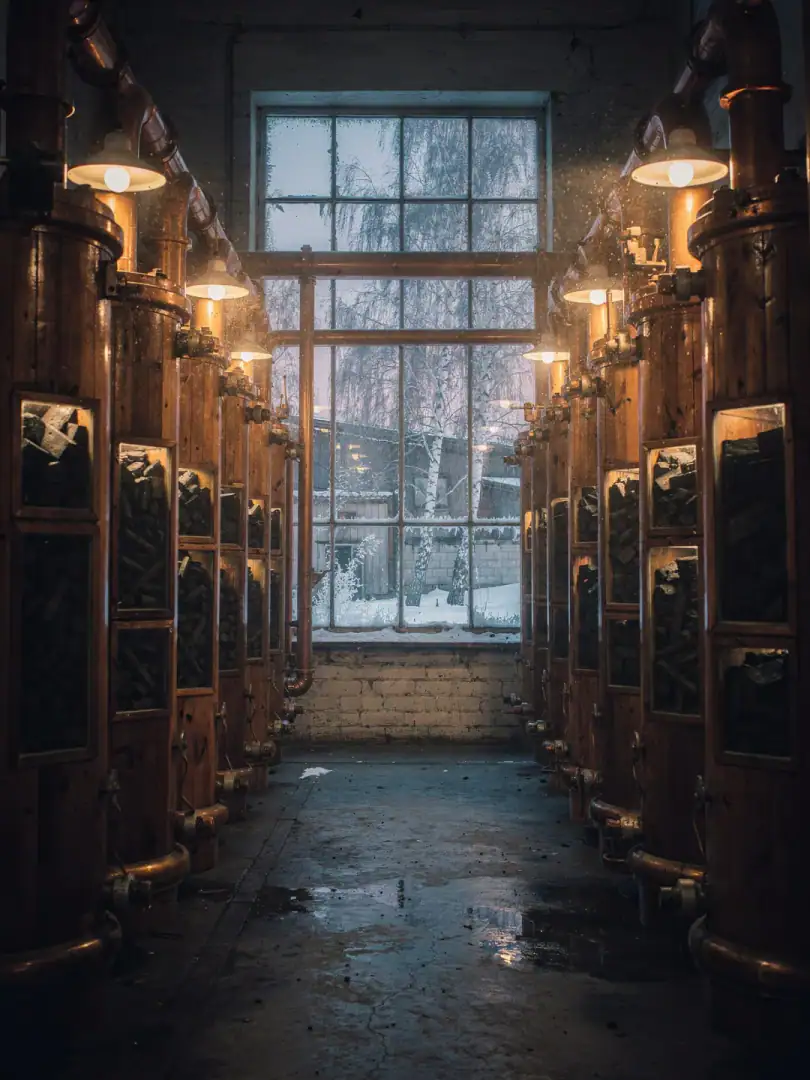
Both of the city's distilleries rely on exactly this principle in their standard production. Several columns of charcoal let the diluted alcohol seep through slowly before it settles in tanks and is then finely filtered. This removes cloudiness and suspended particles, along with some of the sharper aromas still present in the raw distillate.
For its premium line, Tsarskaya Gold, Ladoga describes an additional step. Filters strung with gold-coated thread are said to infuse the vodka with ions of 24-karat gold. This is a claim made by the producer, not an independently verified property. It has nothing to do with the actual purpose of filtration, which is to bind fusel oils.
What filtration demonstrably achieves is more modest, yet still important: clarity, a clean first sip, and a distillate free of sediment or cloudiness. This is tested according to the Russian standard GOST R 51355 for vodka and specialty vodka. The standard governs both chemical values and sensory evaluation by trained tasters.
In the end, the balance sheet is sober. Charcoal removes what disrupts the flavor; gold, at most, changes the story printed on the label. Anyone who wants to taste the difference between the two should pay less attention to marketing claims. What matters more is what actually ends up in the glass after twelve or more filtration stages.