Canals Instead of Fields
Raw Material
You'll search in vain for rye fields around St. Petersburg. The city sits on swamp and Neva floodplain, the climate is short and cool, the soil acidic and thin. For a capital that Peter the Great built from nothing in the middle of a war, grain had to come from far away, or neither the people nor the distilleries would have had anything to mill.
The solution was canals. As early as 1709, the Vyshny Volochyok system linked the Volga to the Neva, bringing barges of grain and timber from the fertile regions to the south right up to the city gates. In the 19th century came the Mariinsky Canal System, opened in 1810, and the Tikhvin Canal of 1811, two further waterways between the Volga and the Baltic. The rye for the capital traveled, rather than growing on the spot.
Today the city's distilleries source their grain differently, but still from elsewhere. Russian Standard states that it uses winter wheat as its base, milled and fermented before it meets the water from Lake Ladoga. This, too, continues the same logic: the grain arrives, the water stays local.
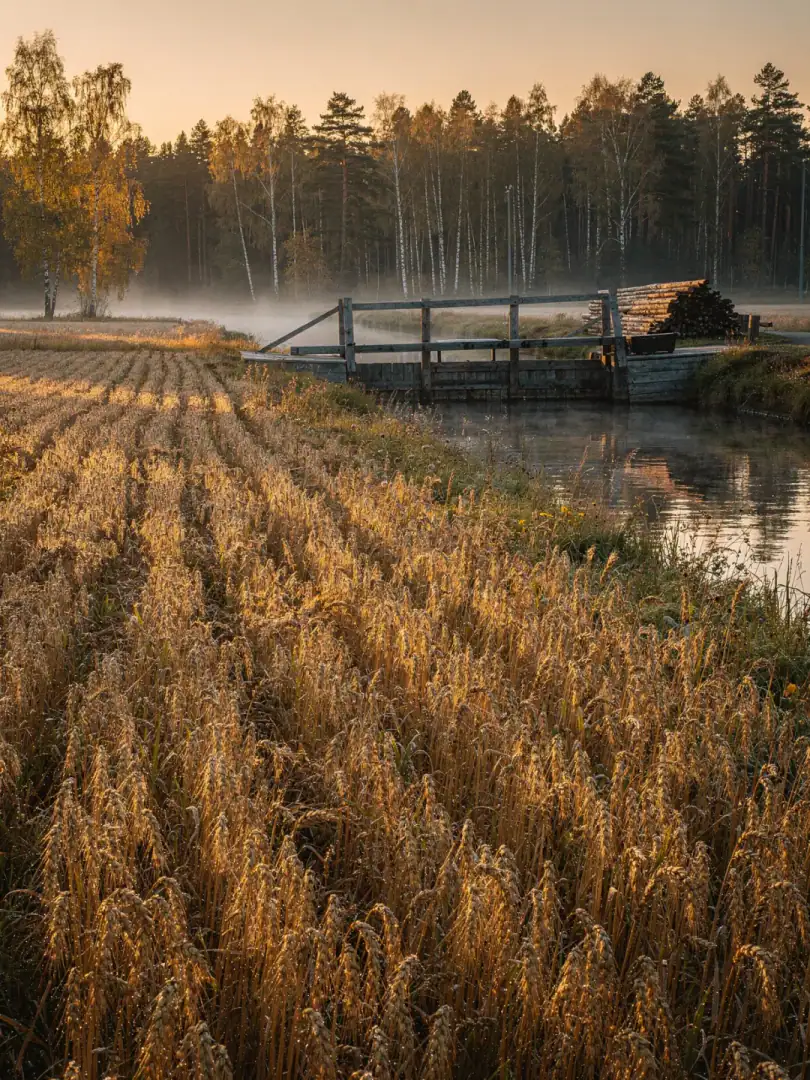
Among the few fields that still exist around the city, barely a hand's breadth of usable soil remains. Directly beneath the thin, acidic humus layer of the coniferous forests lies a sandy, gravelly moraine, deposited by the glacier that retreated around twelve thousand years ago. Roots find little grip in it, and water runs through almost unimpeded.
Beneath that lies dense glacial till, which traps water rather than draining it, precisely the quality that turned the region into swamp and bog for centuries. Only far below does the famous blue Cambrian clay begin, the very ground on which the whole city is literally founded. This soil was never made for rye or wheat, but it was ideal for a capital on the water.
A thin, acidic coniferous-forest humus layer, low in nutrients due to the cool, damp climate on the Gulf of Finland.
The root: Rye and wheat find little grip here, and even fewer nutrients.