Lake Ladoga and the Neva
Water & Climate
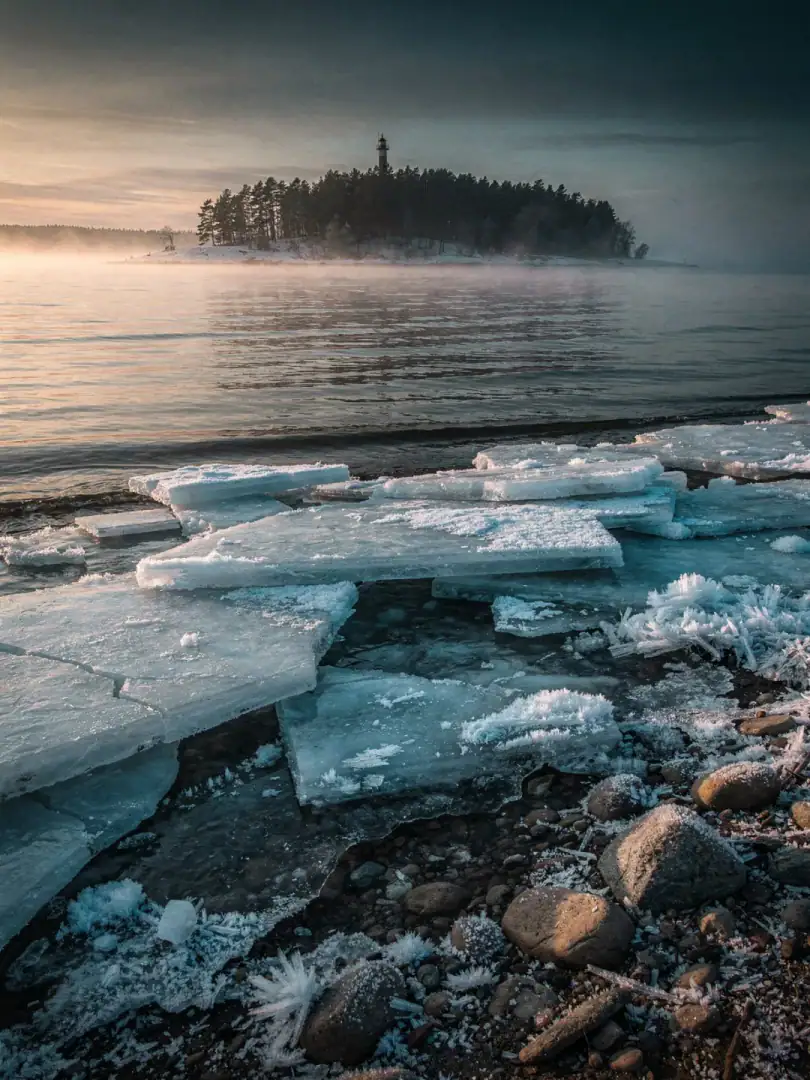
Lake Ladoga is the largest lake situated entirely within Europe, covering an area of around 17,700 square kilometers. It formed after the last ice age from melting glacial ice. Its water is considered soft and low in dissolved minerals, since it drains from granite and sandy soils rather than limestone. For distilleries this is an advantage, as soft water requires less treatment before it meets high-proof alcohol.
Only a single river flows out of the lake, the Neva, just 74 kilometers long. Even so, it carries more water than any other short river in Europe. The reason: behind it stands the entire surface area of Lake Ladoga as a reservoir. It crosses the city in several branches before flowing into the Gulf of Finland.
This volume of water has always made the city prone to flooding. The flood of 1824 ranks among the most consequential in the city's history and was later immortalized in Russian literature. For a distillery right on the river, this means one thing above all: a reliably large supply of water. It is also reliably cold and available year-round.
The climate sharpens this character further. St. Petersburg lies at nearly 60 degrees north latitude, closer to the Arctic Circle than to Moscow. In summer, around the summer solstice, it stays light all night long, the famous White Nights. In winter, by contrast, Lake Ladoga lies under ice for months, and the Neva can freeze over in places.
For the city's distilleries, including Russian Standard, this very cold is a selling point. Cold, mineral-poor glacial water from the Ladoga region is considered in the industry to be especially pure, with little inherent flavor of its own that might interfere with the aroma of the grain. Whether it's truly purer than water from elsewhere can only be shown in a lab. Its geographic proximity to the source, however, is beyond dispute.