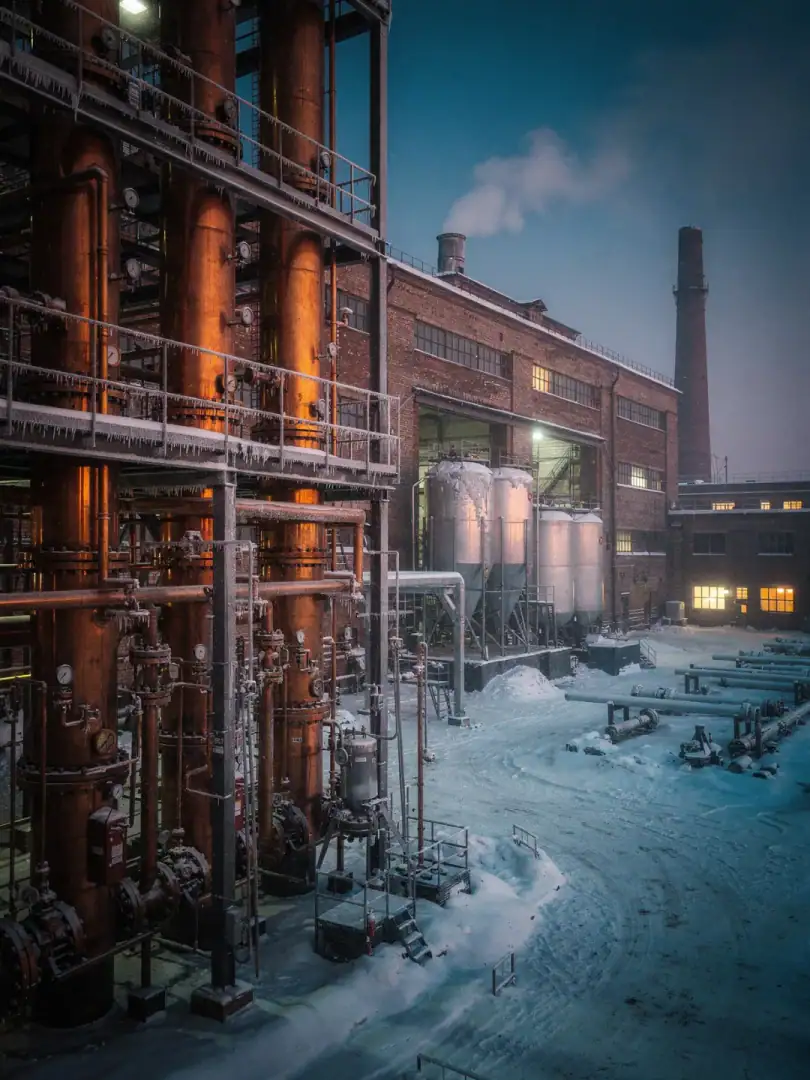
Columns & Grades
Distillation & Rectification
Vodka from this region begins, as everywhere, with a mash of milled grain, warm water, and yeast. Fermentation takes just a few days. Then comes the decisive step: rectification in tall columns of copper and steel. These purify the raw spirit in a continuous process, rather than distilling it repeatedly in individual pot stills as was once done.
What comes off the column isn't simply "alcohol," but one of several legally defined purity grades. "Alfa" ranks among the finest. Under Russian standards, it may only be made from grains like wheat or rye, never potatoes. Tatspirtprom names "Alfa" and "Lyuks" as the grades produced from the wheat grown around Ussady and Mamadysh.
How strong the finished vodka may be is governed in Russia by GOST standard 12712-2013, successor to the older GOST R 51355. It preserves the traditional strength classes: 40 to 45 percent, plus 50 and 56 percent ABV, with 40 percent as the practical floor. By comparison, EU Spirit Drinks Regulation 2019/787 sets the minimum strength for vodka at 37.5 percent, noticeably lower than the Russian standard.
After passing through the column, the high-proof spirit is diluted with treated water down to drinking strength. In most cases, this is the very same water drawn from the artesian wells, or, in Bashkortostan, from the Belaya's catchment area. It's this dilution, not the column alone, that ultimately shapes the character in the glass.
This marks a departure from the historical Pennik of Kazan, which was still made in open kettles over open flame and transferred multiple times. The modern column needs only a single pass, though it starts out with far larger volumes of mash.