Herbs & Borderline Cases
Herbs, Nalewka, and the border with liqueur
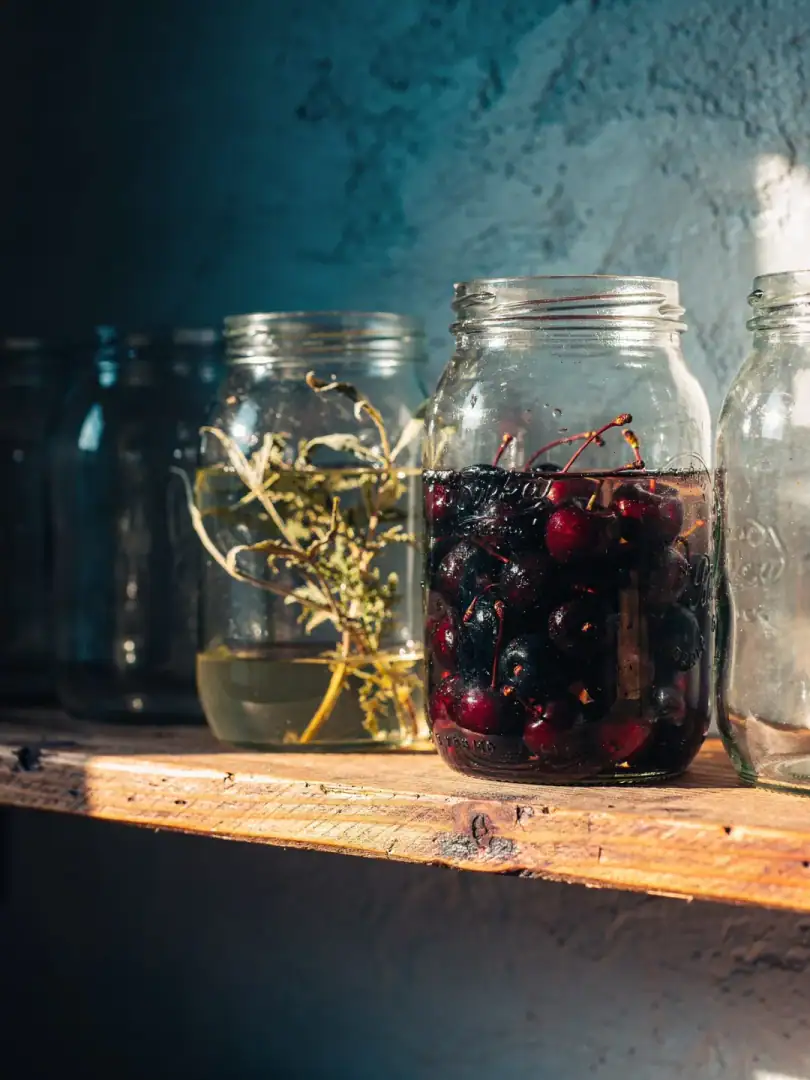
A jar steeped with cherries, walnut shells, or herbs looks like vodka but often already tastes like liqueur. The Polish-Lithuanian Nalewka tradition shows especially clearly how narrow the line between the two categories really is.
What a Nalewka actually is
In Poland and Lithuania, families have steeped cherries, walnut shells, currants, or wormwood in vodka or similar spirits for generations, often sweetened with sugar or honey. The result is called Nalewka, the umbrella term for these homemade infusions. The ingredients steep for weeks before the mixture is strained.
Over generations, this gave rise to a huge repertoire of family recipes that differ from household to household. Unlike industrial brands, a Nalewka usually follows no fixed standard, but rather the preference of the family who makes it, which is why flavor and sweetness can vary widely.
Why many Nalewki are legally liqueurs
The amount of added sugar determines the legal classification. As soon as a Nalewka contains at least 100 grams of sugar per liter, it counts as a liqueur under EU spirits regulations rather than as flavored vodka, even if the family and label still simply call it Nalewka.
Commercial producers bringing Nalewka to market must adhere to this threshold and label their product accordingly. For a homemade batch, though, only personal taste matters, not labeling law.
Herbs instead of fruit: the more bitter line
Alongside fruity versions, there are herb-forward Nalewki made with wormwood, gentian, or mugwort that turn out more bitter than sweet. These varieties sit closer to the classic herbal liqueur than to the fruity family, and are often drunk after meals as a digestive aid, similar to a digestif in Western Europe.
Thujone, the bitter compound found in high concentrations in wormwood, is subject to its own maximum limits in the EU, much like coumarin in bison grass. Anyone making herbal Nalewka at home should therefore use tested, store-bought herbs rather than wild-picked wormwood in unknown quantities.
Nalewka compared with flavored vodka
A dry, barely sweetened industrial herbal vodka and a sweet homemade cherry Nalewka come from the same basic idea, but legally they often land in different categories. The difference rarely lies in the herb or fruit content itself, but almost always in the added sugar.
For anyone making their own, it's worth paying close attention to the sugar level: less sweetness preserves the dry vodka character, more sweetness pushes the result toward a liqueur. Both are fine, as long as you know what ends up in the glass.
Nalewka in home kitchens today
Even today, many families in Poland, Lithuania, and neighboring countries continue to make their own Nalewki, often following handwritten recipes passed down through generations. Some recipes stay unchanged for decades, while others are slightly adjusted by each generation, say with less sugar or new fruit combinations. This openness clearly distinguishes homemade Nalewka from an industrially fixed recipe.
In recent years, small producers have also begun officially marketing Nalewka-style drinks as liqueurs, with a clear ingredient list and set sugar content. This brings the old home recipe closer to legal categories without completely losing its original character. Buyers get a product that recalls the family recipe but is reliably labeled.
Anyone making their own Nalewka should decide in advance on fruit or herbs as the main direction, rather than mixing both at random. A clear focus makes the final flavor rounder and easier to grasp, even for first-time tasters.
This way, Nalewka remains a bridge between household tradition and modern spirits culture. Both sides benefit from the exchange, old recipes as much as new brands.