Law & Category
What flavoured vodka is under the law
A sip with pepper or lemon raises a simple question: does this still count as vodka, or does it already cross into liqueur territory? EU Regulation 2019/787 answers that with clear thresholds for alcohol, sugar and flavouring.
The basics: what vodka must be under EU law
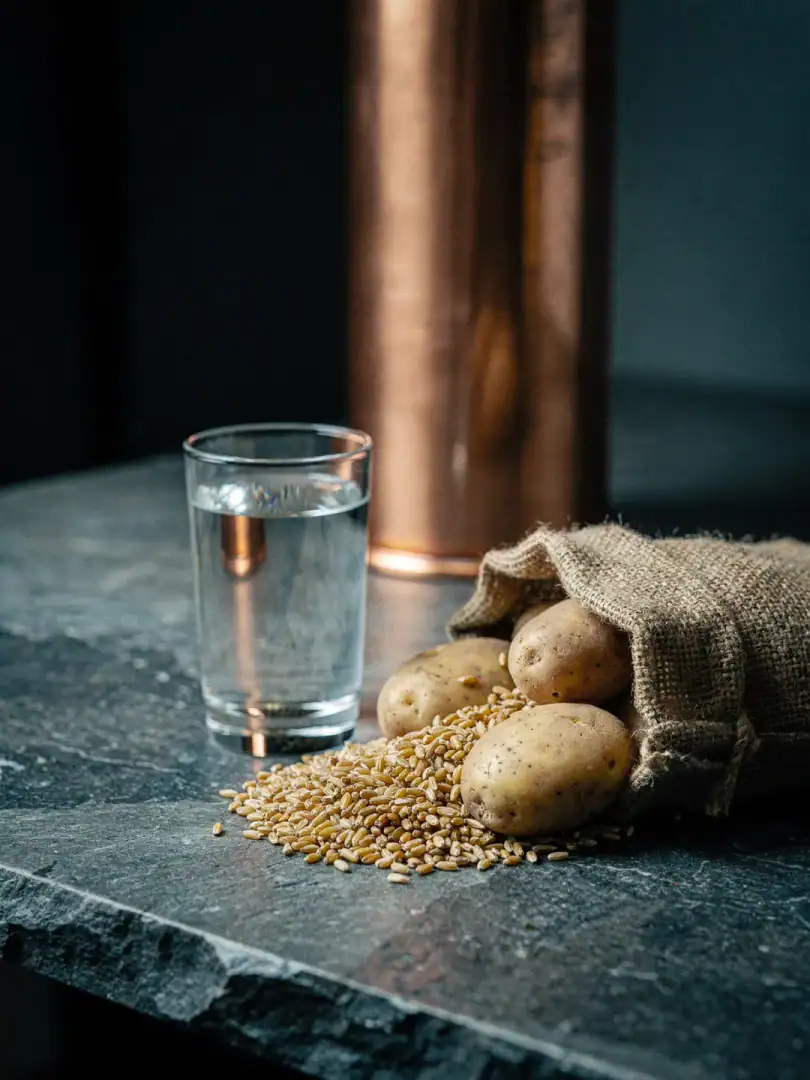
Neutrality comes first, not flavour. Under the EU Spirit Drinks Regulation (EU) 2019/787, vodka is made from fermented agricultural raw materials such as grain or potatoes, processed into a distillate with at least 37.5 percent alcohol. Rectification, meaning repeated purification, is meant to strip away almost all of the raw material's inherent flavour. In the end, hardly anything of the original ingredients' taste survives, just a clean alcohol character.
If the vodka doesn't come from grain or potatoes, say from grapes or whey instead, the label must state the raw material, for example with the addition made from grapes. This labelling requirement protects buyers from expecting a raw material base that isn't actually there. Without this note, a producer may only sell grain- or potato-based vodka as simply vodka.
Flavoured vodka as its own category
For flavoured versions, the same regulation created a second, distinct category. Flavoured vodka builds on a vodka from the first category but gains, through added flavourings, a taste that no longer reads as neutral alcohol but as grass, pepper, lemon or herbs. Sweetening, colouring and cask ageing are all permitted too, as long as the added flavour sets the tone.
This category is no footnote. It covers, for example, the protected designation of origin for the herbal vodka from the North Podlasie region, flavoured with an extract of bison grass. Alongside the plain vodka origin designation Polska Wódka, this is the second Polish origin designation for spirits protected across Europe. Anyone using the name must follow the prescribed production method and region.
Where the line to liqueur runs
Sugar plays a decisive role in the categorisation. Under the same regulation, a liqueur needs at least 100 grams of sugar per litre, calculated as invert sugar, at a minimum strength of 15 percent alcohol. Flavoured vodka may be sweetened, but it must stay well below that threshold, otherwise it loses its name and has to be declared a liqueur.
For the bottle on the shelf, that means: a honey-pepper vodka with strong sweetness may legally already be a liqueur, even if the name on the label still suggests vodka. A closer look at the exact designation pays off, since liqueur and flavoured vodka often taste similar but differ in sugar content and sometimes in price.
Why the classification matters to buyers
The category on the label matters for more than pure bureaucracy. It tells you something about sweetness, production method and sometimes region, without having to open the bottle. Anyone buying Pertsovka, Żubrówka or a lemon variant can therefore go by the official designation instead of relying purely on marketing.
There's also an important distinction at the lower end: a non-alcoholic vodka alternative with zero percent falls entirely outside this regulation, since it only governs spirits with genuine alcohol content. The next stops on this journey show how individual flavours like bison grass, pepper or lemon fill out this legal category in everyday practice.
How control and labelling work together
Anyone producing flavoured vodka must document the recipe precisely so authorities can trace it if needed. Inspectors carry out spot checks to see whether alcohol content, sugar level and flavourings used match the declared category. If a product falls outside the intended framework, the producer must either change the designation or adjust the recipe before the next batch goes on sale. Such checks usually run quietly in the background, without buyers in the shop noticing anything.
For export, the law of the destination country also applies, which can differ from the EU rule. A vodka considered flavoured in Europe may have to meet different requirements on additives and labelling in the US or Russia. That's why labels sometimes differ noticeably from market to market, even though the bottle holds the same contents. Anyone buying abroad should keep these differences in mind rather than treating domestic labelling as the sole benchmark.