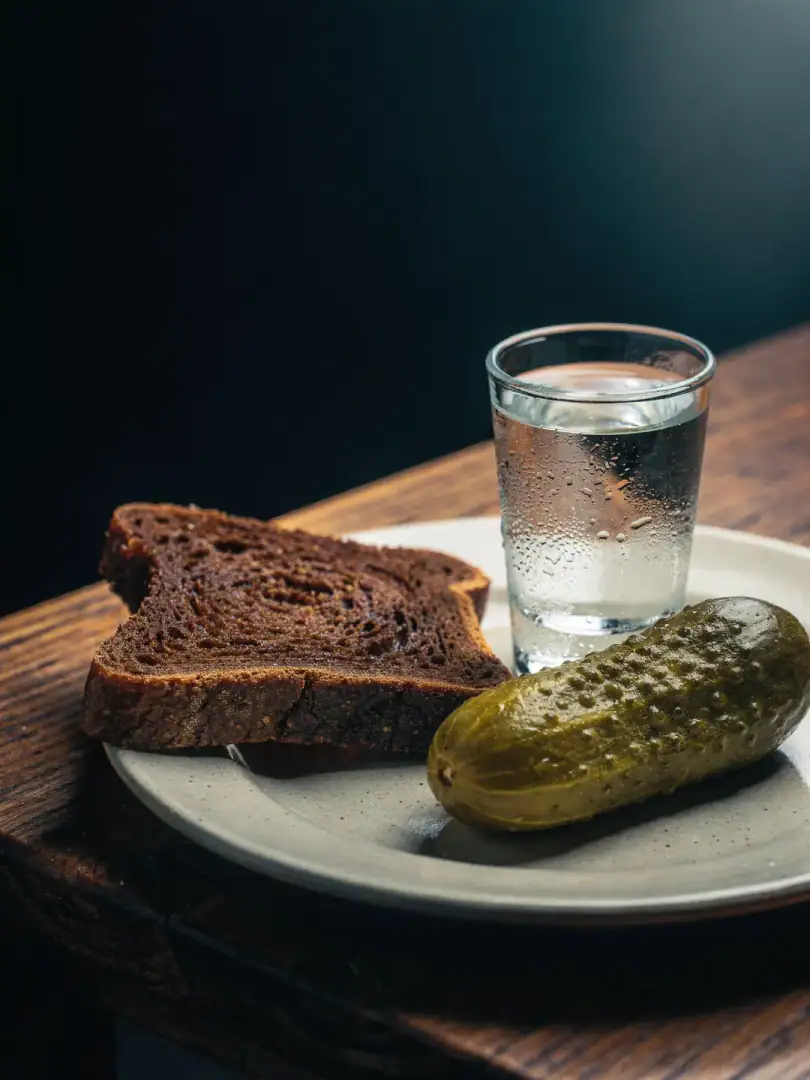
Zakuski explained briefly
Why People Eat with Vodka
In Russia, Poland, and Ukraine, hardly anyone drinks vodka without zakuski: small, bold bites before, between, and after every sip. In Russian they're called zakuska, in Polish zakąska. This stop explains why the bite is almost as important as the glass.
What zakuska means
Zakuska comes from the Russian word for "to take a bite." It refers to a small morsel that belongs with drinking just as much as the glass itself. In Poland the same idea is called zakąska, plural zakąski. Neither word describes a single dish, but rather an entire system of small cold and hot foods spread across the table the moment the bottle is opened. The same word applies in Ukraine too, usually spelled zakuska.
Unlike an appetizer at a restaurant, zakuski run alongside the drinking. You help yourself whenever you like, refill, swap plates. A drinking evening without these bites is considered unfinished in these countries, almost rude to the guests. Even a brief visit usually brings at least a piece of bread with sausage to the table.
Why food makes vodka easier to handle
Pure alcohol irritates the mucous membranes of the mouth and stomach. Fat, acidity, and salt dampen this irritation and slow down how quickly the alcohol enters the bloodstream. That's why the classic bites almost always consist of one of these three ingredients or a mix of them: pickled cucumber, smoked fish, hearty cured pork. Keep these three building blocks in mind, and you'll understand almost any zakuski spread at a glance.
The effect is more about experience than chemistry. Anyone who eats between glasses tends to drink more slowly and stays focused on the taste of the vodka rather than just the burn. That's exactly the point: zakuski are meant to accompany the vodka, not cancel out its effect. A full stomach doesn't change that, but it does slow down how quickly the evening seems to pass.
The fixed rhythm of drinking
In a classic round, every sip is immediately followed by a bite, never the other way around. A toast comes before the glass, then it's drunk in one go, never sipped. Only after the sip does the zakuska come into play, often accompanied by a sniff of a slice of dark rye bread. Some people simply hold a fist under their nose instead, if no bread happens to be at hand.
This sequence has a practical reason: vodka is drunk chilled and neat, without ice, without dilution. Without food in between, the sharpness would quickly become unpleasant. With zakuski, the evening stretches out and the company stays convivial. Guests who know this rhythm often end up drinking less overall, not more.
The difference from tapas and snacks elsewhere
Tapas in Spain or meze in the eastern Mediterranean are often ordered to fill you up, even without alcohol alongside. Zakuski, by contrast, are tied to the glass: they exist as an accompaniment, not as a standalone meal, even though a lavish spread can end up amounting to a full dinner. Without vodka on the table, zakuski lose their actual purpose.
Anyone following this journey further will get to know the individual building blocks in the next stops: pickles, herring, caviar, cured pork. Together they paint the picture of why vodka in its countries of origin is never imagined without a set table. Each stop builds on the previous one, from everyday simplicity to festive occasion.
The host's role: why an empty table would be embarrassing
A host without zakuski quickly loses standing. Guests expect a full table, even for a spontaneous visit. This holds true in Russia just as much as in Poland and Ukraine. Anyone short on time puts out at least bread, pickles, and some sausage.
This expectation explains why many households always keep a stash of pickled goods in the cupboard. A jar of pickles keeps for months. That way the table stays ready, no matter when guests arrive. This very stash is explained in more detail in the next stop.