What filters actually do
Filtration with birch charcoal
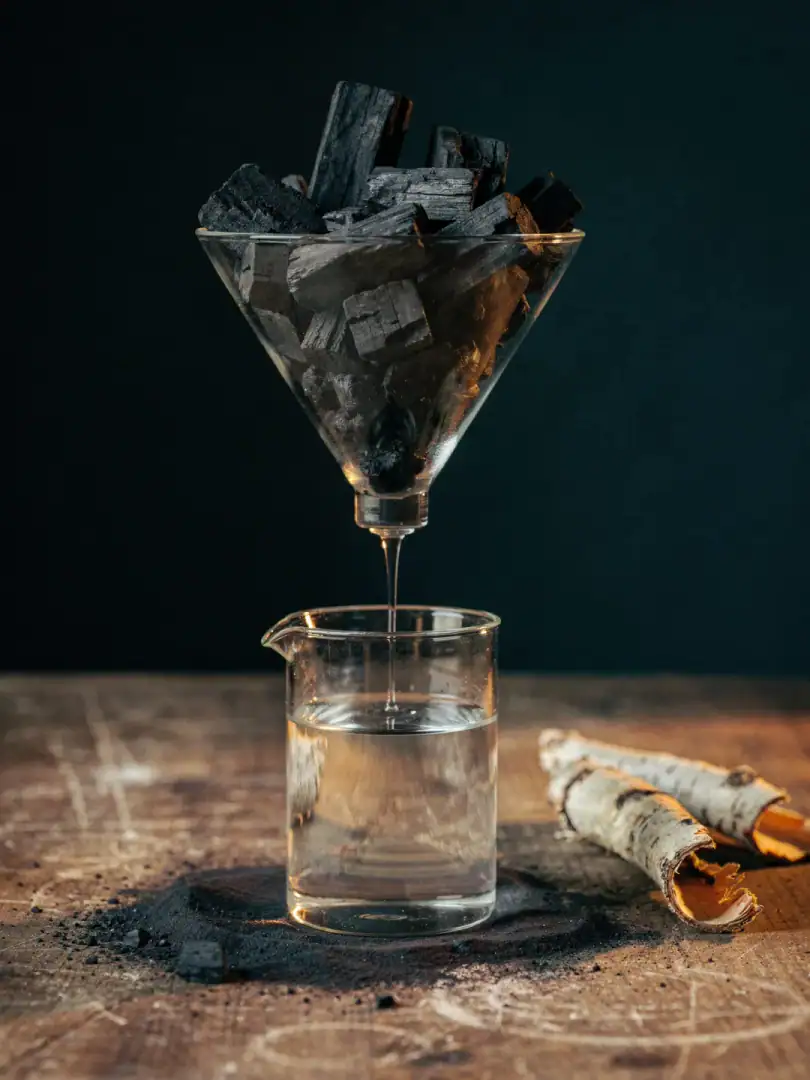
After distillation, many producers filter their vodka, most famously through birch charcoal. The filter is meant to bind residual haze and lingering flavor compounds, even though its actual effect on already very pure alcohol is limited and somewhat disputed.
How a charcoal filter works
Activated charcoal consists of tiny, porous carbon particles with an enormous internal surface area. As alcohol flows slowly through a layer of such charcoal, certain molecules get trapped in the pores, a process called adsorption. This affects mainly larger, flavor-intensive compounds such as fusel oils. The slower the alcohol flows, the more thoroughly the filter works. Passing through too quickly reduces contact time and, with it, the filter's effect considerably.
Small molecules like ethanol or water, by contrast, pass through the pores almost unimpeded. That's why charcoal filtration primarily affects subtle secondary aromas and haze, not the alcohol content itself. The finer and longer the filtration, the more neutral the resulting distillate becomes. Some facilities run the alcohol through the same layer of charcoal multiple times. Others use several filtration stages in sequence to achieve as even a result as possible.
Why birch charcoal specifically
Birch charcoal is traditionally made from charred birch wood and has been linked to vodka production in Eastern Europe for centuries. Historically, it was simply an available, effective filter material, long before modern activated charcoal made from coconut shells or bituminous coal was produced industrially. Birch trees grew abundantly across large parts of Russia and Eastern Europe. Other regions relied instead on locally available wood or mineral materials.
Today, birch charcoal is mainly both a brand marker and a story: it signals traditional craftsmanship and Eastern European heritage. Chemically, it differs from other activated charcoal mainly in pore size and distribution, not in any fundamentally different mode of action. For pure filtering performance, the origin of the carbon barely matters.
Other filter materials at a glance
Besides birch charcoal, producers also use quartz sand, gravel, silver, or diamond dust as filter media, and some combine several stages. Quartz sand works mainly mechanically, holding back small particles, while silver serves mainly as a selling point for purity without decisively improving filtration performance in any scientifically proven way. Diamond dust is largely a marketing term for especially fine, expensive filter layers. Its technical added value over simple activated charcoal is hard to demonstrate conclusively.
Cold is also used: in so-called cold filtration, the alcohol is chilled significantly before filtering, causing certain fatty acids and oils to flocculate and become easier to remove. The technique is best known from whisky production as chill filtration and is used similarly for vodka. With already very pure alcohol, though, the additional effect turns out to be minimal.
What filtration actually changes
In an already cleanly rectified alcohol at 96 percent, there's little flavor-disrupting material left for a filter to remove. The measurable effect of additional filtration is therefore often small, even though tasters in blind tests sometimes describe subtle differences in texture. Objective measurements rarely confirm such differences conclusively. Often it's the tasters' expectations, more than anything else, that shape the perceived result.
For marketing and brand image, filtration still matters, because it tells a story of purity and care. If you're basing a purchase decision on filtration claims, it's better to read them as part of the brand narrative rather than as measurable proof of quality. The taste itself often changes less than the packaging would have you believe.
Filtration compared with other production steps
Within the overall process, filtration remains a small, late step compared with fermentation and distillation. It can mask minor flaws, but it can't rescue a fundamentally poorly distilled alcohol whose fusel oil content was already too high coming out of the still. A good filter, in other words, only improves what was already done well beforehand.
If you want to understand the flavor of a vodka, pay attention to the whole picture of raw material, distillation method, and water, not just the filtration claim on the label. Filtration is one building block among several, not a substitute for the steps that came before it.