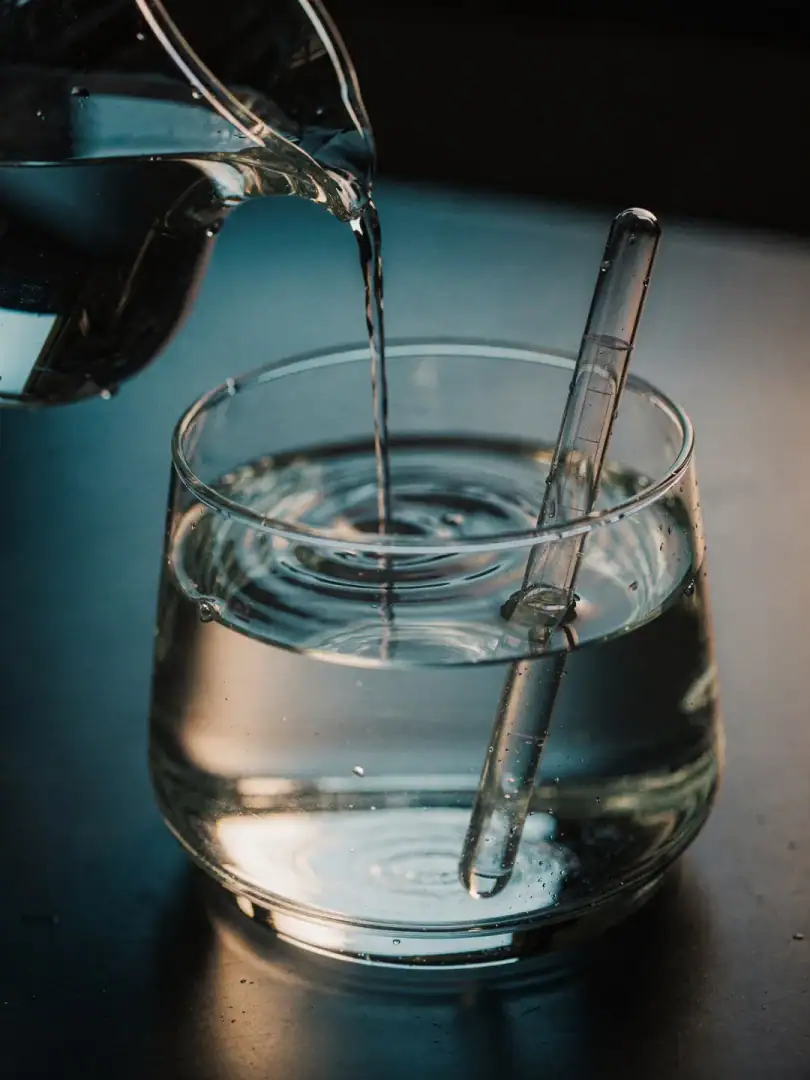
Water as an ingredient
Diluting to drinking strength
The distilled, nearly pure alcohol at around 96 percent ABV is far too strong to drink. Only diluting it with treated water brings vodka down to drinking strength, usually 37.5 to 40 percent, and in the process, water itself becomes a decisive ingredient.
Why vodka has to be diluted
Alcohol at 96 percent would burn on the way down. It hardly tastes like anything other than sharp ethanol. Only dilution with water makes it drinkable, softens the harshness, and lets the subtle aromas that remain in the distillate, despite all that purity, come through. Without water, vodka would remain essentially undrinkable. Even seasoned tasters would struggle to handle pure 96 percent alcohol beyond the tiniest of sips.
The target strength isn't an arbitrary number. It has developed historically and legally over time. In many countries, around 40 percent has become the standard, because this concentration balances the effect of the alcohol, the flavor, and shelf stability within a practical range. Lower values often feel thin, while higher ones quickly turn aggressive on the palate.
Why water quality matters
Because the alcohol itself carries almost no flavor of its own, the added water shapes a substantial part of the resulting flavor profile. The mineral content, hardness, and purity of the water influence how smooth or sharp a vodka feels on the palate. The differences remain subtle, but experienced tasters can often perceive them. Soft water is generally considered more pleasant than very hard, mineral-rich water.
That's why many brands emphasize the origin of their water, whether from springs, glaciers, or specially treated groundwater. Before use, the water is usually demineralized or filtered. This rules out unwanted minerals and impurities before the water is added back in a controlled way. Some distilleries even blend several water sources deliberately to achieve a particular profile.
Legal minimum strength in the EU, US, and Russia
EU spirits regulation (EU) 2019/787 sets a minimum strength of 37.5 percent ABV for vodka. This is a legal floor, not a target. Many European brands still bottle at 40 percent anyway, partly out of tradition and partly because export markets expect that figure. The difference of two or three percentage points sounds small but is noticeable when drinking.
In the US, regulation 27 CFR 5 likewise requires at least 40 percent ABV for vodka. Russia's state GOST standard traditionally fixes classic vodka at exactly 40 percent, with little room to move above or below. Compare internationally, and you'll find genuinely different legal minimums for what is nominally the same product.
How the dilution is actually carried out
Dilution is carried out under controlled conditions in large blending tanks, with alcohol meters continuously checking the concentration. Water and alcohol aren't simply poured together but mixed gradually, step by step. Blending generates heat, and the resulting volume behaves slightly differently than simple addition would suggest. Automated systems today typically compensate for this effect through ongoing measurement.
After mixing, the liquid needs a short resting period so the alcohol and water can fully integrate and any last traces of haze can settle out. Only then does a final filtration step usually follow. Only after that is the finished vodka released for bottling. Ending this step too early can result in visible haze later, once the vodka is already in the bottle.
Why producers promote their water so heavily
For consumers, the finished drink can hardly be distinguished based on water quality alone, yet many brands use the origin of their water as a central selling point. Terms like spring water or glacier water are meant to convey purity and naturalness. For purchase decisions, this narrative often carries more weight than the technical details.
From a technical standpoint, what matters is that the water was properly treated before blending, regardless of its original source. The story built around the water therefore says more about brand positioning than about any actually measurable edge in quality. Anyone curious will recognize the difference far more readily in a side-by-side tasting than on the label.