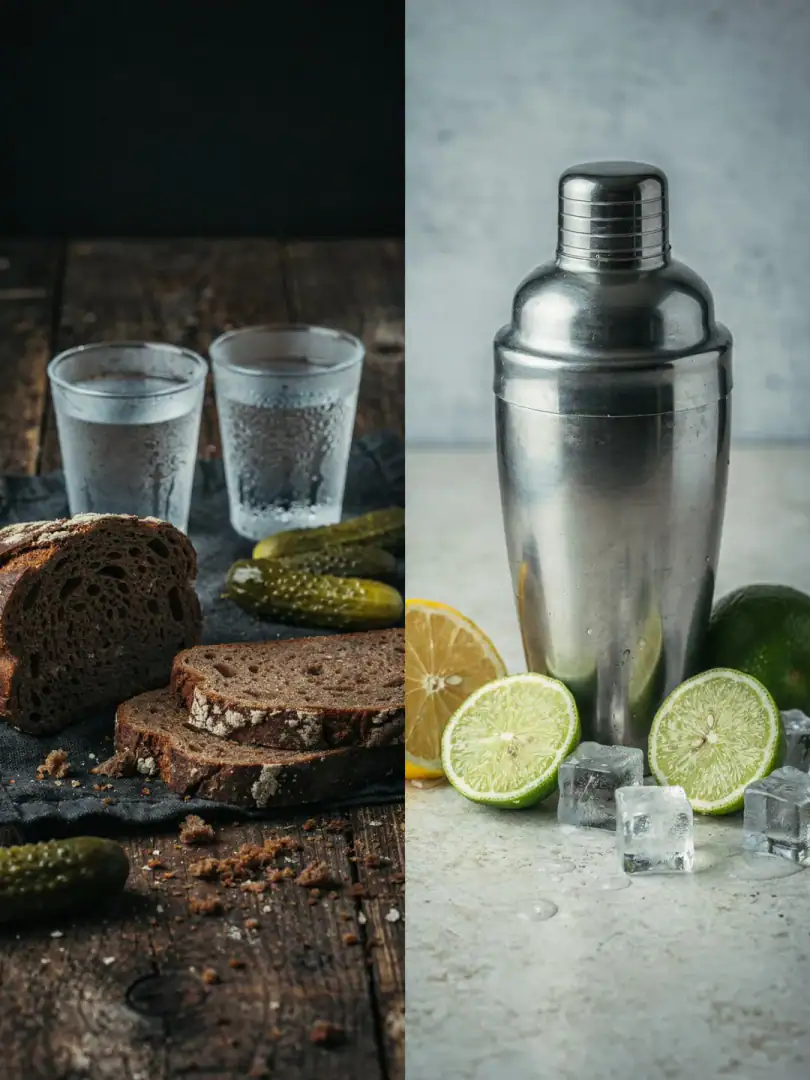
Two drinking cultures
Eastern or western style?
Vodka from Poland or Russia often tastes different from vodka made in the US or Western Europe. The reason rarely lies in the raw material alone, but in a fundamentally different drinking culture. This stop compares eastern tradition with western cocktail culture.
The eastern style: neat, cold, with character
In Poland, Russia, and much of Eastern Europe, vodka is traditionally served ice-cold and drunk neat. This usually happens in small glasses, taken in several short sips rather than mixed into a drink. This culture traces back historically to peasant and later Soviet drinking rituals. The shared shot was often a formal act, accompanied by a brief toast. Drinking traditionally comes with zakuski—small salty or pickled bites like pickled cucumbers, herring, or dark rye bread—which cushion the high-proof alcohol and settle the stomach between sips. Here, vodka is regarded less as an ingredient for other drinks and more as a standalone drink with a fixed place at gatherings and toasts.
This context also explains why Eastern European brands traditionally place less emphasis on complete neutrality. A vodka drunk neat with a recognizable rye or potato character suits this drinking culture better than an alcohol designed to taste as bland as possible, which would quickly get lost during shared drinking. In this setting, vodka takes on almost a social function, similar to sharing a cup of coffee together—just with a much higher alcohol content.
The western style: neutral and built for cocktails
In the US and much of Western Europe, vodka established itself mainly as a cocktail ingredient meant to bring almost no flavor of its own, so that it blends harmoniously with fruit juice, tonic, or ginger beer. Classics like the Moscow Mule or the Vodka Martini deliberately rely on the most neutral alcohol possible as a base, whose job is more about texture than its own flavor. This role as an unobtrusive base also explains why western bar menus rarely mention a vodka's raw material, but almost always mention the brand.
This expectation of neutrality has pushed many western brands toward particularly heavy rectification and additional charcoal filtration. US law even enshrines this requirement legally: according to American standards, vodka must have no distinctive character, aroma, taste, or color. Otherwise, by definition, it counts as flavored vodka and must be labeled differently accordingly. In practice, this means: anyone wanting to mix the most effective cocktail tends to reach for a heavily neutralized western vodka.
Where the two styles overlap today
The divide between East and West is softer today than it once was. Polish and Russian producers deliberately export to western cocktail markets and release more neutral variants for that purpose, while western craft distilleries, in turn, tout character and deliberately rectify less heavily to keep rye or potato flavors detectable. Global trade and international bar culture have brought the two traditions noticeably closer together in recent decades. New consumption trends, such as craft cocktail bars in Warsaw or Moscow that blend western mixology with local ingredients, also contribute to this convergence.
Still, it's worth looking at the origin: a vodka that explicitly touts tradition and raw material tends to come from the eastern line, while a vodka that touts purity and mixability tends to come from the western one, even though both bottles today often sit on the same shelf. Anyone searching for origin while shopping will usually find it more in the back-label description than in the big brand name on the front.
The decisive question remains taste
Whether shaped by eastern tradition or western neutrality: in the end, what matters is whether the respective style can actually be distinguished in the glass. Both traditions claim to offer the more authentic vodka, and neither side is fundamentally wrong in that claim. This final question can't be answered by legal texts alone, but only through a direct comparison of several glasses. That's exactly the question the last stop on this journey explores.